
Tag: climate

  • How Large Particles Get in Sea Spray

    How Large Particles Get in Sea Spray

    When bubbles burst at the ocean’s surface, they eject droplets that can carry high concentrations of contaminants like pollutants, viruses, and microplastics. Previous theories posited that only particles smaller than the microlayer surrounding the bubble could make their way into these drops, but new work shows otherwise.

    As bubbles rise to the surface, they carry particles on their surface, collecting them to a concentration that’s even higher than the surrounding seawater. But which particles make it into the air depend on the details of what happens when the bubble pops. Previously, researchers assumed that the thin microlayer of fluid surrounding the bubble was uniform, but that turns out not to be the case. As the bubble pops, some regions of the microlayer stretch and thin, while others grow thicker. The thicker the microlayer, the larger the particles it can pull along. In their single-bubble experiments, the researchers found that 15- and 30-micrometer plastic beads — representing oceanic microplastics — appeared in high concentrations in ejected droplets.

    This animated simulation shows how fluid along the edge of a bubble makes its way into ejected droplets. Green particles indicate fluid from the left half of the bubble; blue shows fluid from the right side.
    This animated simulation shows how fluid along the edge of a bubble makes its way into ejected droplets. Green particles indicate fluid from the left half of the bubble; blue shows fluid from the right side.

    Environmental scientists are keen to understand these mechanisms because they link our oceans and atmosphere, potentially affecting rainfall, pollution spread, and epidemiology. (Image, video, and research credit: L. Dubitsky et al.; via APS Physics)
  • A Real Tatooine

    A Real Tatooine

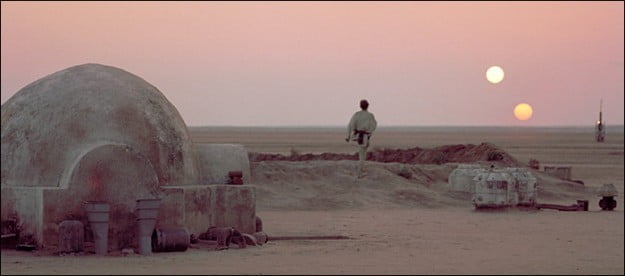
    Since at least the release of “Star Wars”, we have wondered what life would be like on a circumbinary planet – a planet orbiting two stars. In the past few decades, we have discovered several such planets, but we are still in the early days of modeling the climate of these worlds. One recent study uses the stars of the Kepler 35 system, which are only slightly less luminous than our sun, to explore the climate of an Earth-like water planet.

    According to the study, this fictional planet would maintain Earth-like habitability at a distance of 1.165–1.195 astronomical units from its suns’ center of gravity – just a little further out than our own orbital distance. Variables like the planet’s mean global surface temperature and precipitation vary with two distinct periods – the time required for the stars to orbit one another and the time it takes for the planet to orbit its stars. Both factors affect how much sunlight the planet receives. The planet’s climate response to these changes is complex and varies depending on location, but the overall variations observed in the climate are small. It does show, however, that places like Tatooine don’t have to be desert planets! (Image credit: Tatooine – Star Wars; Kepler 35 system – L. Cook; research credit: M. Popp and S. Eggl)

  • Ice Bridges

    Ice Bridges

    During winter, Canada’s Arctic Archipelago, home of the Northwest Passage, generally fills with sea ice. These ice bridges form in the long and narrow straits between islands. A new paper models ice bridge formation and break-up, showing that ice bridges can only form when ice floating in the strait is sufficiently thick and compact. To form a bridge, wind must first push the ice together and then frictional forces between individual pieces of ice must be large enough to resist wind or water driving them apart. As temperatures drop, the individual ice chunks can then freeze together into solid sheets until summer returns.

    The existence of a critical thickness and density of the ice field for ice bridge formation has important implications for climate change. As Arctic temperatures warm for longer periods, these waters may no longer generate ice of sufficient thickness and quantity for ice bridges to form. Since ice bridges serve as important oases for marine mammals and sea birds and help isolate Arctic sea ice from warmer waters, their loss will have a profound impact on both Arctic ecology and global climate. (Image credit: NASA Earth Observatory; research credit: B. Rallabandi et al.; via Physics Buzz)

  • Featured Video Play Icon

    The Earth in Infrared

    The motions of Earth’s atmosphere are often invisible to the human eye, but fortunately, we’ve built tools to reveal them. This timelapse video shows the Earth in infrared light, first from a satellite view centered on the Pacific Ocean and second from a satellite centered on Central America. The water vapor in clouds is an excellent insulator, so clouds appear dark in this video. Warmer areas look brighter. The large-scale motion of the atmosphere and the wind bands that cut east and west across the world are apparent in the first half of the video, largely because they are not being interrupted by any land masses. In the second half of the video, the western coast of South America is intermittently visible. This is because the Andes Mountains disrupt air flow, pushing warm, moist air upward and causing it to condense into the dark-colored clouds that recirculate over the Amazon. Look further south along the coast and you’ll see the Atacama Desert flashing white each day as it heats up.  (Video credit: J. Tyrwhitt-Drake/NASA; submitted by entropy-perturbation)