Researchers have observed their first “space hurricane” – a 1,000-km-wide vortex of plasma – in Earth’s upper atmosphere. Like conventional hurricanes, this storm featured precipitation (of electrons rather than rain), a calm eye at its center, and several spiral arms. Based on the group’s model, interactions between the solar wind and Earth’s magnetic fields drive the storm. Interestingly, the storm they observed occurred during a period of low solar and geomagnetic activity, which suggests that such space hurricanes could be frequent, both on Earth and in the upper atmospheres of other planets. (Image credit: Q. Zhang; research credit: Q. Zhang et al.; via Physics World)
Tag: space weather

Simulating Solar Flares
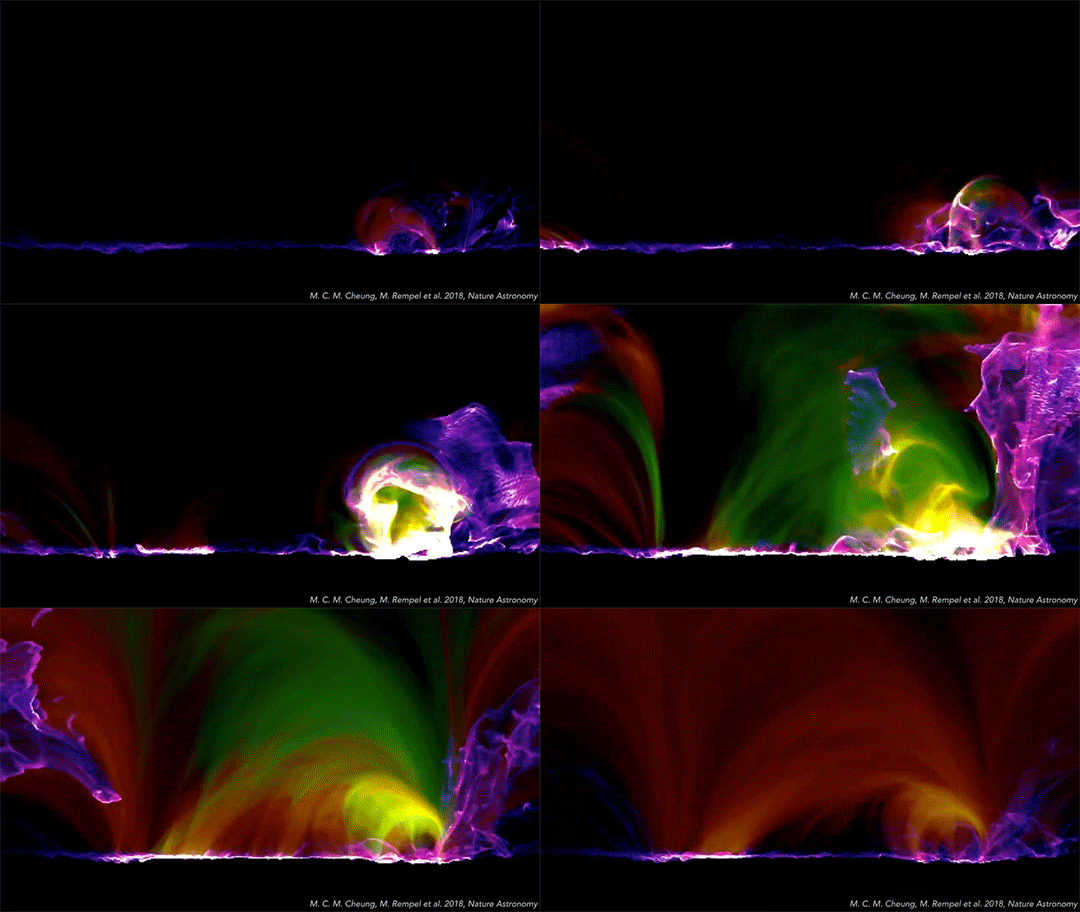
Few topics in fluid dynamics are more mathematically complicated than magnetohydrodynamics – the marriage between electromagnetism and fluids. That mathematical complexity, along with the vast range of scales necessary to describe physical systems like our sun, means that, until now, researchers had to simplify their assumptions when simulating solar physics. But now, for the first time, a group has built a comprehensive, three-dimensional simulation capable of generating realistic solar flares. This is what you see above.
Solar flares occur when a tangle of magnetic loops near the sun’s surface break and reconnect, releasing enormous magnetic energy and spewing a fountain of ionized plasma into the corona. They’re a danger particularly to satellites in orbit, so being able to simulate these events realistically is a major advance toward understanding the physics of space weather. (Image and video credit: NCAR & UCAR Science; research credit: M. Cheung et al.; via Bad Astronomy; submitted by Kam-Yung Soh)