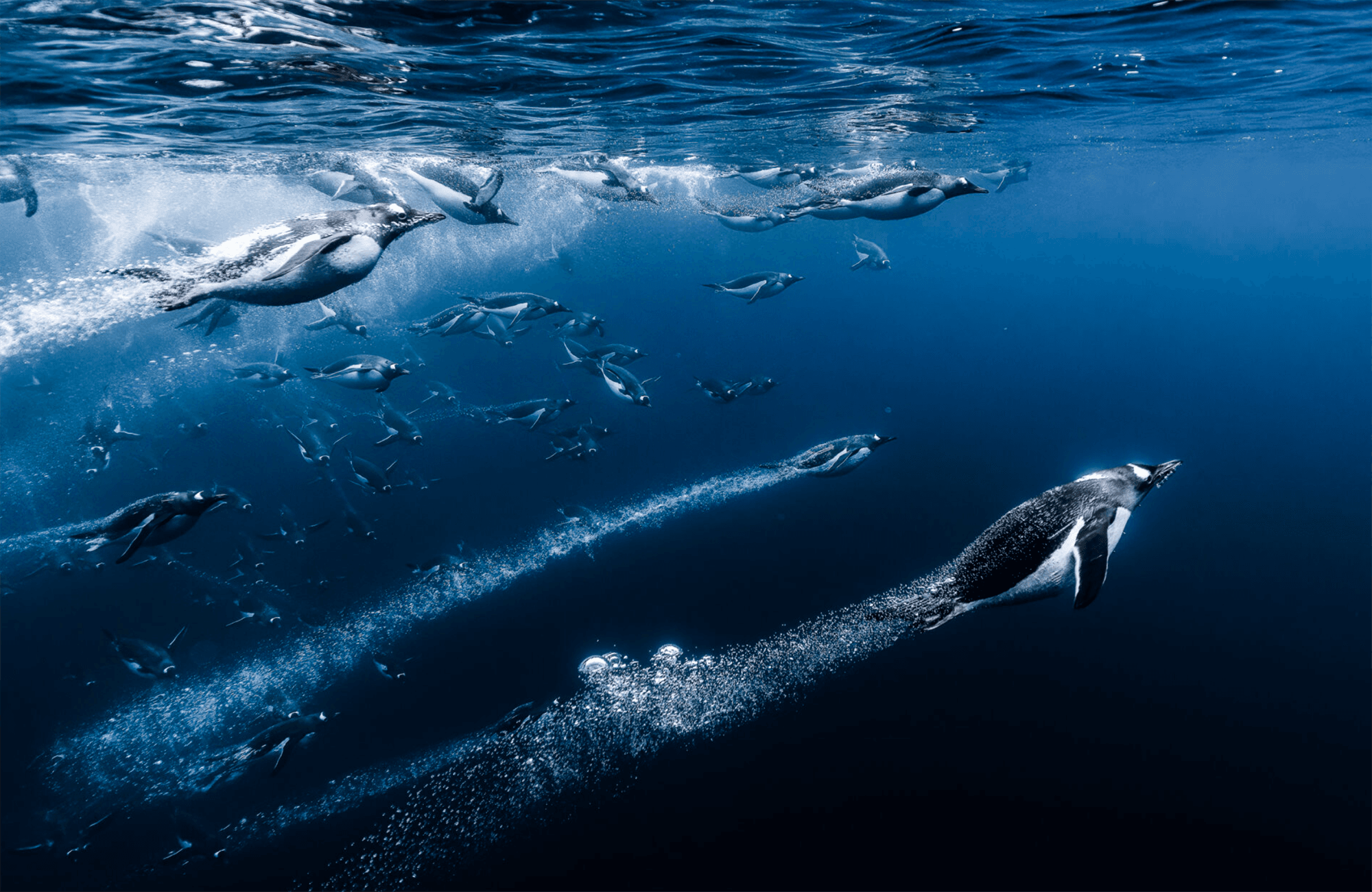
If you’re used to seeing penguins on land, their speed and grace in the water can surprise. Penguins are even capable of extra bursts of speed through supercavitation. They trap air beneath their feathers and then release it underwater when they need to move faster. Their coating of bubbles reduces their drag and gives them the extra speed to help escape predators like leopard seals. (Image credit: R. Barats/OPOTY; via Colossal)
Tag: supercavitation

“Through the Bubbles”
Many seabirds catch their prey through plunge diving, where they fly to a particular height, then fold their wings, and dive into the ocean. In busy waters, bubbles from all this diving can help obscure the birds from hapless fish. Some birds even use bubbles to escape from their own predators; some penguin species, for example, release trapped air from beneath their feathers as they surface, creating a flurry of bubbles that reduce the drag they have to overcome as they make their exit from the water. The fast exit and bubbly wake help them escape prowling seals. (Image credit: H. Spiers; via BWPA)

Molten Thermite


This glowing, molten liquid captured by the Slow Mo Guys is thermite. The chemical reaction behind thermite is highly exothermic, hence its intense glow. There’s some great fluid dynamics hiding in this video. First, there’s the dripping thermite (Image 1), which breaks up into droplets via the Plateau-Rayleigh instability before shattering when it hits the ground.
Then there are the sequences (Images 2 and 3) of thermite dripping into water. The heat of the reacting thermite vaporizes a layer of water around it, creating a bubble that completely envelops the thermite. In other words, the falling thermite is supercavitating! That layer of air significantly reduces drag on the thermite and it insulates the thermite from the cooler temperature of the water. (Video and image credit: The Slow Mo Guys)
Supercavitating Penguins
[original media no longer available]
Penguins, already fluid dynamicists by nature, have developed clever methods of increasing their speed to escape from the leopard seals that prey on them. In the clip above, notice from 1:55 onward as the penguins swim for the surface and leap onto the ice – they leave a trail of bubbles in their wake. The penguins are using supercavitation to decrease their drag. When the penguins first dive in to the water, they splay their feathers out in the air and then lock them closed in the water, trapping pockets of air beneath them. When the need for a burst of speed arises, the penguin shifts its feathers to release the air, coating most of its body in a layer of bubbles. Because the drag in air is much less than the drag in water, this enables the bird to achieve much higher speeds than they normally do when swimming.