From the right vantage point, an approaching dust storm — known as a haboob — can look downright apocalyptic. In this compilation of clips a decade in the making, photographer Mike Olbinski shows these storms in all their terrifying majesty. I love seeing how the cloud front overhead densifies as the dust below advances. Without these wide perspectives, it’s hard to appreciate an approaching haboob. When one blew through Denver a few years ago, I never saw it coming. My first clue was the tree in front of my office window whipping wildly back and forth just before the sky turned brown! I much prefer Olbinski’s versions. Congratulations, Mike, on a decade of haboob-chasing! (Image and video credit: M. Olbinski; submitted by jpshoer)
Tag: storms

Stormy Skies
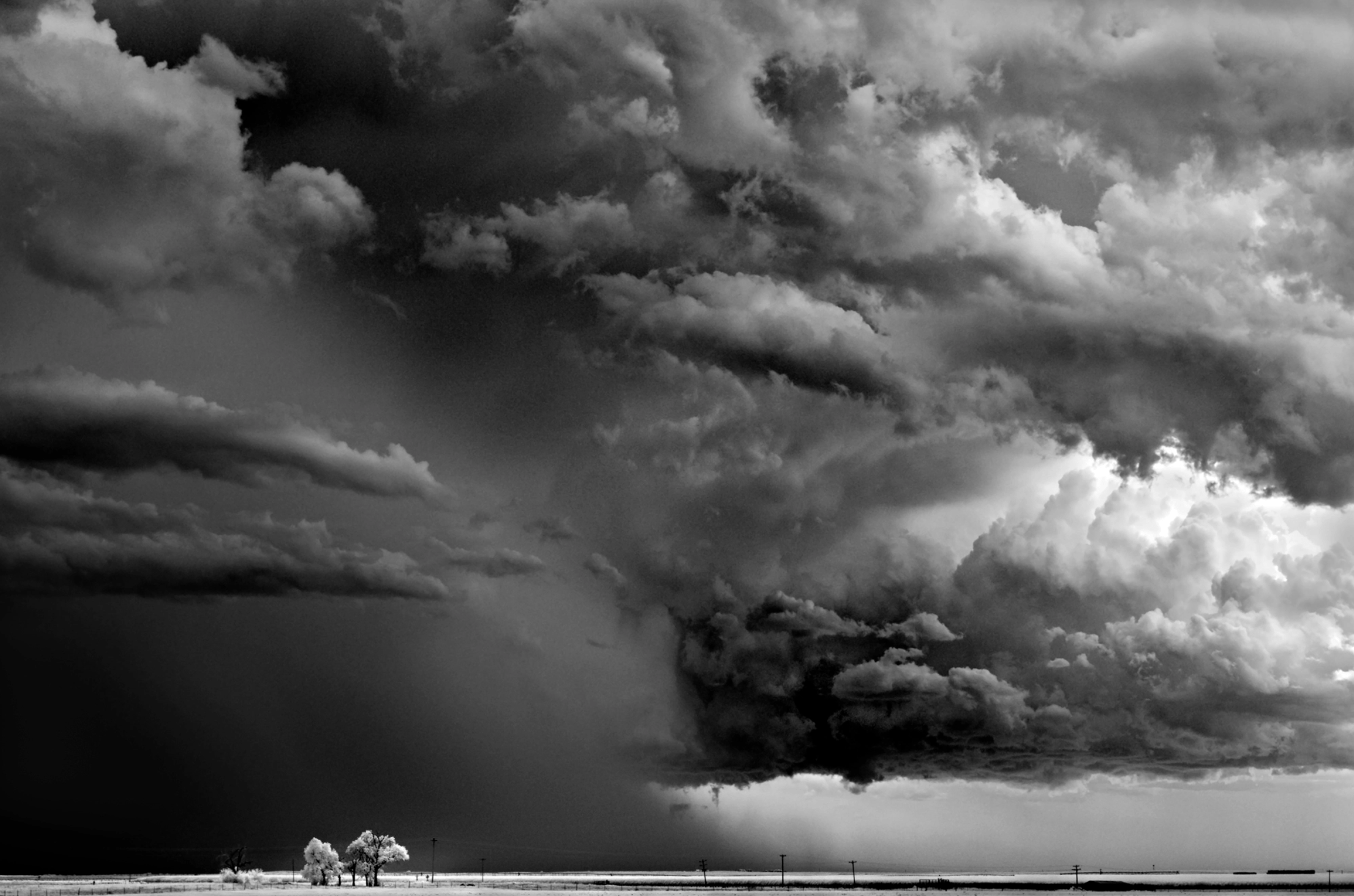
Photographer Mitch Dobrowner captures the majestic and terrifying power of storms in his black and white images. Towering turbulence, swirling vortices, and convective clouds abound. See more of his work at his website and Instagram. (Image credit: M. Dobrowner; via Colossal)

Jupiter in Infrared
This stunning new image of Jupiter in infrared is part of a data set combining measurements from ground- and space-based observatories. The glowing Jovian orb seen here is a composite of some of the sharpest images captured by the Gemini North Telescope’s Near-Infrared Imager from its perch on Mauna Kea. The brightest areas correspond to warmer temperatures over thinner, hazier clouds, whereas the dark areas mark towering, thick clouds.
The ground-based images — and observations from Hubble — were timed to coincide with passes from the Juno spacecraft. This combination of infrared, visible light, and radio wave observations gives scientists an unprecedented look at Jovian atmospheric processes. It revealed, for example, that lightning measured by Juno deep inside Jupiter’s atmosphere corresponded to convective storm cores visible to the other imagers. The combination of observations allowed the researchers to reconstruct the structure of these Jovian storms in a way that no single instrument could reveal. No doubt planetary scientists will learn lots more about Jovian convection from the data set. (Image credit: Jupiter – International Gemini Observatory/NOIRLab/NSF/AURA, M.H. Wong (UC Berkeley)/Gizmodo, illustration – NASA, ESA, M.H. Wong (UC Berkeley), and A. James and M.W. Carruthers (STScI); research credit: M. Wong et al.; via Gizmodo)

Saturn’s Great White Spot
We’ve touched a couple times on Saturnian storms, but this NASA video gives a great overview of the Great White Spot, a storm that appeared in late 2010. Gauging the fluid dynamics of gas giants like Saturn and Jupiter is difficult, in large part because we can see only the outermost portion of the atmosphere. Numerous theories and models have been suggested to explain features and dynamics that we observe, but much of the overall behavior remains a subject of debate among planetary scientists. (Video credit: NASA Goddard)

Saturn’s Storm Stretches All the Way Around
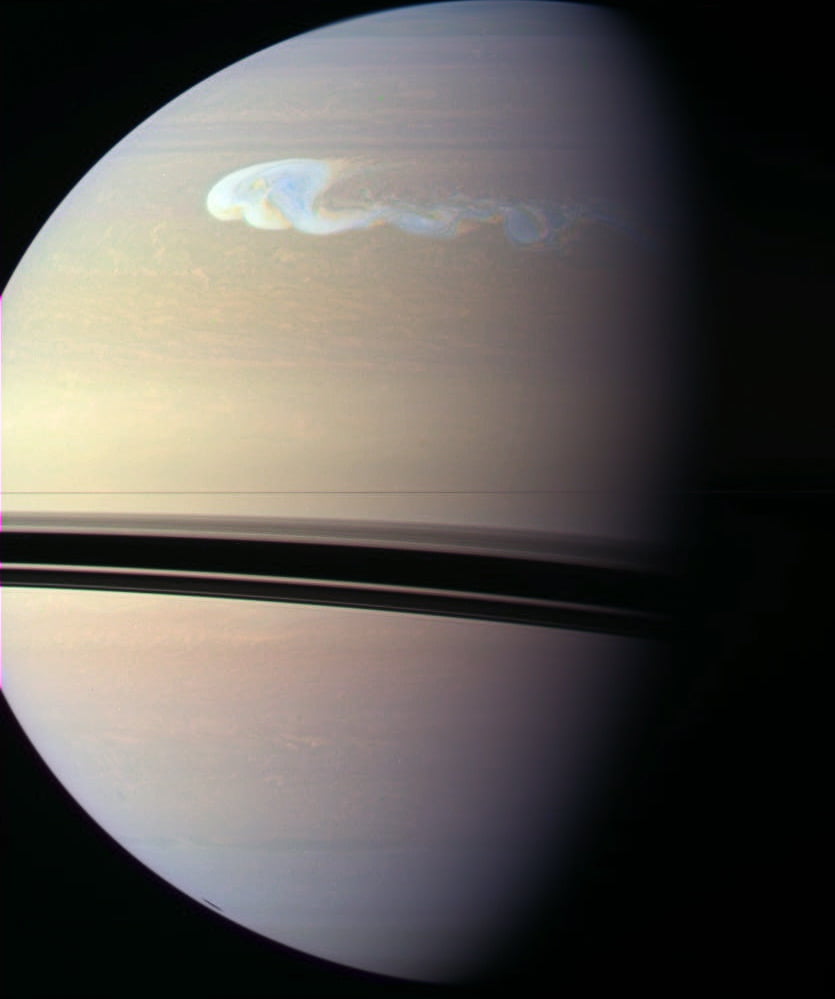
This picture captured by Cassini in February shows a storm on Saturn stretching all the way around the planet. Unlike Earth and Jupiter, which have numerous storms virtually all the time, Saturn tends to store energy in its atmosphere for decades and then release it all at once in mega-storms like this one. #

Saturnian Storm
Back in mid-December, amateur astronomers discovered an enormous new storm on Saturn. The Cassini spacecraft captured this image early in the storm’s history (it now stretches farther around the planet). The fluid dynamics of Saturn’s atmosphere are incredibly complex and well beyond our current understanding, but we can certainly appreciate the majesty of a swirling, turbulent storm half the size of our entire planet. (via APOD, Martian Chronicles)