Tag: liquid nitrogen

  • Does Liquid in a Vacuum Boil or Freeze?

    Does Liquid in a Vacuum Boil or Freeze?

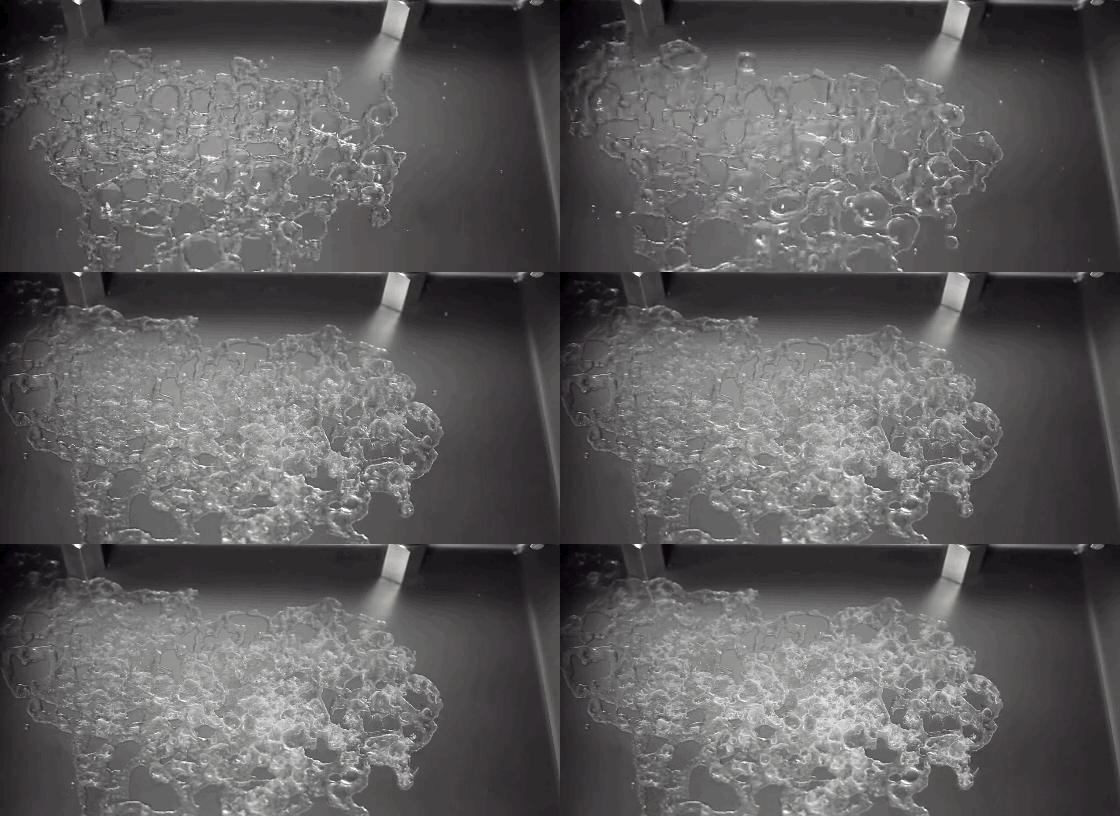
    What happens to a liquid in a cold vacuum? Does it boil or freeze? These animations of liquid nitrogen (LN2) in a vacuum chamber demonstrate the answer: first one, then the other! The top image shows an overview of the process. At standard conditions, liquid nitrogen has a boiling point of 77 Kelvin, about 200 degrees C below room temperature; as a result, LN2 boils at room temperature. As pressure is lowered in the vacuum chamber, LN2’s boiling point also decreases. In response, the boiling becomes more vigorous, as seen in the second row of images. This increased boiling hastens the evaporation of the nitrogen, causing the temperature of the remaining LN2 to drop, the same way sweat evaporating cools our bodies. When the temperature drops low enough, the nitrogen freezes, as seen in the third row of images. This freezing happens so quickly that the nitrogen molecules do not form a crystalline lattice. Instead they are an amorphous solid, like glass. As the residual heat of the metal surface warms the solid nitrogen, the molecules realign into a crystalline lattice, causing the snow-like flakes and transition seen in the last image. Water can also form an amorphous ice if frozen quickly enough. In fact, scientists suspect this to be the most common form of water ice in the interstellar medium. (GIF credit: scientificvisuals; original source: Chef Steps, video; h/t to freshphotons)

  • Featured Video Play Icon

    Liquid Nitrogen and the Leidenfrost Effect

    One of the tried and true cooking tips my mother gave me when I was younger was to test the temperature of my griddle before making pancakes by splashing a few drops of water on it. If it was hot enough that the water skittered across the surface before evaporating, then it was ready. Aside from being a way to make great pancakes, this tip demonstrates an everyday application of the Leidenfrost effect. When the surface of the pan is significantly higher than the boiling point of the water, the part of the water drop that hits the pan is vaporized, creating a thin layer of water vapor on which the rest of the droplet rests. The vapor serves as an insulator, protecting the rest of the water drop from the heat of the pan, as well as a lubricant, allowing the drop slip and slide easily across the surface. The same effect lets the brave plunge a hand into liquid nitrogen without damage, but they have to be quick, otherwise their hand will cool to the point that the liquid nitrogen contacts it without a protective layer of nitrogen. (In that case, a nasty case of frostbite may be the least of one’s worries. We do NOT recommend trying this one at home.)

  • Featured Video Play Icon

    The Leidenfrost Effect

    The Leidenfrost effect occurs when a liquid comes in contact with a mass significantly hotter than the liquid’s boiling point. Upon contact, a thin layer of the liquid will be vaporized, forming a lubricating gas layer that temporarily insulates the hot mass from the cold liquid. This effect is responsible for water skittering across a hot plate as well as protecting the hands of many a professor from a dunk in liquid nitrogen at the front of a classroom.

    reblogged from fyeahchemistry:

    (Thanks for the submission, singbird-sing!)