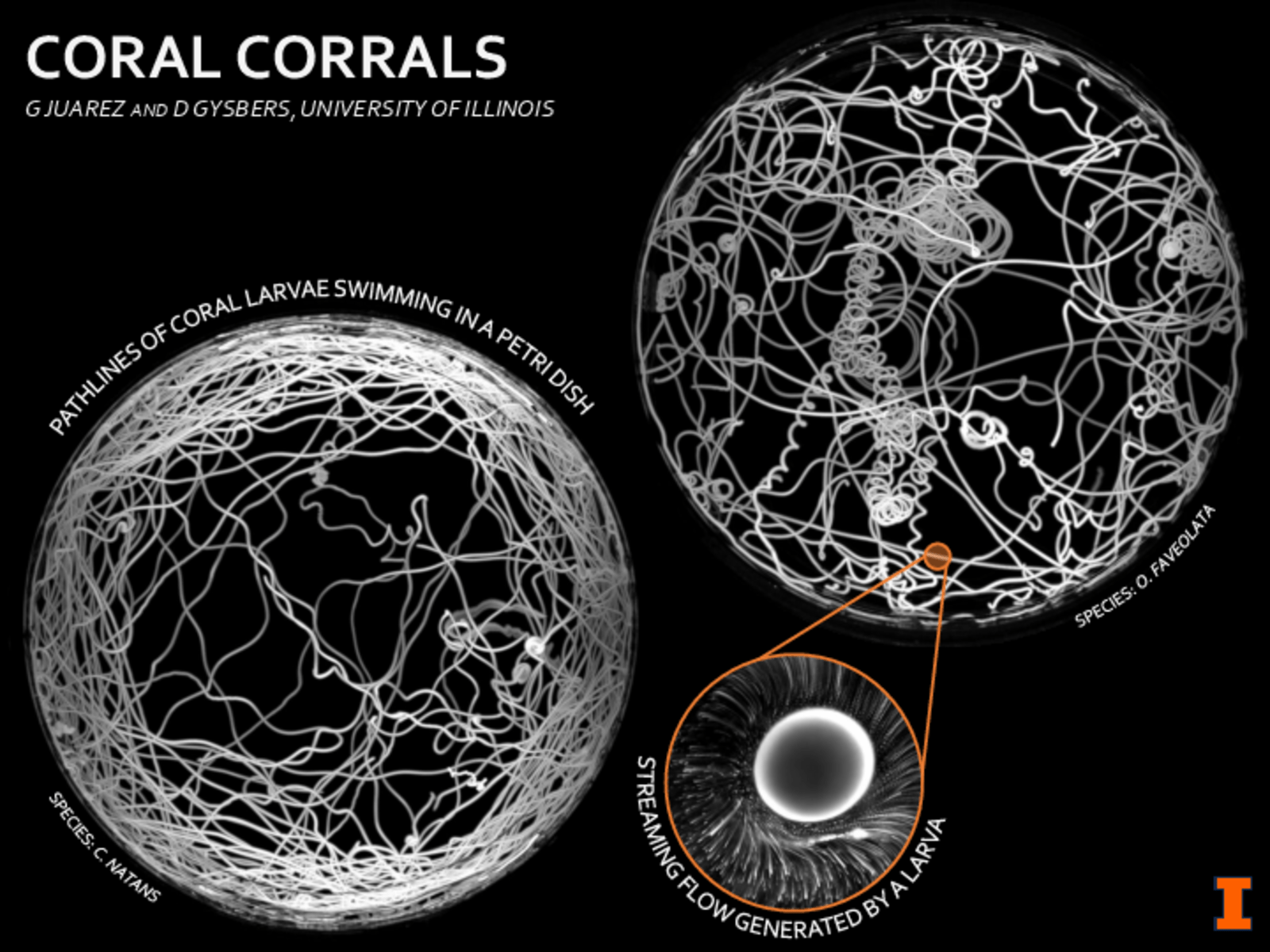
So much of fluid dynamics is seeking patterns. Shown here are two sets of patterns, each created by a different species of coral larvae. These tiny creatures form a streaming flow (orange inset) around them as they swim. Combined together in a petri dish, the larvae follow winding paths, shown in white. The overall pattern is distinctly different for the two species. One shows a clear preference for paths near the wall of the dish (left), while the other corkscrews through open spaces (right). This difference raises questions researchers can explore: do the larvae differ in their propulsion methods or in their collective behavior? (Image credit: G. Juarez and D. Gysbers)
Tag: coral

Dance of the Coral Polyps
Coral reefs are made of up small organisms, called coral polyps, that live together in a colony. Individual polyps can expand, contract, and wave in the flow around them, and, in a recent study, researchers looked at whether changing conditions in temperature and light wavelength can affect polyp movement. To do so, they built a little flow control tank around a coral nubbin containing several polyps.
Under normal light and temperature conditions, they found the polyps’ motions are correlated. (Scientists don’t know why this is the case, but it could help with foraging or photosynthesis for the organisms.) When temperatures rise and light levels shift to bluer wavelengths — simulating warmer and rising oceans — the polyps lose their coordination. Without knowing the purpose behind the motion, scientists can’t yet say what that lack of coordination means, but the team believes their experimental methods can be adapted to help answer those questions, perhaps even in natural, rather than lab-created, circumstances. (Image credit: S. Ravaloniaina; research credit: S. Li et al.; via APS Physics)

The Churning of Corals


Corals may appear static, but near the surface the tiny hair-like cilia of these polyps are churning the water. Although it has been known for some time that corals have cilia, scientists had previously assumed they only moved water parallel to the coral’s surface. Instead recent flow visualizations show that the cilia’s movements generate larger-scale vortical flows near the coral that can help draw fresh nutrients in as well as flush waste away. This means that, instead of being reliant on currents and tides, corals can exert some control on their environment in order to get what they need. This insight into coral cilia may shed some light on the micro- and macroscopic flows generated by other cilia, like those in our lungs. For a similar example of seemingly-passive organisms generating their own flows, check out how mushrooms create air currents to spread their spores. (Image credits: O. Shapiro et al. and MIT News; source video; h/t to Katie B)