Tag: water-jumping

  • Water Jumping Hoops

    Water Jumping Hoops

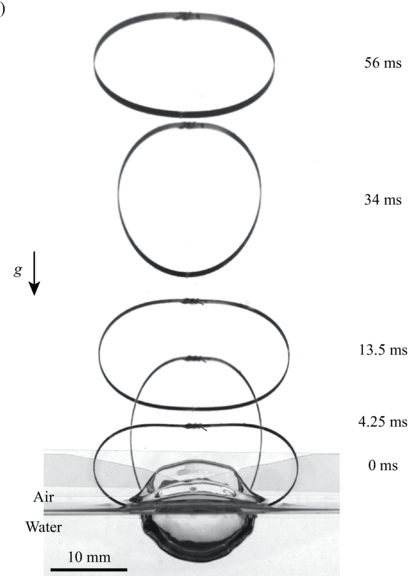
    Small creatures like springtails and spiders can jump off the air-water interface using surface tension. But larger creatures can water-jump, too, using drag. Here, researchers study drag-based water jumping with a simple elastic hoop. Initially, two sides of the hoop are pulled closer by a string, deforming the hoop. Then, with the hoop sitting upright on the air-water interface, a laser burns the string, releasing the energy stored in the hoop. The hoop’s bottom pushes into the water, generating drag. That resistance provides a reaction force strong enough to launch the hoop.

    Compared to the hoop’s jumps off land, it’s slower to take-off from water, and it’s less efficient at jumping. Lighter hoops, however, jump better off water than heavier ones — a wrinkle that isn’t seen in ground jumpers. That suggests that weight reduction is more important for aquatic jumpers than for their terrestrial counterparts. (Image and research credit: H. Jeong et al.)

  • Featured Video Play Icon

    Water-Jumping Springtails

    Springtails are small, jumping insects. Semiaquatic varieties use their tails to jump off water in order to move around and escape predation. Among these water jumpers, results vary; some, like in the third image, have little to no control over their landings and will frequently faceplant or land on their backs. But some species in the family have a better technique.

    These springtails grab a water droplet with their hydrophilic ventral tube (seen in the second image with a red identifying arrow) during take-off. This tiny water droplet serves several purposes. First, it adds extra weight to the insect, allowing it to better orient its body to land belly-down. Second, the drop gives the insect a way to adhere to the water during landing, preventing it from bouncing. Check out the video to see lots of high-speed video of these tiny acrobats! (Video and image credit: A. Smith/Ant Lab; research credit: V. Ortega-Jimenez et al.)

  • Featured Video Play Icon

    Springtails Jump Off Water

    Springtails are tiny hexapods often found near water, where they execute their superpower: backflipping off the water’s surface. When standing on the water, the springtail’s hydrophilic claws protrude beneath the water surface and give it traction. But its spring-loaded furcula is hydrophobic, so when it snaps down it strikes the water without breaking through. The impact propels the springtail upward and sets it spinning at an incredible rate — Smith saw up to 290 backflips a second! (Image and video credit: Ant Lab/A. Smith)

  • Jumping Off Water

    Jumping Off Water

    Many insects and arachnids can walk on water by virtue of their hydrophobicity and small size. With their light weight and skinny legs, these invertebrates curve the air-water interface like a trampoline, with surface tension providing the elasticity that keeps them afloat. What’s truly incredible, though, is that many of these creatures, like water striders, can actually jump off the water surface.

    The top animation shows high-speed video footage of a water strider leaping off the water. Notice how it distorts the air-water interface but doesn’t break the surface – it makes no splash.

    The key is not to push too hard. If the insect exerts a force exceeding the limits of what surface tension can withstand, then its legs will break the water surface and it will lose energy to drag and viscous forces. The insect must generate its jumping force without exceeding a hard limit.

    The water strider achieves this feat not by pushing downward but by rotating its middle and hind legs. Rotating its legs allows the insect to maintain contact with the water surface longer and continue deforming the interface as it jumps. This maximizes the momentum it transfers to the water, which, in turn, increases the insect’s take-off velocity. By studying and then emulating this mechanism, scientists were able to successfully create a tiny 68-mg water-jumping robot. (Image credits: J. Koh et al., sources, PDF)

    This week FYFD is exploring the physics of walking on water, all leading up to a special webcast March 5th with guests from The Splash Lab