Drips, blobs, and squishes – that’s how artist Dan Lam describes her recent series of sculptures. The pieces are a mix of polyurethane foam, resin, and acrylic, decorated in bold gradients of neon color. I love the fluidity of each piece, as well as the decorative piping of spikes on many of them. (As a matter of fact, they remind me of this work.) Check out more of Lam’s work on her website and Instagram feed. (Image credit: D. Lam; via Colossal)
Month: May 2020

Aerodynamic Flight Testing
Flight testing models has a long history in aerodynamics. Above you see a Curtiss JN-4 biplane in flight with a model wing suspended below the fuselage. This test was conducted circa 1921 by NASA’s predecessor, NACA. At the time, of course, computational simulations were non-existent, and, although wind tunnels existed, presumably they could not recreate the exact circumstances needed for the test. Available wind tunnels might have lacked the power to reach the speeds engineers wanted, or they could have been too small for the model or had too many disturbances compared to the pristine flight environment. Any or all of these concerns can drive decisions to use flight testing instead of ground tests.
Flight testing in aerodynamics is still used today, albeit sparingly. The second image shows a crew of Texas A&M graduate students (including yours truly) with a swept wing model we were about to test with a Cessna O-2 aircraft. By this point (roughly 10 years ago), we had wind tunnels capable of overlapping the conditions we could achieve in flight, but flight testing still gave us a larger range of conditions than working solely in the wind tunnel. (Image credits: JN-4 – NASA, O-2 – M. Woodruff; via Rainmaker1973; submitted by Marc A.)

Particle-filled Splashes
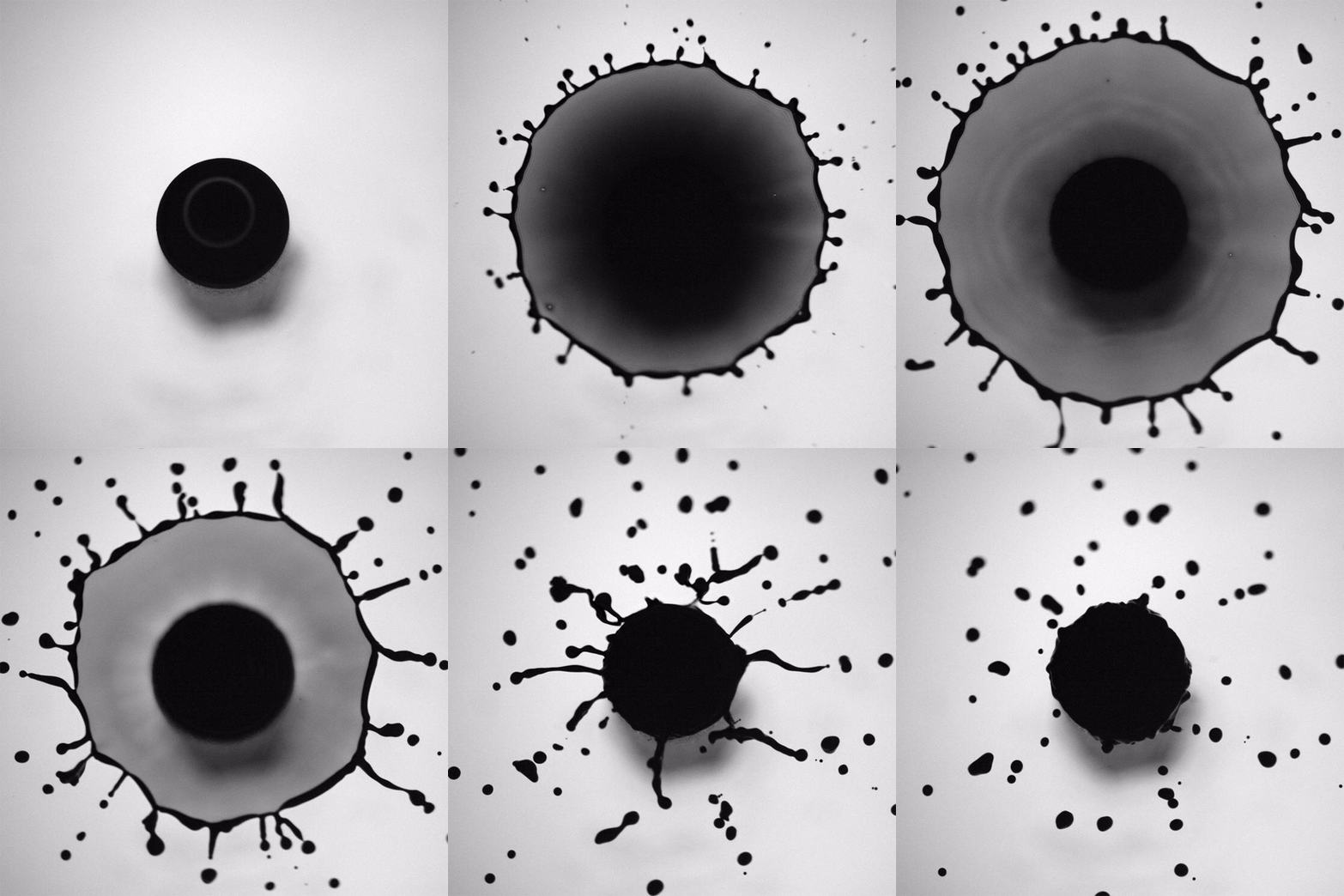
Adding particles to a liquid can significantly alter its splash dynamics, as shown in this new study. In the first image, a purely-liquid droplet spreads on impact into a thin liquid sheet that destabilizes from the rim inward, ripping itself into a spray of droplets. At first glance, the particle-filled droplet in the second image behaves similarly; it, too, spreads and then disintegrates. But there are distinctive differences.
During expansion, the particles increase the drop’s effective viscosity, meaning that the splash sheet does not expand as far. That apparent viscosity increase is also part of why the drops the splash sheds are bigger than those without particles. The other part of that story comes from the retraction, where the variations in thickness caused by the particles and their menisci create preferential paths for the flow. As a result, the particle-filled splash breaks up faster and into larger droplets compared to its purely-liquid counterpart. (Image and research credit: P. Raux et al.)

Updating Undergraduate Heat Transfer
For many engineering students, their first exposure to fluid dynamics comes in a heat transfer class. The typical focus in these classes is not on the underlying physics but on learning to use empirical formulas and correlations that are used in engineering heat exchangers, computer fans, and other applications.
As part of this, students are presented with an extremely simplified view of classical flows like flow over a flat wall, known as a flat-plate boundary layer. Students are told that there are two main features of this and other flows: a laminar region where flow is smooth and orderly, and a turbulent region where flow is chaotic and better at mixing. The transition between these two, according to the undergraduate picture, takes place at a particular point that can be calculated as part of the correlation.
The problem with this picture is that it grossly oversimplifies the actual physics, and for students who may not take dedicated, graduate-level fluid dynamics courses, leaves future engineers with a false understanding that may impact their designs. The truth of transition is far more complicated and nuanced. Transition from laminar to turbulent flow rarely takes place at a single, predictable point; instead it takes place over an extended region and where it begins depends on factors like geometry, vibration, and the level of turbulence already present in the flow.
In an effort to bring undergraduate heat transfer correlations more in line with actual physics — as well as with real, experimental data — a new study revamps the mathematical models. Personally, I applaud any effort to add some nuance to the introduction of this important topic. (Image and research credit: J. Lienhard; via phys.org)

“Focus, Vol. 2”
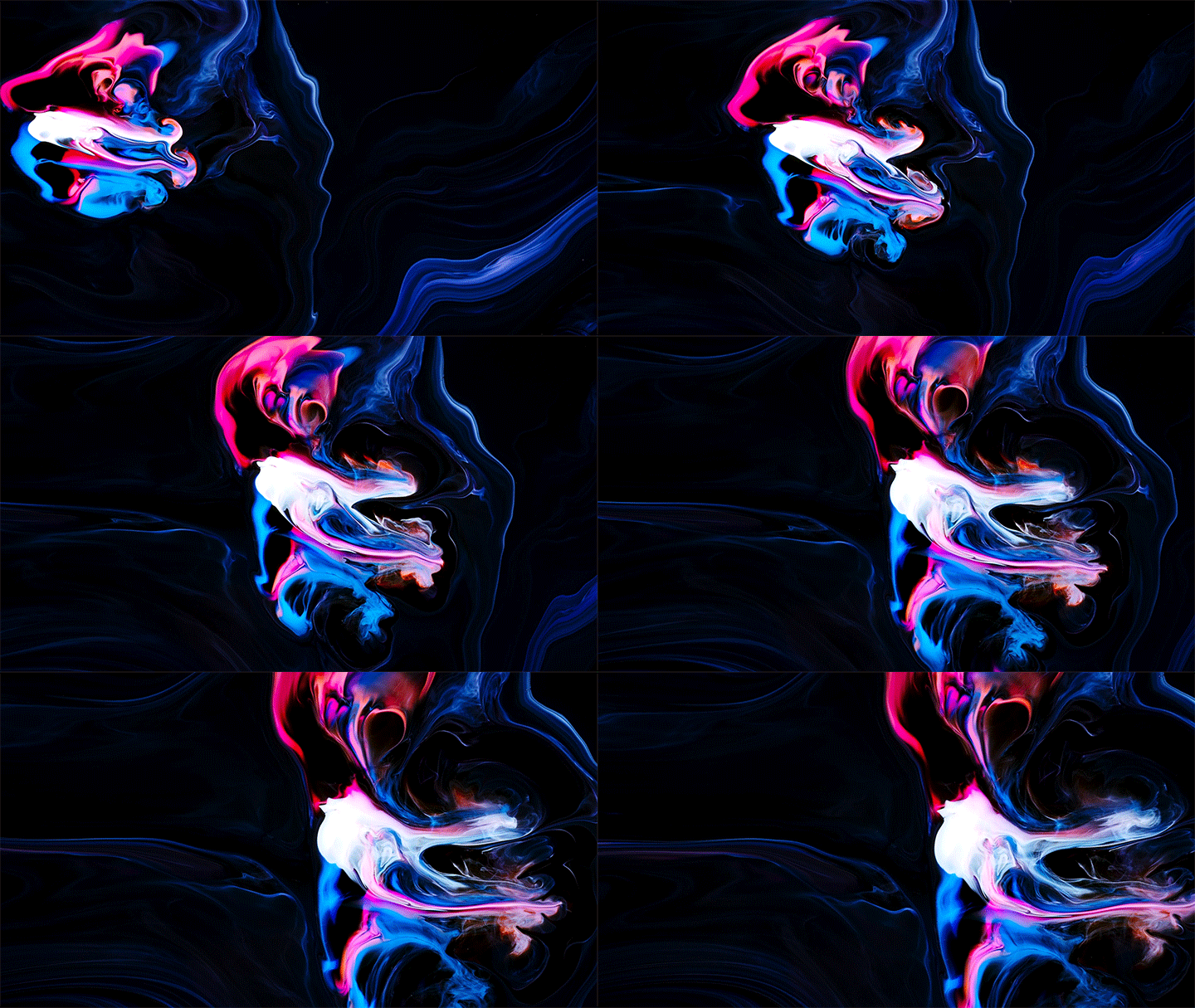
This short film from photographer Roman De Giuli focuses on ethereal and abstract fluids. What you’re watching is primarily paint, with a little in the way of flow additives. There’s lovely marbling and some impressively sharp edges, but mostly you can just sit back and enjoy the flow! (Image and video credit: R. De Giuli)

The Naruto Whirlpools
Enormous whirlpools are not simply the work of overactive imaginations. There are several spots in the world, including Japan’s Naruto Strait, that regularly see these spectacular vortices.
Naruto’s whirlpools are formed through the interaction of tidal currents with the local topography. Spring tides funneled through the vee-shaped strait can reach speeds of 20 kph as they rush between the Pacific Ocean and the Inland Sea. Below the surface, there’s also a deep depression that helps bring the tides together in such a way that it generates vortices 20 meters in diameter.
In normal times, the whirlpools are a significant tourist attraction during the springtime. Travelers can view them from tour boats, helicopters, and from the Onaruto Bridge. (Image credits: whirlpools – Mainichi/N. Yamada, Discover Tokushima; artwork: Hiroshige; via Mainichi; submitted by Alan M.)

Fractal Flame Propagation
Hydrogen is a promising alternative to carbon-based fuels, but it comes with its own special challenges. Hydrogen gas is extremely flammable, including under circumstances that would normally quench flames, as shown in this recent study.
What you see above are water condensation patterns left behind after the passage of hydrogen flames through a narrow gap between two glass plates. With other fuels, the narrow confinement and low fuel ratio used in these experiments would keep the flames from spreading. But because hydrogen is so light, it diffuses much faster than other fuels, allowing it to spread in these fractal patterns despite its confinement. Engineers will have to account for hydrogen’s easy spread when designing containment strategies. (Image and research credit: F. Veiga-López et al.; via APS Physics)

Bubble Dynamics Govern Faster Pouring
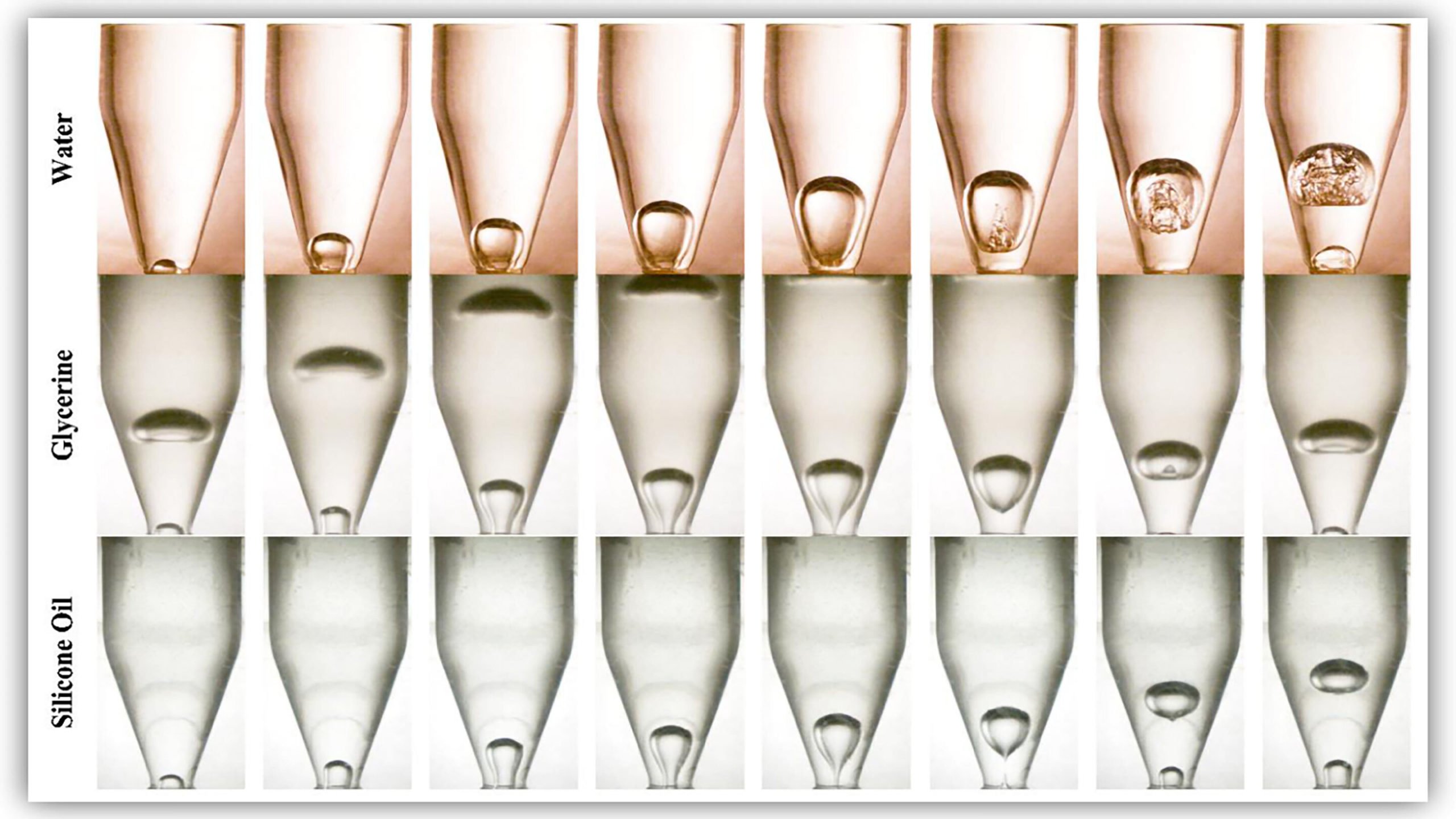
We’re all familiar with the problem of pouring a liquid from a narrow-necked bottle. To a certain extent, tilting the bottle further will reduce the time it takes to empty, but if you tilt too far, your smooth pour becomes violent glugging as bubbles forming at the bottle’s mouth block liquid from exiting.
Researchers find that the time it takes to empty a bottle depends both on the qualities of the liquid — its viscosity and surface tension — and on the geometry of the bottle. In particular, they found that the shape of the bottle influences how quickly bubbles grow at the bottle’s mouth when tilted to the critical angle. Their findings suggest that higher tilt angles and faster pours can be achieved by optimizing bottle geometry. (Image and research credit: L. Rohilla and A. Das; via phys.org)

Aerosol Transport
NASA Goddard has produced another gorgeous visualization of how various aerosols move around our world. This visualization is constructed from data collected between August 2019 and January 2020, which means that it captures numerous typhoons as well as the extreme bushfires that occurred in Australia.
Different colors represent different aerosol sources: carbon (red), sulfate (green), dust (orange), sea salt (blue), and nitrate (pink). The brighter the color, the higher the concentration of aerosols. With this, we see steady patterns of natural sea salt transport and the billowing flow of dust from Saharan Africa. But we can also see manmade pollution from sources across the Northern Hemisphere, as well as major output from the Australian bushfires. It’s a good reminder that none of us is truly isolated in this interconnected world of ours. (Video and image credit: NASA Goddard; via Flow Vis)