Month: April 2020

  • Eroding Ice

    Eroding Ice

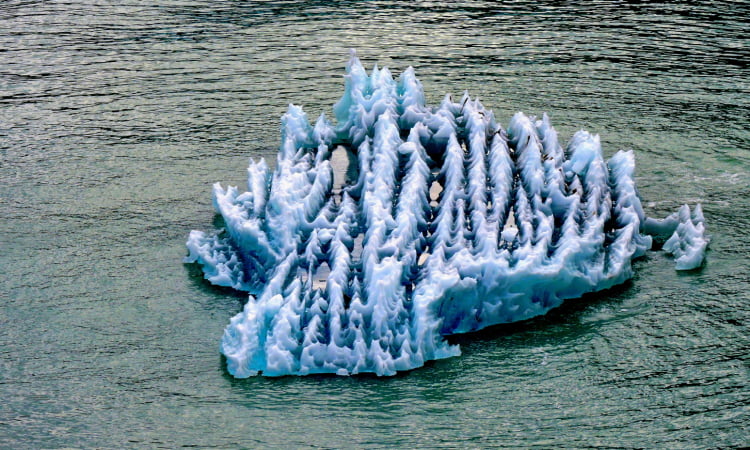
    When glaciers form, they do so in layers, with clear blue ice sandwiched between sediment and air-bubble-filled white ice. Because each of these layers absorbs sunlight differently, they don’t melt evenly. The spikes and ridges seen in this ice formed because of this differential melting between layers. The blue ice is particularly good at absorbing visible wavelengths of light, and so erodes more easily than the other layers.

    Although the results look somewhat similar to the penitente ice seen at high altitudes, the formation mechanisms are a little different. Penitentes rely heavily on sublimation — where their ice and snow change directly into a gas — rather than the melting seen here. That said, both eroded forms depend strongly on how different layers within them absorb and scatter sunlight. (Image credit: J. Van Gundy; via EPOD; submitted by Kam-Yung Soh)

  • Featured Video Play Icon

    Unsinkable Hydrophobic Metal

    Although we typically describe hydrophobic surfaces as “water-repelling,” we could just as easily focus on the fact that they’re “air-attracting.” This video from The Action Lab demonstrates that property nicely with a hydrophobic-coated “boat” that’s effectively unsinkable, thanks to its ability to trap air pockets.

    Even punching holes through the boat doesn’t sink it because its surface is so chemically and physically attractive to air that the bubble won’t budge. In fact, as the video demonstrates, the only effective way to remove the hydrophobicity is to remove the air bubble by using a vacuum chamber. But even then, the effect only lasts until air is reintroduced to the boat. (Image and video credit: The Action Lab)

    P.S. – No, this is not an April Fool’s joke, just actual science! – Nicole