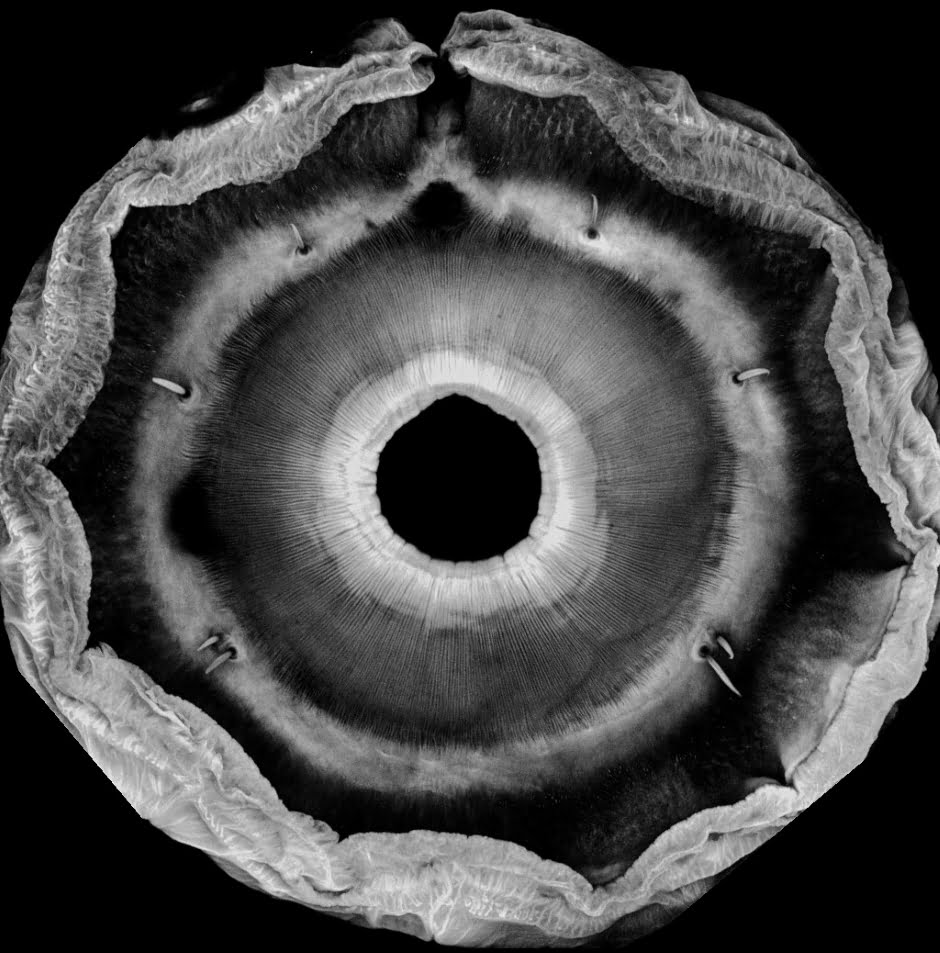
Roman De Giuli’s “Otherworld, Volume 1” is a beautiful exploration of color and flow. Glittery particulates act as tracers in the flow, reminiscent of the way rheoscopic fluids do. In many sequences, the glitter lends a sense of texture to the flow. Without context, I cannot say whether those are true flow features, but they certainly remind me of instabilities like Tollmien-Schlichting waves. (Image and video credit: R. De Giuli)
Month: January 2020

Holding Fast in the Flow
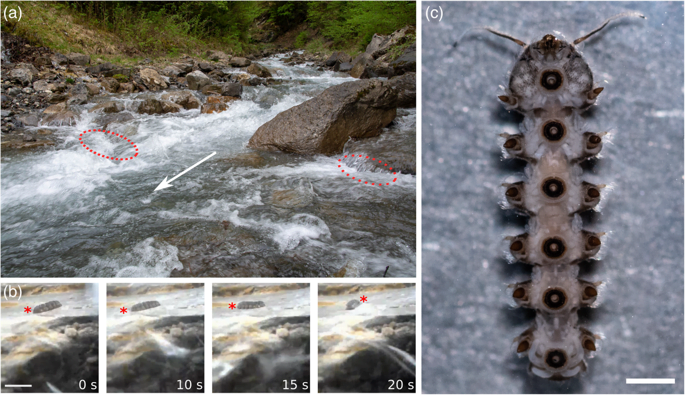
Many tiny creatures in the natural world face living in fast flows. The larvae of the net-winged midge, for example, forage their way through fast-flowing Alpine springs with speeds of 3 m/s or more. You or I would find standing in such water a challenge, but these larvae are unbothered, thanks to the clever suction-cup-like appendages that help anchor them to rough rocks.
The larvae generate their strong attachment with an outer rim flexible enough to conform to uneven surfaces. When they activate the central piston of the suction cup, this creates a seal strong enough to withstand forces up to 600 times the larvae’s body weight. But holding on to one spot forever is hardly useful, so the larvae also have a V-shaped notch in the cup controlled by dedicated muscles. When activated, this quickly breaks the seal, allowing the larvae to relocate. (Image and research credit: V. Kang et al.; via The Engineer; submitted by Marc A.)

Superwalking Droplets
Vibrate a pool of silicone oil and you can generate walking droplets. Drive the vibration at two simultaneous frequencies and you can support much larger droplets, known as superwalkers. These superwalkers have their own intriguing dynamics, a few of which are featured in this video.
Superwalkers can create promenading pairs, chase one another, orbit, and even form ordered and disordered crystals. They can even generate stop-and-go traffic patterns. As with regular walkers, these complex behaviors come from the interaction of bouncing droplets with their ripples and those of their neighbors. (Image, video, and research credit: R. Valani et al.)

Morphing Wings Using Real Feathers
Although humanity has long been inspired by bird flight, most of our flying machines are nothing like birds. Engineers have struggled to recreate the ease with which birds are able to morph their wings’ characteristics as they change from one shape to another. Now researchers have built a biohybrid robot, PigeonBot, that uses actual pigeon feathers as part of its morphing design.
Many species of birds, including pigeons, have Velcro-like hooks in the microstructure of their feathers. These hooks help the flight feathers stick to one another and create a continuous wing surface that air cannot easily slip through, even as the wing drastically changes shape. By using actual feathers, PigeonBot shares this advantage.
PigeonBot also has a somewhat minimalist design in its articulation, using only a wrist and finger joint in each wing to control shape. The feathers are connected through an elastic ligament, which — along with their microstructure — allows them to smoothly change shape under aerodynamic loads. The end result is a remarkably capable and agile biorobot researchers can use to better understand how birds control their flight. (Image and research credit: L. Matloff et al. and E. Chang et al.; via NPR and Gizmodo)

Breaking the Euler Equations
Mathematicians like to break things. Or, more exactly, they like to know when the equations we use to describe physics break down. One popular target in fluid mechanics are the Euler equations, which describe the motion of frictionless, incompressible flows. Mathematicians have been on the hunt for centuries for situations where these equations predict singularities, points where the velocity or vorticity of a fluid change infinitely quickly. Since that can’t happen in reality (at least as far as we understand it), these singularities indicate weaknesses in our mathematical description and may help uncover fundamental flaws in our understanding.
Despite centuries of effort, the Euler equations withstood mathematical assault… until recently. Since 2013, a series of mathematicians have been successfully chipping away at the Euler equations’ seeming perfection with a series of scenarios that seem to lead to singularities. One is similar to stirring a cup of tea, except that you stir the upper part of the cup in one direction and the bottom half in the opposite. As the flow develops, a singularity occurs where the secondary flows of these two stirring motions collide. For more, check out these two articles over at Quanta. (Image credit: L. Fotios; see also Quanta Magazine 1, 2)

When the Mediterranean Dried Up
Geological evidence shows that millions of years ago, the Mediterranean Sea nearly dried out. In fluid mechanics, we’d describe this problem using one of our fundamental equations: conservation of mass, also known as continuity.
Imagine a volume containing the entire Mediterranean. To describe the amount of sea water in that volume, you need to keep track of two major quantities: how much water is flowing into the volume and how much is leaving it. For the prehistoric (as well as today’s) Mediterranean, the sources feeding the sea are 1) an inflow from the Atlantic through the Strait of Gibraltar; 2) inflows from rivers; and 3) rainfall. Water is lost primarily to evaporation.
As explained in the video, the Mediterranean’s dry spell was heralded by tectonic changes that sealed the Strait of Gibraltar, depriving it of its largest source of inflow. At the same time, warmer temperatures and less rainfall reduced influx from rivers and the atmosphere while increasing evaporation rates. The result? Water levels in the Mediterranean dropped by hundreds of meters, creating massive salt deposits, wiping out native marine life, and allowing mass migration by land-dwelling animals. Eventually, though, the Strait re-opened, creating what might have been a massive flood. (Video and image credits: PBS Eons)

Captured by Waves
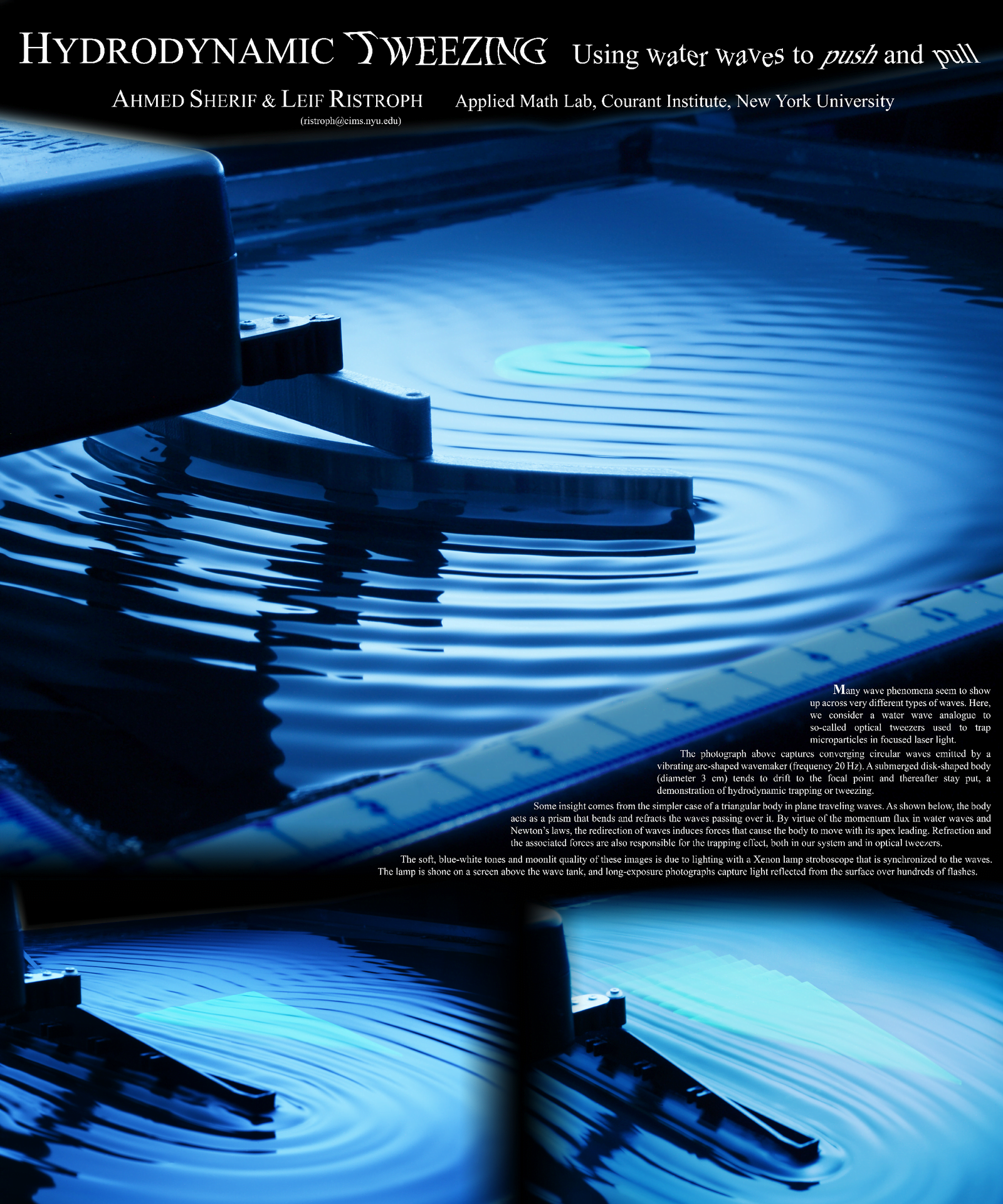
Acoustic levitation and optical tweezers both use waves — of sound and light, respectively — to trap and control particles. Water waves also have the power to move and capture objects, as shown in this award-winning poster from the 2019 Gallery of Fluid Motion. The central image shows a submerged disk, its position controlled by the arc-shaped wavemaker at work on the water’s surface. The complicated pattern of reflection and refraction of the waves we see on the surface draws the disk to a focal point and holds it there.
On the bottom right, a composite image shows the same effect in action on a submerged triangular disk driven by a straight wavemaker. As the waves pass over the object, they’re refracted, and that change in wave motion creates a flow that pulls the object along until it settles at the wave’s focus. (Image and research credit: A. Sherif and L. Ristroph)

Rattlesnakes Sip Rain From Their Scales
Getting enough water in arid climates can be tough, but Western diamondback rattlesnakes have a secret weapon: their scales. During rain, sleet, and even snow, these rattlesnakes venture out of their dens to catch precipitation on their flattened backs, which they then sip off their scales.
Researchers found that impacting water droplets tend to bead up on rattlesnake scales, forming spherical drops that the snake can then drink. Compared to other desert-dwelling snakes, Western diamondbacks have a far more complicated microstructure to their scales, with labyrinthine microchannels that provide a sticky, hydrophobic surface for impacting drops. (Video and image credit: ACS; research credit: A. Phadnis et al.; via The Kid Should See This)

Bouncing Off Defects
The splash of a drop impacting a surface depends on many factors — among them droplet speed and size, air pressure, and surface characteristics. In this award-winning video from the 2019 Gallery of Fluid Motion, we see how the geometry of a superhydrophobic surface can alter a splash.
When a drop falls on a protruding superhydrophobic surface, like the apex of a cone, it can be pierced from the inside, completely changing how the droplet rebounds and breaks up. The variations the video walks us through are all relatively simple, but resulting splashes may surprise you nevertheless. (Image and video credit: The Lutetium Project)

Superman’s Hair Gel
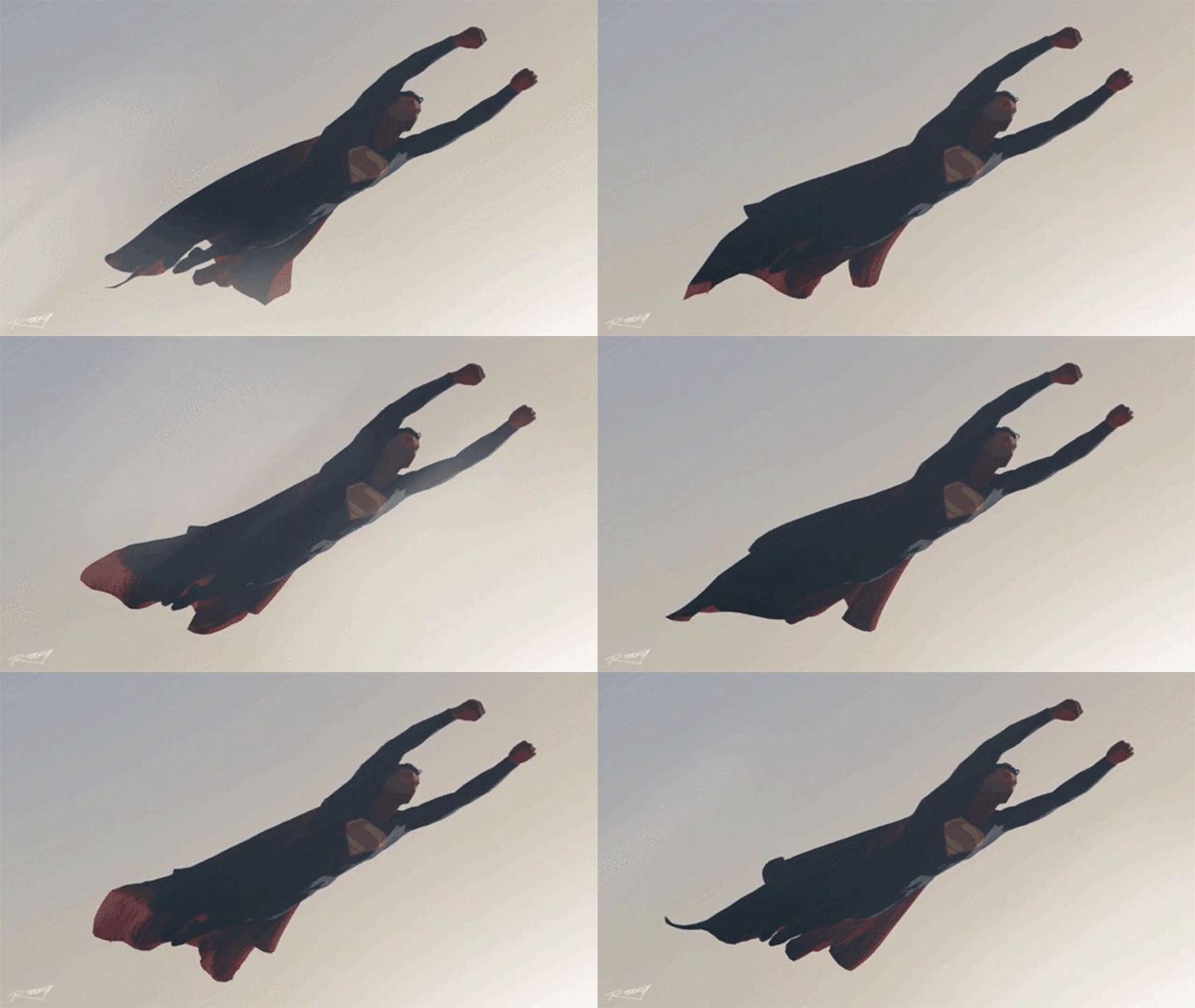
I love a good tongue-in-cheek physical analysis of superheroes. This estimate of the drag force experienced by Superman’s hair when outracing a plane or speeding bullet was done by Cornell students. According to their calculations, Superman’s hair (or his hair gel) must withstand nearly 80,000 Newtons of force. That’s a bit less than the typical force experienced by a restrained passenger in a car crash at highway speeds.
In grad school, my labmates and I held a spirited debate about the difference in drag Superman would experience when flying at hypersonic speeds depending on whether he had one or both arms extended in front of him. Sadly, we never found the chance to test our hypotheses in the wind tunnel. (Image and video credit: R. Geltman et al.)