Month: October 2018

  • Titan’s Dust Storms

    Titan’s Dust Storms

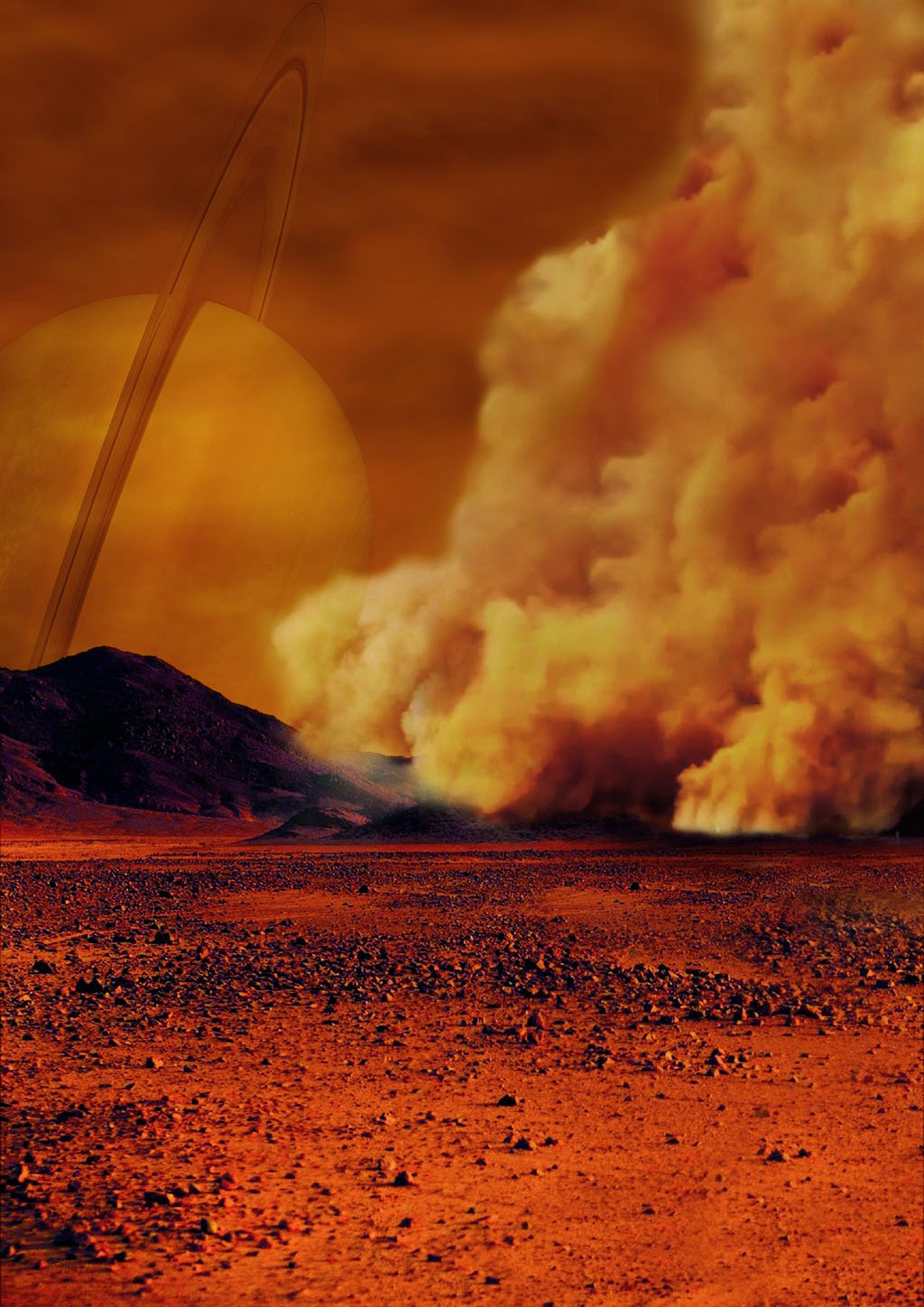
    Earth and Mars are well-known for their dust storms, but a new source of extraterrestrial dust storms is joining them: Saturn’s moon Titan. Titan already shares unusual similarities to Earth: it is the only other place known to currently have stable liquid bodies at its surface. On Earth, water makes up our lakes and oceans; on Titan, it’s methane.

    The evidence that Titan may also have dust storms dates from several Cassini flybys in 2009 and 2010. Cassini observed short-lived infrared bright spots in a dune-covered equatorial region. After considering several other possible sources for these temporary bright spots, researchers concluded that the most likely explanation was dust clouds suspended by high winds. This suggests that the dune fields on Titan are still actively changing, just like those on Earth and Mars! (Image credit: artist’s concept for Titan dust storm – NASA/ESA/IPGP/Labex UnivEarthS/University Paris Diderot; research credit: S. Rodriguez et al.; submitted by jpshoer)

  • Wheeling Drops

    Wheeling Drops

    Leidenfrost drops – which skitter almost frictionlessly across extremely hot surfaces on a thin layer of their own vapor – are notoriously mobile. We’ve seen numerous methods of controlling their propulsion, often using specially-shaped surfaces. But it turns out that some Leidenfrost drops can self-propel even on a smooth, flat surface (top image). 

    Internally, large Leidenfrost drops have complicated, but symmetric flows that are driven by temperature and surface tension variations across the drop. But as the drop evaporates, that symmetry eventually gets broken, leaving behind a single large circulating flow. 

    Beneath the drop, that internal circulation affects the vapor layer. It causes the layer to take on an overall tilt, and the rotation, along with that slight angle in the vapor layer, causes the Leidenfrost drop to roll away like a wheel. (Image and research credit: A. Bouillant et al.; via NYTimes)

  • How Mantas Filter But Never Clog

    How Mantas Filter But Never Clog

    Manta rays spend much of their time leisurely cruising through the water with their meter-wide mouths open. As they swim, they filter plankton, which makes up most of their diet, from the water. And they do so without ever clogging. 

    The inside of the manta’s mouth is lined with gill rakers (upper right), a series of comb-like teeth. When flow hits the leading edge of these (bottom), it creates a vortex that accelerates any particles caught in the flow. They essentially ricochet along the top of the gill rakers, getting led straight into the manta’s digestive system – while excess water gets deflected between the gill rakers and back out the manta’s gills. To drive this, all the manta has to do is swim; with the right flow speed, the shape of the gill rakers handles all the filtration with no additional effort. (Image credit: manta ray – G. Flood; gill rakers – M. Paig-Tran; flow vis – R. Divi et al., source; research credit: M. Paig-Tran et al.; via The Atlantic; submitted by Kam-Yung Soh)