Month: September 2018

  • Water Bottle Flipping Physics

    Water Bottle Flipping Physics

    In 2016, a senior talent show launched a new viral craze: water bottle flipping. As improbable as it seems at first glance, physics is actually on your side when it comes to pulling this trick off. As explained in this classroom-oriented paper and the video abstract below, the sloshing of the water in the bottle as it flips slows its rate of rotation, which creates the stable landing. You don’t even need water to make the trick possible. Using two tennis balls will also give a stable flip – provided they have room to spread out. When they fly apart, they change the bottle’s moment of inertia and that slows down the rotation rate. All in all, it’s a great lesson in conservation of angular momentum.

    And, in case you’re wondering whether the water helps with sticking that landing, we’ve got you covered there, too. (Image credit: A. Johnson, source; video and research credit: P. Dekker et al.)

  • Featured Video Play Icon

    Bioinspiration, Underwater Sniffing, and Mixing Toothpaste

    In this month’s FYFD/JFM video, we explore some intersections between the animal kingdom and our own lives. Learn about designing better buildings with inspiration from termites; see the fascinating superpower of the star-nosed mole; and learn what goes into products like the toothpaste you (hopefully) use daily. All this and more in the latest video! Missed one of our previous ones? Good news: we’ve got you covered. (Image and video credit: N. Sharp and T. Crawford)

  • Exploding Meteors

    Exploding Meteors

    During the recent Perseid shower, photographer Petr Horálek caught an awesome timelapse of an exploding meteor and the vortex ring it created. This is a type of persistent train left when meteors pass through the upper atmosphere. The exact physics are not well understood because such events are difficult to observe; catching them at all is basically just happenstance. But one interpretation is that we’re seeing trails of plasma left by the ionization of parts of the meteor. When the meteor hits the upper atmosphere, there’s an extremely strong hypersonic shock wave. The jump in temperature across that shock wave is enough to pull atoms apart, creating a plasma. The train left by this meteor’s demise was faintly visible even an hour after the fireball. (Image credit: P. Horálek, video version; via APOD; submitted by Andrea S.)

  • Levitating with Sound

    Levitating with Sound

    Sound can manipulate fluids in fascinating ways, from levitation to vibration. Here researchers use sound to levitate and manipulate droplets and turn them into bubbles. Increasing the acoustic pressure on the levitating droplet flattens it, then slowly causes the drop to buckle. When the buckled film encloses a critical volume, the sound waves resonate inside it. That causes a big jump in acoustic pressure, which makes the drop snap closed into a bubble. (Image and research credit: D. Zang et al.; via Science News; submitted by Kam-Yung Soh)

  • “Hydrophytes”

    “Hydrophytes”

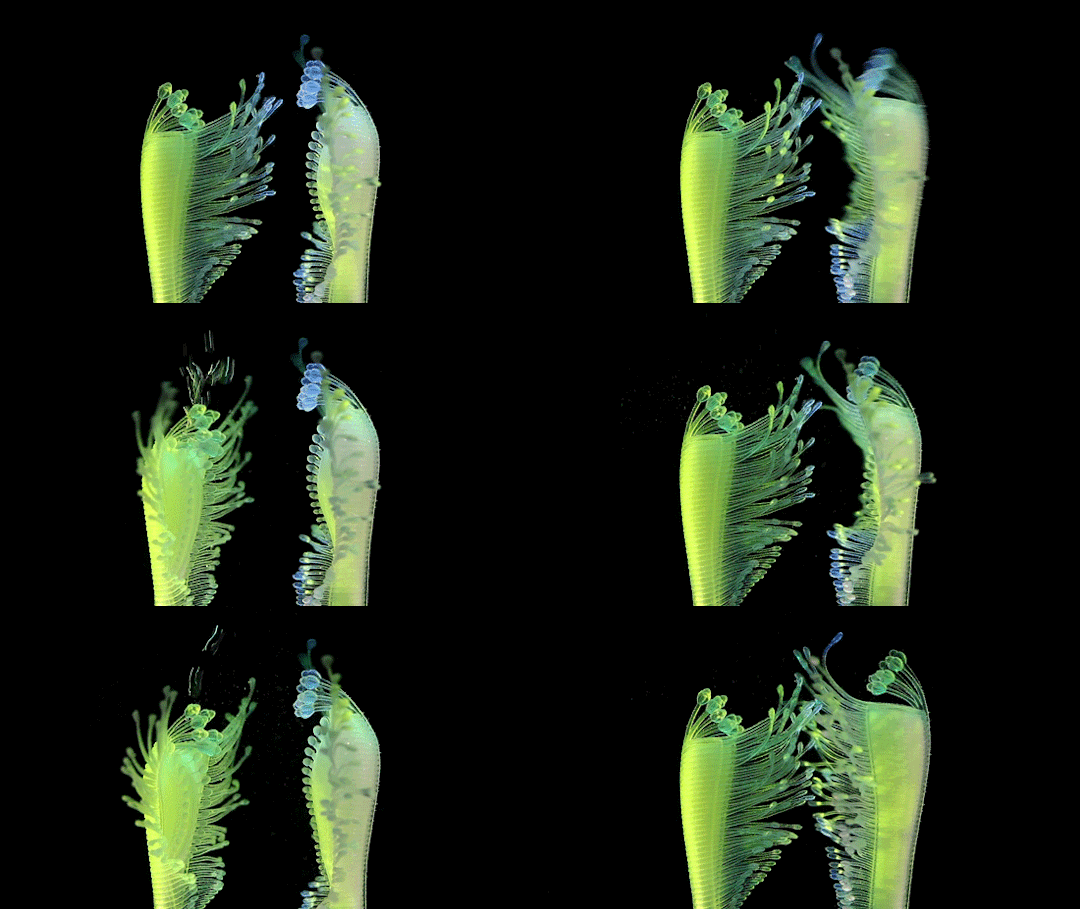
    In “Hydrophytes,” industrial designer Nicole Hone imagines a future in which we’ve designed aquatic plants to counter some of the effects of climate change. To create her plants, Hone designed them with digital tools, then printed them with multi-material 3D printers. Their movements are brought to life with pneumatic pumps that fill and collapse them in response to external interactions. The motion and character of these imagined plants is astounding; they truly seem to be alive. It’s an incredible intersection of science, art, and technology. Check out the full film below. (Image and video credit: N. Hone; via Colossal)

  • Featured Video Play Icon

    Flying Beetles, Stinging Nettles, and Jellyfish

    In the latest JFM/FYFD video, we tackle some of the less pleasant aspects of summer weather: stopping invasive insects, understanding how plants dispense poison, and looking at the physics behind jellyfish stings. And if you’ve missed any of our previous videos, we’ve got you covered. (Image and video credit: T. Crawford and N. Sharp)

  • Replacing Kalliroscope

    Replacing Kalliroscope

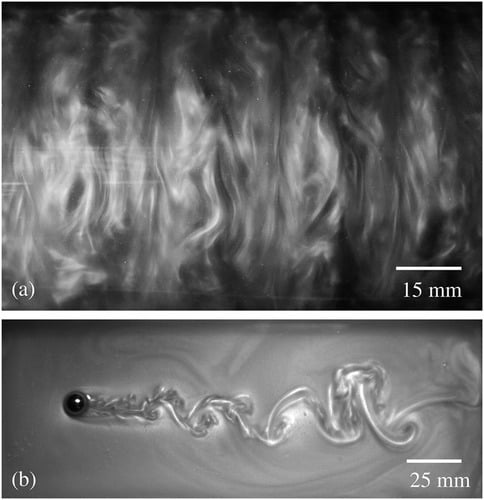
    Although you may not recognize the name, you’ve probably seen Kalliroscope (top image), a pearlescent fluid that creates beautiful flow patterns when swirled. This rheoscopic fluid was invented in the mid-1960s by artist Paul Matisse and, over the following decades, became a staple of flow visualization techniques. Kalliroscope contained a suspension of crystalline guanine. Since the crystals were asymmetric, they would orient themselves depending on the flow and, from there, scatter light, creating the beautiful pearlescent effect seen above.

    Unfortunately for researchers, the production of guanine crystals was expensive and difficult. The cosmetics industry was their main consumer and over time, they moved toward mica and other cheaper mineral alternatives. The company that produced Kalliroscope gave up production in 2014, leaving researchers scrambling for a suitable alternative.

    One contender for a new standard rheoscopic fluid is based on shaving cream. By diluting shaving cream 20:1 with water, researchers are able to extract stearic acid crystals, which form an admirable alternative to Kalliroscope (middle collage). Like Kalliroscope, the resulting fluid is pearlescent and reveals flow features well (bottom two images). Stearic acid crystals are also closer in density to water than guanine, so the fluid remains in suspension far better than Kalliroscope. Plus, the best shaving cream is cheap and widely available, meaning that this is a DIY project just about anyone can do! (Image credits: Kalliroscope – P. Matisse; other images – D. Borrero-Echeverry et al.; research credit: D. Borrero-Echeverry et al.)

  • Flowing Flowers

    Flowing Flowers

    Granular mixtures with particles of different sizes will often segregate themselves when flowing. In this half-filled rotating drum large red particles and smaller white ones create a stable petal-like pattern. As the drum turns, an avalanche of small particles flows down, forming each white petal. When the avalanche hits the drum wall, a second wave – one of the larger, red particles – flows uphill toward the center of the drum. If the uphill wave has enough time to reach the center of the drum before the next avalanche of smaller particles, then the petal pattern will be stable. Otherwise, the small particles will tend to fall between the larger ones, disturbing the pattern. (Image and research credit: I. Zuriguel et al., source; via reprint in J. Gray)

  • Using Sound to Print

    Using Sound to Print

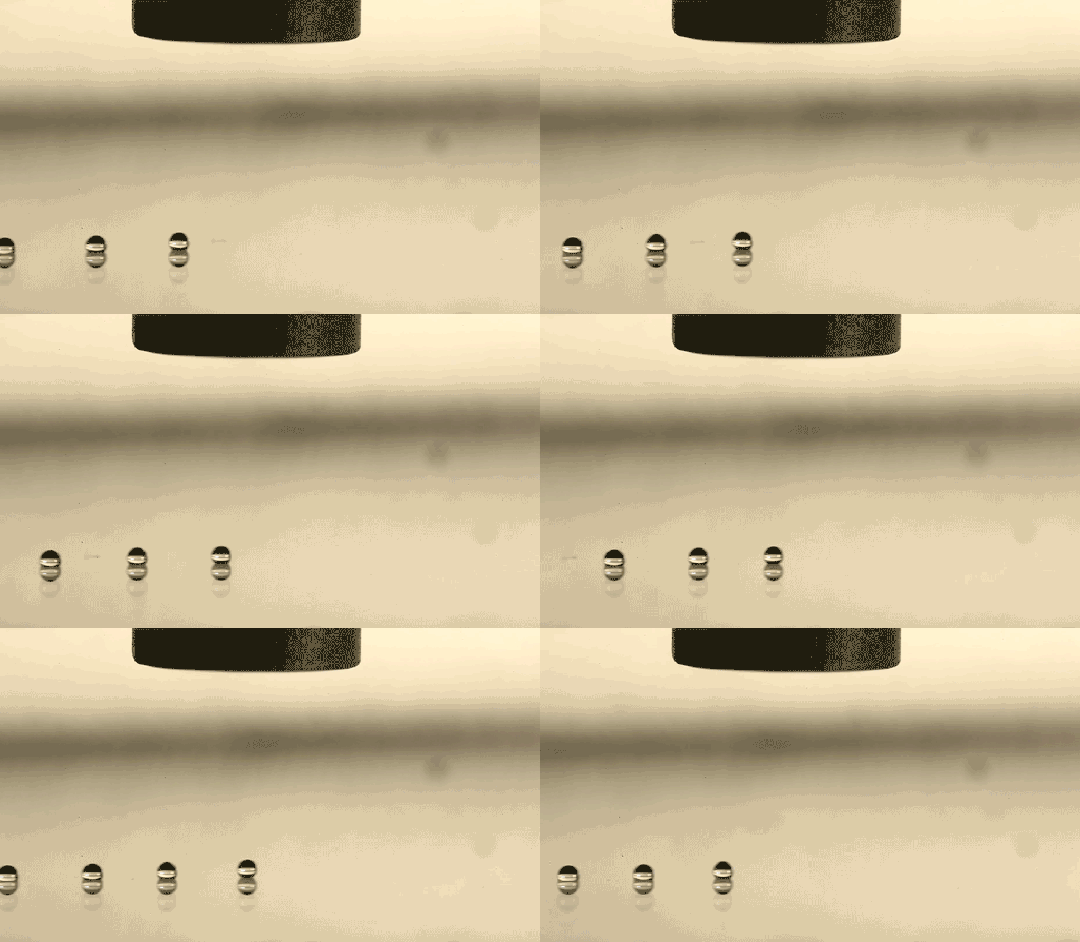
    Inkjet printing and other methods for directing and depositing tiny droplets rely on the force of gravity to overcome the internal forces that hold a liquid together. But that requires using a liquid with finely tuned surface tension and viscosity properties. If your fluid is too viscous, gravity simply cannot provide consistent, small droplets. So researchers are turning instead to sound waves

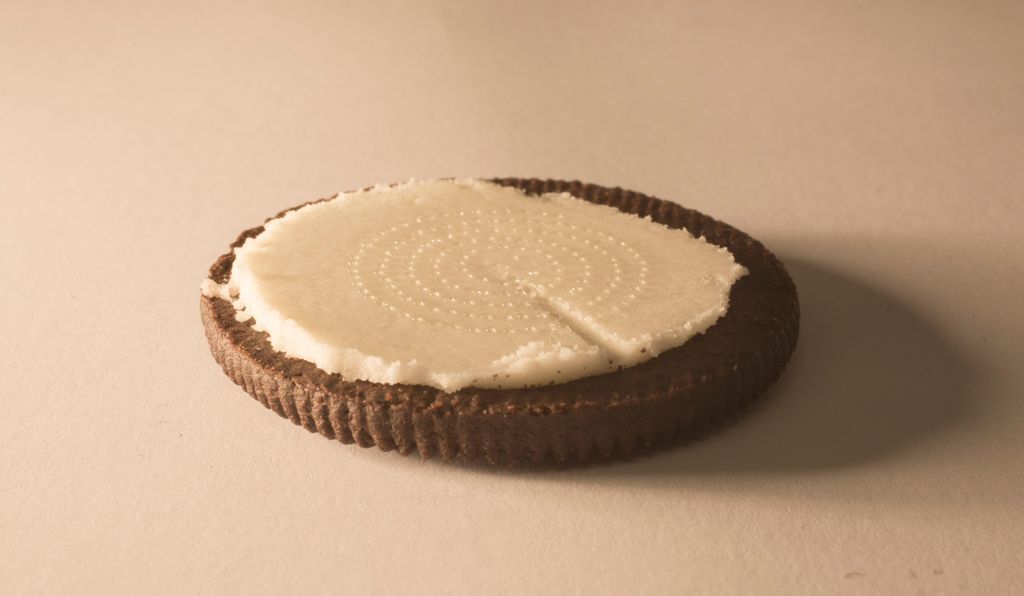
    Using an acoustic resonator, scientists are able to generate forces up to 100 times stronger than gravity, allowing them to precisely and repeatably form and deposit micro- and nano-sized droplets of a variety of liquids. In the images above, they’re printing tiny drops of honey, some of which they’ve placed on an Oreo cookie for scale. The researchers hope the technique will be especially useful in pharmaceutical manufacturing, where it could precisely dispense even highly viscous and non-Newtonian fluids. (Image and research credit: D. Foresti et al.; via Smithsonian Mag; submitted by Kam-Yung Soh)

  • Inside a Bubble Wall

    Inside a Bubble Wall

    Schlieren photography has an almost magical feeling to it because it enables us to see the invisible – like shock waves and the tiny currents of heat that rise from our skin. But it can also reveal new perspectives on things that aren’t invisible. Here we see soap bubbles viewed through the lens of a schlieren set-up. Schlieren is sensitive to small changes in density, so instead of appearing in their usual rainbow iridescence, the bubbles look glass-like and filled with tiny currents and bubbles. What we’re seeing are some of the many tiny flow variations across the surface of a soap bubble. They’re driven by a combination of forces – gravity, temperature, and surface tension variations, to name a few. Seen in video, you can really appreciate just how dynamic a thin soap film is! (Image credit and submission: L. Gledhill, video version, more stills)