Month: October 2017

  • Featured Video Play Icon

    Dam Failure

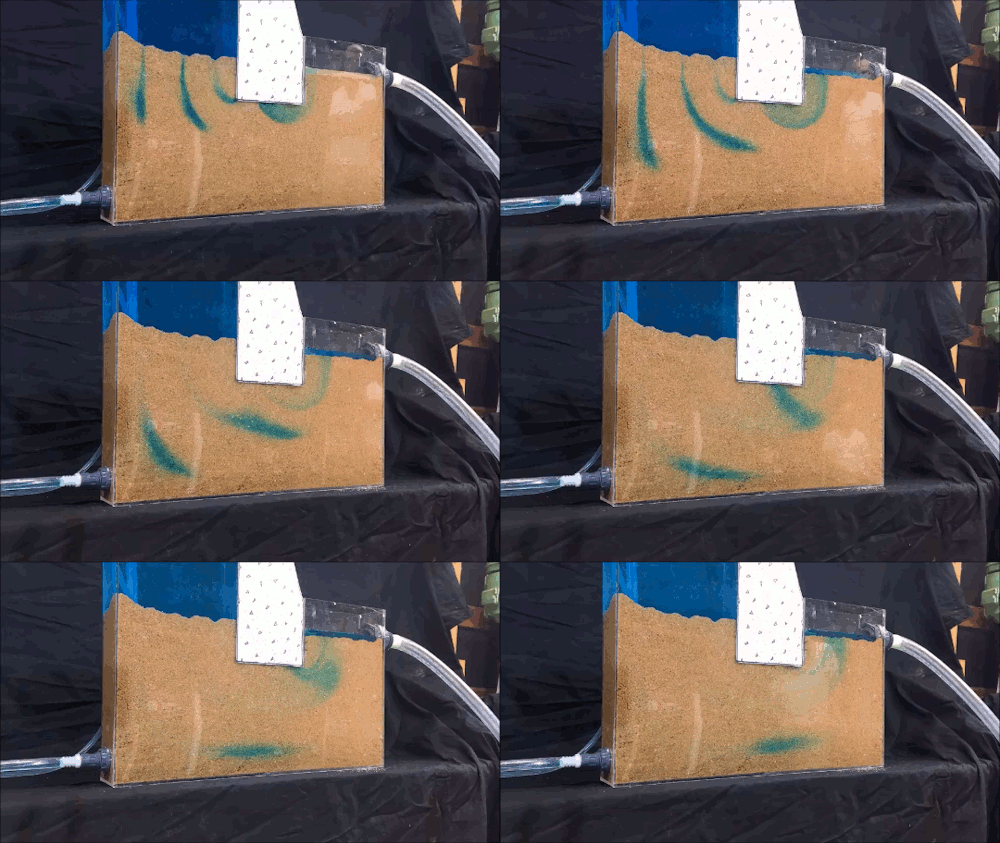
    In a recent video, Practical Engineering tackles an important and often-overlooked challenge in civil engineering: dam failure. At its simplest, a levee or dam is a wall built to hold back water, and the higher that water is, the greater the pressure at its base. That pressure can drive water to seep between the grains of soil beneath the dam. As you can see in the demo below, seeping water can take a curving path through the soil beneath a dam in order to get to the other side. When too much water makes it into the soil, it pushes grains apart and makes them slip easily; this is known as liquefaction. As the name suggests, the sediment begins behaving like a fluid, quickly leading to a complete failure of the dam as its foundation flows away. With older infrastructure and increased flooding from extreme weather events, this is a serious problem facing many communities. (Video and image credit: Practical Engineering)
  • Self-Healing Bubbles

    Self-Healing Bubbles

    Soap films have the remarkable property of self-healing. A water drop, like the one shown above, can pass through a bubble (repeatedly!) without popping it. This happens thanks to surfactants and the Marangoni effect. Surfactants are molecules that lower the surface tension of a liquid and congregate along the outermost layer of a soap film. When water breaks through the soap film, its lack of surfactants causes a higher surface tension locally. This triggers the Marangoni effect, in which flow moves from areas of low surface tension toward ones of high surface tension. That carries surfactants to the region where the drop broke through and helps stabilize and heal the soap film. Incidentally, the same process lets you stick your finger into a bubble without popping it as long as your hand is wet! (Image credit: G. Mitchell and P. Taylor, source)