Month: May 2016

  • Wingtip Vortices Visualized

    Wingtip Vortices Visualized

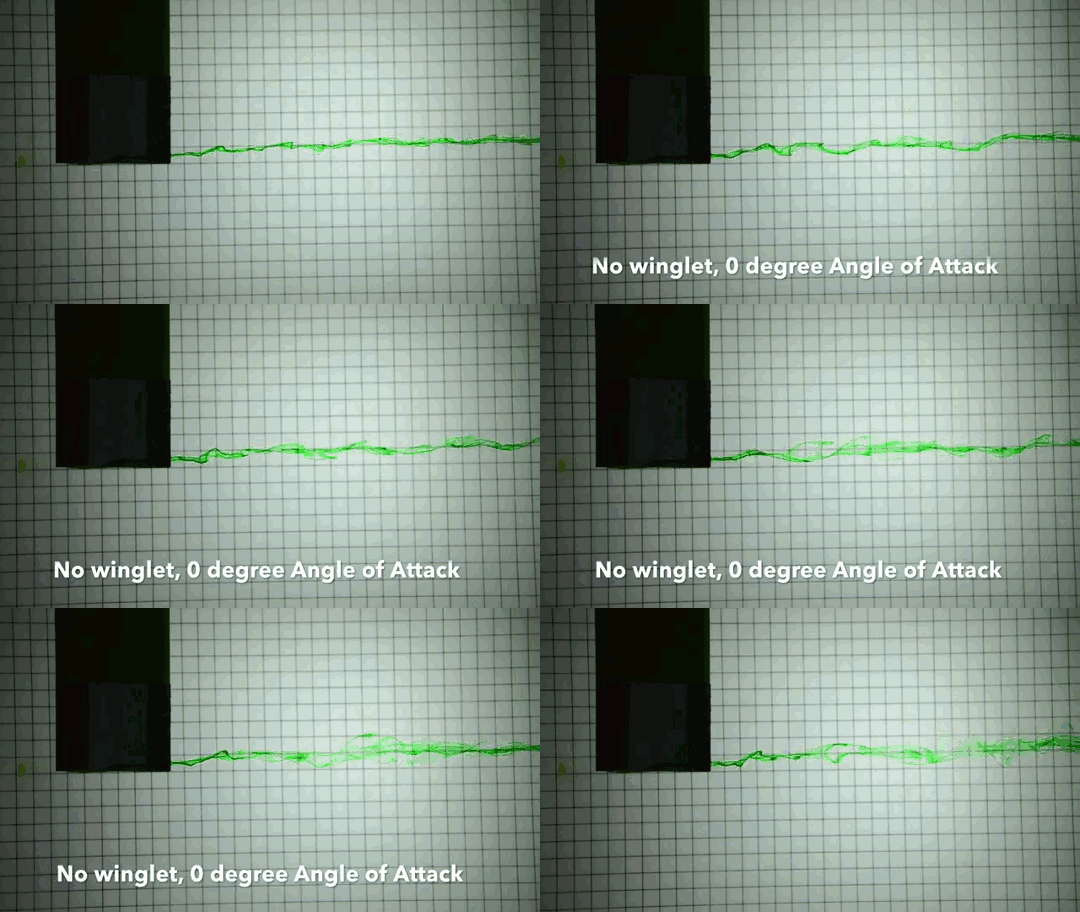
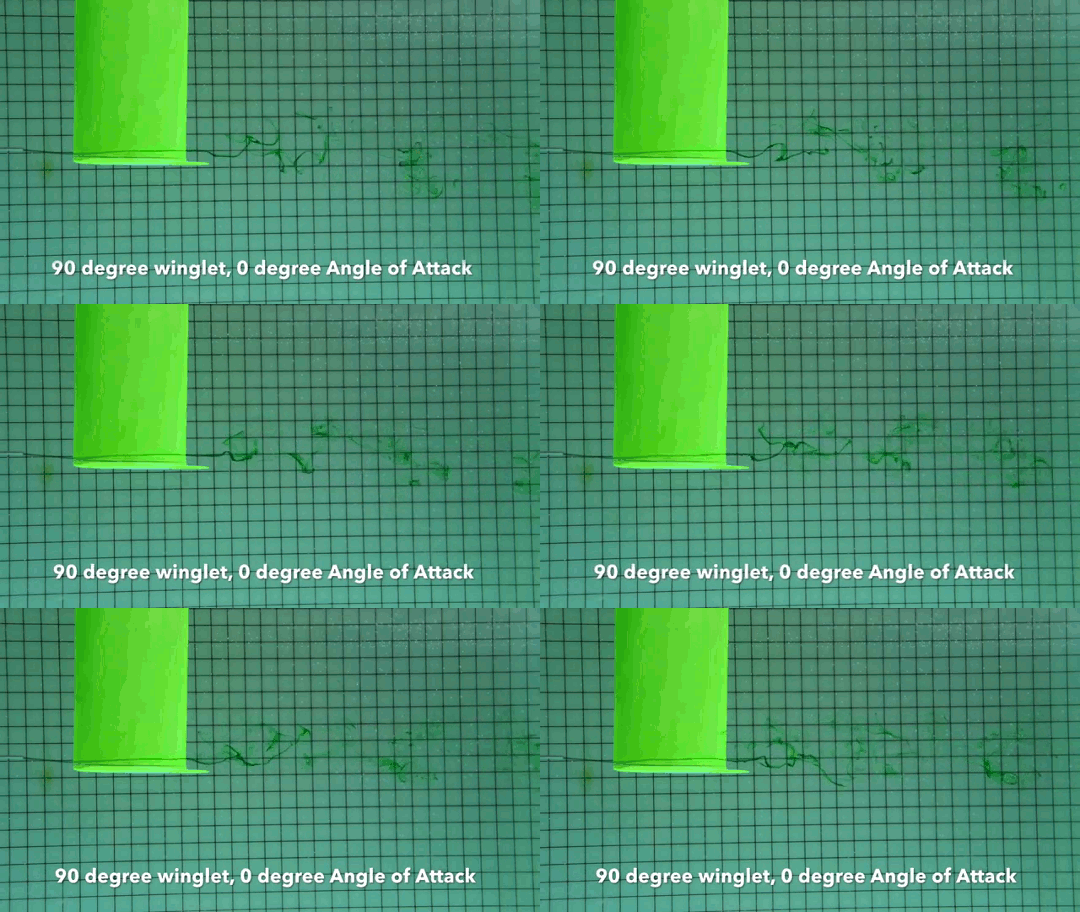
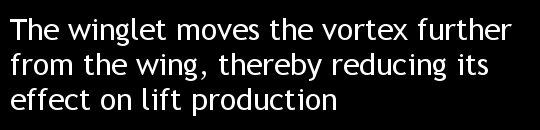
    In flight, airplane wings produce dramatic wingtip vortices. These vortices reduce the amount of lift a 3D wing produces relative to a 2D one. How much they influence the lift depends on both the strength and proximity of the vortex. The stronger and closer it is, the more detrimental its effect. One way airplane designers reduce the effects of wingtip vortices is by adding an extra section, called a winglet, to the end of the wing. Among other effects, the winglet moves the wingtip vortex further away from the main wing, which reduces its influence and allows the airplane to regain some of the lift that would otherwise be lost. (Image credits: A. Wielandt et al., source)

  • HIFiRE

    HIFiRE

    Earlier this month, an international team launched a successful hypersonic flight test in Australia. The Hypersonic International Research Experimentation (HIFiRE) Flight 5b was launched atop a two-stage rocket and reached its maximum speed of Mach 7.5, well above Mach 5, which defines the start of the hypersonic regime. The purpose of this particular flight test was not to test new propulsion technologies – there was no scramjet engine on this flight. Instead, researchers wanted to study aerodynamics at high Mach number, specifically the behavior of the air very close to the vehicle, its boundary layer.

    The payload being tested was an elliptical cone mounted on the front of the vehicle and shown in images above. The shape of the payload is such that flow will curve around the cone rather than following straight lines. The image on the lower right contains black streamlines that show how air twists around the cone. This complex flowfield complicates the physics of the boundary layer near the cone’s surface and increases the likelihood that the boundary layer will transition from laminar flow to turbulent flow, thereby increasing heating on the payload. Ideally, the data from the test flight will let engineers test their ability to understand and predict this boundary layer transition in the future. For more on boundary layer transition and its effects at hypersonic speeds, check out my latest FYFD video. (Image credit: Australia Department of Defense, R. Kimmel et al., F. Li et al.; topic requested by Guido)

  • Skating on Vapor

    Skating on Vapor

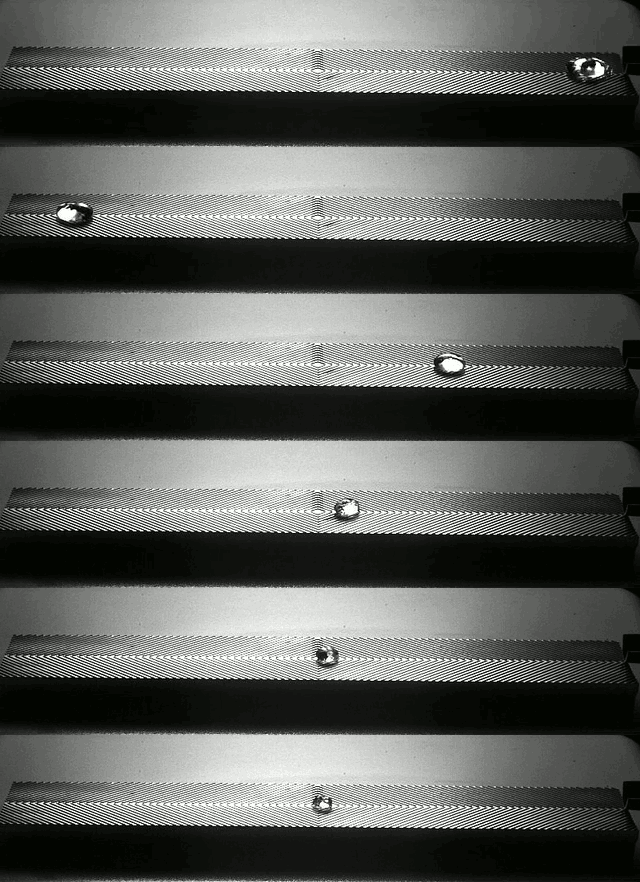
    Turn the stove up high enough and you may have noticed that drops of water stop boiling away and instead skate across the surface. This is the Leidenfrost effect, which occurs when a surface is so much hotter than a liquid’s boiling point that any liquid that contacts instantly vaporizes. That thin vapor layer insulates the rest of the drop and makes it skate around on very little friction. Previously, researchers found that putting these drops on patterned surfaces causes them to self-propel. Here you see Leidenfrost drops on a V-shaped “herringbone” surface. The grooves in the surface catch and direct the vapor out the Vs. If it seems counter-intuitive that the drops move in the same direction as their vapor, you’re not alone! It turns out that Leidenfrost drops aren’t propelled by vapor moving away from them – like, say, a rocket is. Instead the drops are being dragged along by friction between them and the escaping vapor. By controlling the direction of the vapor, researchers were able to create race tracks (top) and even traps (bottom) for the drops. (Image credit: D. Soto et al., from Supplemental Movies 2 and 3)

  • Why Does This Kite Look So Real?

    Why Does This Kite Look So Real?

    A recent viral video features mesmerizing footage of a giant octopus kite flown at a kite festival in Singapore earlier this month. The kite’s arms twist and wave lazily in the breeze. Watching the video, I was struck by how realistic the kite’s motion looks. It really looks like an octopus is just cruising there in mid-air. And that resemblance might not be accidental.

    In fluid dynamics, scientists often use a concept called dynamic similitude to test the physics of a scale model instead of the full-size original. The simplest version of this uses the Reynolds number to compare the model and the original. The Reynolds number is a dimensionless number that depends on the object’s size, the flow’s speed, and the density and viscosity of the fluid. If you match the scale model’s Reynolds number to the original’s Reynolds number, then the physics will be the same – even if you changed the fluid or the size of the object.

    Returning to our kite, one thing the footage doesn’t entirely convey is just how enormous this kite really is. The Straits Times reports the kite is about the length of five buses and requires six people to get aloft. But the kite’s size helps compensate for the fact that it’s flying in air instead of swimming through viscous water like a real octopus. Although I’m left estimating the kite’s size and the wind’s speed, my quick calculations put the Reynolds numbers for the kite and the octopus on the order of 10,000. So, strange as it seems, this giant kite really is acting like a swimming octopus!

    (Image credits: E. Chew, source)

  • Featured Video Play Icon

    The Reverse Magnus Effect

    A good soccer player can kick the ball from the corner of the field into the goal thanks to the Magnus effect. But if you’ve ever tried to play soccer with a smooth ball, you may have noticed that sometimes the ball bends the wrong way! This is the reverse Magnus effect and it’s caused when the boundary layers on either side of the ball switch from turbulent to laminar flow at different times. Dianna Cowern explains (with a little help from yours truly) in the video above. Want to learn more about how roughness affects boundary layers? Check out our companion video on FYFD’s YouTube channel. (Video credit: D. Cowern/Physics Girl)

  • Featured Video Play Icon

    How Fluid Dynamics Saved the Space Shuttle

    New FYFD video! In which Dianna Cowern (Physics Girl) joins me to explore boundary layer transition and how a couple of small bits of roughness could be a huge problem for the Space Shuttle during re-entry. A lot of people have asked me what I did for my PhD research, and the truth is, I’ve never really discussed my own work here on FYFD. This video is probably the closest I’ve come. The story I tell about STS-114 is one that appears in the first chapter of my dissertation, and it did, in many respects, motivate my work exploring roughness effects on transition in Mach 6 boundary layers. I hope you enjoy my video, and don’t forget to check out Dianna’s video, too! (Video credit: N. Sharp/FYFD)

  • Climbing Up the Walls

    Climbing Up the Walls

    You may have noticed when baking that fluids don’t always behave as expected when you agitate them. If you put a spinning rod into a fluid, we’d expect the rod to fling fluid away, creating a little vortex that stirs everything around. And for a typical (Newtonian) fluid, this is what we see. The fluid’s viscosity tries to resist deforming the fluid, but the momentum imparted by the rod wins out. With a viscoelastic fluid, on the other hand, the story is much different. As before, the spinning of the rod deforms the fluid. But the viscoelastic fluid contains long chains of polymers. As those polymers get stretched by the deformation, they generate their own forces, including forces parallel to the rod. Instead of being flung outward, the viscoelastic fluid starts climbing up the rod, with the stretchy elasticity of the polymers helping pull more fluid up and up.  (Image credit: Ewoldt Research Group, source)

  • Bursting Into Droplets

    Bursting Into Droplets

    Our atmosphere is full of aerosols – extremely tiny particles and droplets of salt, dust, pollutants, and other substances. Wind’s effects alone cannot account for the sizes and quantities of aerosols we measure. Another potential source is the bursting of bubbles; more specifically, the bubbles that form at the oceans’ surface. Frothy, crashing waves often capture pockets of air. When these bubbles burst, the thin film of their surface ruptures into long filaments that break into tiny droplets. Such droplets can be small enough to get carried on the breeze, eventually evaporating and leaving the particulates that were once in the water to ride the winds. (Image credit: H. Lhuissier & E. Villermaux; see also: Y. Couder)

  • Whiskey Stains

    Whiskey Stains

    Photographer Ernie Button discovered that whiskey left behind intriguing patterns after it evaporated. Unlike coffee rings, the whiskey leaves behind a more uniform residue. Curious, he contacted researchers at Princeton, who were eventually able to explain why whiskey and coffee dry so differently. They observed three major effects in drying whiskey mixtures. Firstly, the alcohol in whiskey evaporates faster than other components, creating differences in concentration and, therefore, surface tension along the droplet. These variations in surface tension create Marangoni flow, which tends to mix the droplet. Coffee, being non-alcoholic, does not do this.

    Whiskey also contains surfactants, low surface tension chemicals, which help pull particulates away from the edge of the droplet so they aren’t trapped there like in coffee. And finally, they found that the polymers in whiskey helped glue particles to the glass so that they were less likely to be carried by the flow. Taken together, these three ingredients – alcohol, surfactants, and polymers – all help make the whiskey stain more uniform. For more, watch the video below, see Button’s website, or check out the research paper. (Image credit: E. Button; research credit: H. Kim et al.; video credit: C&EN; submitted by @tommyjwilson)


  • Vortex Ring Roll-Up

    Vortex Ring Roll-Up

    Vortex rings are endlessly fascinating, and they appear throughout nature from dolphins to volcanoes and from splashes to falling drops. One way to form them is to inject a jet into a stationary fluid. Viscosity between the fast-moving jet and the quiescent surrounding fluid slows down fluid at the jet’s edge. That slower fluid slips to the rear, only to get sucked into the faster -moving flow and pushed forward again. The result is a spinning toroid, or ring. A similar method generates vortex rings by pushing a fluid out a round orifice. In this case, interaction between the fluid and the wall provides some of the force necessary to form the vortex ring. (Image credit: Irvine Lab, source)