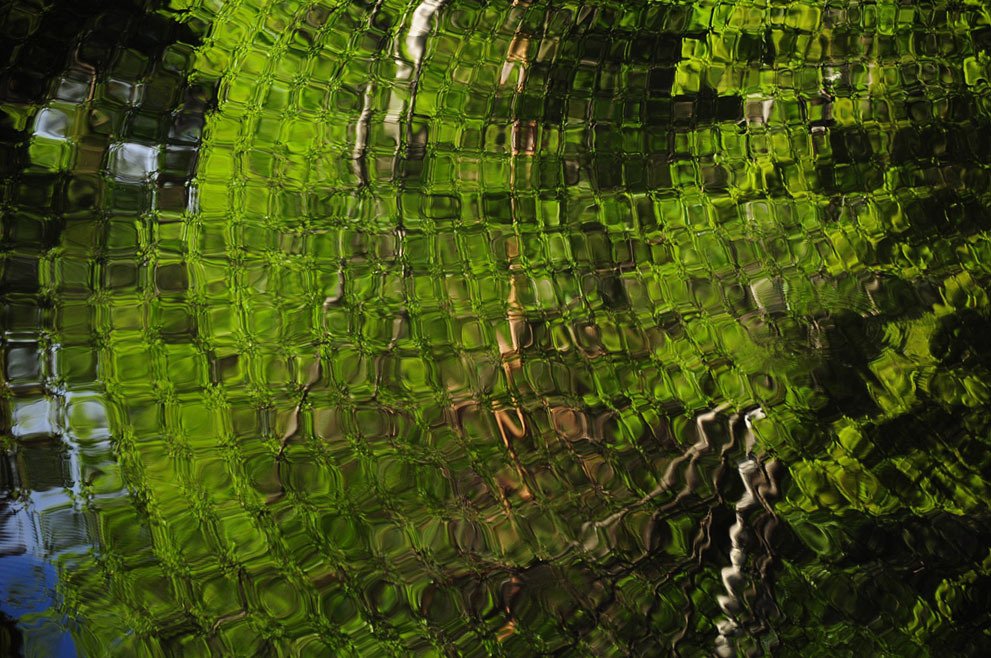
Capillary waves–ripples–interfere with one another after the photographer throws objects into a narrow point in a small lake. The reflections of these waves off the lake’s boundaries and against one another creates a mosaic-like geometric effect on the liquid surface. (Photo credit: Jorgen Tharaldsen/National Geographic Photo Contest)
Month: January 2013

Flame Thrower Physics
This high-speed video–which we do not recommend recreating yourself–features burning gasoline flying through the air. In addition to the sheer entertainment value, there are some neat physics. In the first segment, when they kick a tray of gasoline, one can see lovely fiery vortices forming around the backside of the tray as it’s launched. This is the start of the tray’s wake. In the latter half of the video, they launch the flaming gasoline from a bucket. Notice how the flames are in the wake while liquid gasoline streams out ahead without burning. This is because it is primarily gaseous petrol that is flammable. As the liquid fuel breaks up into droplets heated by the burning gasoline vapors nearby, the rest of the fuel changes to a vapor state and catches flame. (Video credit: The Slow Mo Guys; submitted by Will T)

Lenticular Clouds
Lenticular clouds, such as the one shown above, are stationary lens-shaped clouds that form over a mountain or range of mountains. Moist air is deflected up over the mountain, and, if the temperature at higher altitudes is below that of the dew point, the water vapor in the air can condense, forming a cloud that sits over the peak of the mountain. Once the air traverses the mountain and reaches warmer, lower altitudes on the far side, it will often transition back to a gaseous state. Lenticular clouds are sometimes also called UFO clouds, due to their distinctive shape and the way they seem to hover over a peak. (Photo credit: James Woodcock, Billings Gazette via Associated Press)

