Month: August 2012

  • London 2012: Diving Physics

    London 2012: Diving Physics

    Divers twist and spin gracefully in the air, but the highest marks come when they enter the water with little to no splash. This rip entry–named after paper-ripping sound characteristic of such a dive–is possible thanks to fluid dynamics.  Any time a solid object enters a still liquid, it tears a cavity into the liquid. The smaller this cavity is, the less the liquid will rebound and splash when the cavity gets refilled. In diving, achieving a small splash requires a couple items. First, the diver will grab his hands over his head to form a flat surface. This will create the initial small cavity through which his body follows. When entering, the diver will keep his body straight and rigid, with arms pressed against his head; this adds stability to keep the diver from letting the force of striking the water at 35 mph affect his body’s form and create splash.  Finally, the perfect dive enters vertical to the water surface. This ensures that all of the diver’s body finds its way into that cavity created by the hands without striking any undisturbed water. Once under the water, divers often extend their arms to generate enough drag to slow down quickly.  All in all, the rip entry minimizes the cavity size and thus the splash, adding a great exclamation point to a beautiful dive. (Photo credits: Associated Press, Adam Pretty/Getty Images, Nigel Wade, Jed Jacobsohn)

    FYFD is celebrating the Olympics by featuring the fluid dynamics of sport. Check out our previous posts on how the Olympic torch works, what makes a pool fast, the aerodynamics of archery, the science of badminton, and how cyclists “get aero”.

  • London 2012: Cycling Physics

    London 2012: Cycling Physics

    In no discipline of cycling is more emphasis placed on fluid dynamics than in the individual time trial.  This event, a solo race against the clock, leaves riders no place to hide from the aerodynamic drag that makes up 70% or more of the resistance riders overcome when pedaling. Time trial bikes are designed for low drag and light weight over maneuverability, using airfoil-like shapes in the fork and frame to direct airflow around the bike and rider without separation, which creates an area of low pressure in the wake that increases drag.  Riders maintain a position stretched out over the front wheel of the bike, with their arms close together.  This position reduces the frontal area exposed to the flow, which is proportional to the drag a rider experiences.

    Special helmets, some with strangely streamlined curves, are used to direct airflow over the rider’s head and straight along his or her back. Both helmets and skinsuits are starting to feature areas of dimpling or raised texturing. These function in much the same way as a golf ball; the texture causes the boundary layer, the thin layer of air near a surface, to become turbulent.  A turbulent boundary layer is less susceptible to separating from the surface, ultimately leading to lower drag than would be observed if the boundary layer remained laminar. Wheels, skinsuits, gloves, shoe covers, and even the location of the brakes on the bike are all tweaked to reduce drag.  In an event that can be decided by hundredths of a second between riders, every gram of drag counts. (Photo credits: Stefano Rellandini, POC Sports, Reuters, Paul Starkey, Louis Garneau)

    FYFD is celebrating the Olympics by featuring the fluid dynamics of sports. Check out our previous posts on how the Olympic torch works, what makes a pool fast, the aerodynamics of archery, and the science of badminton.

  • London 2012: Badminton Physics

    London 2012: Badminton Physics

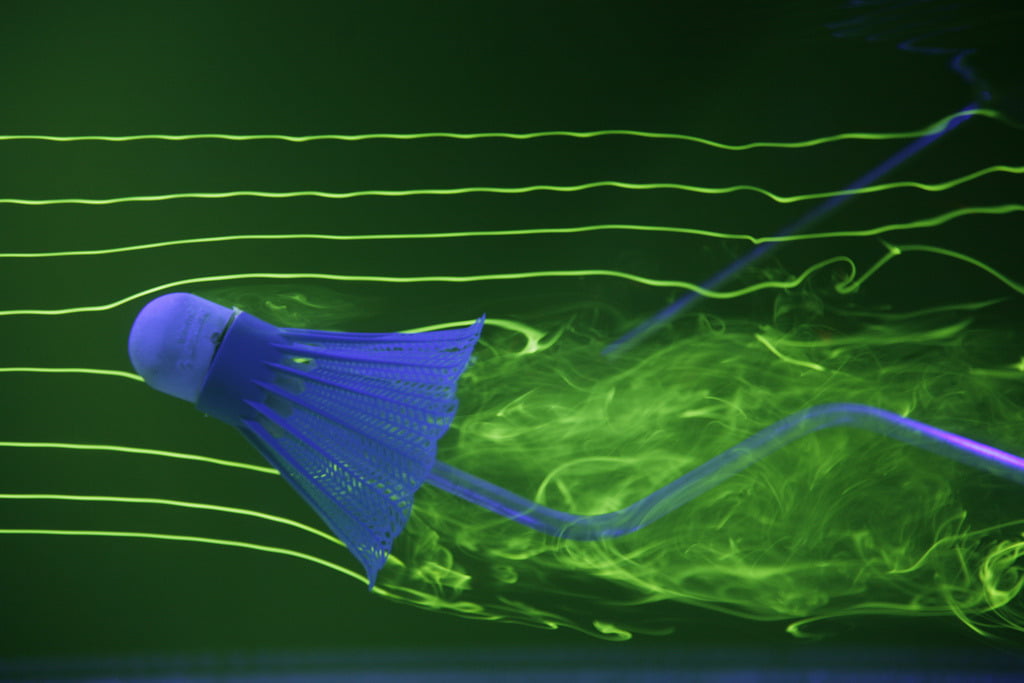
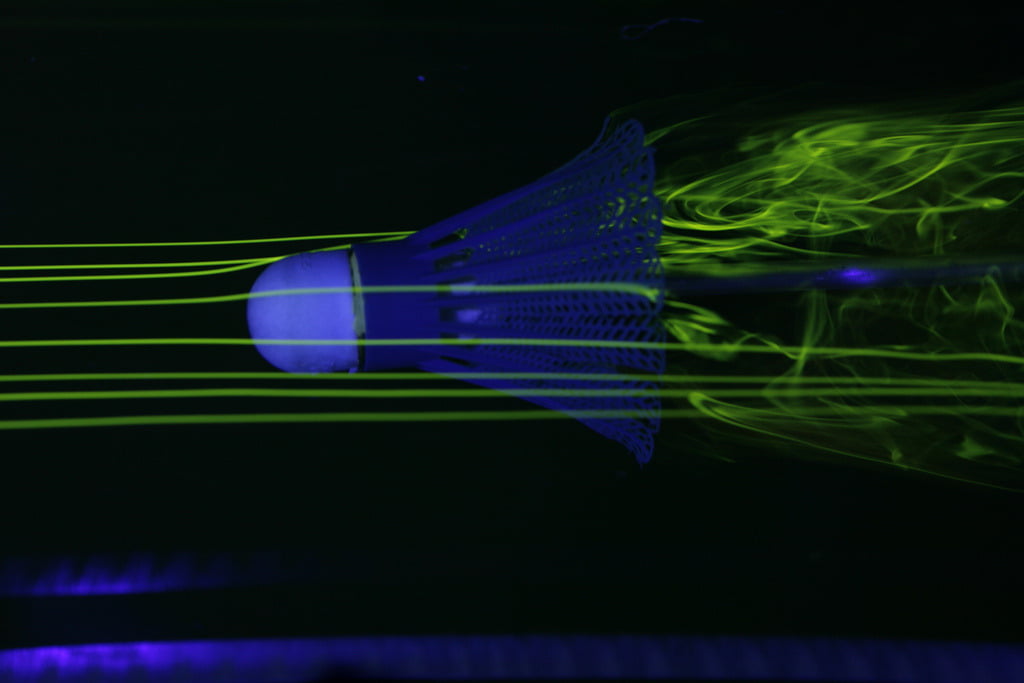
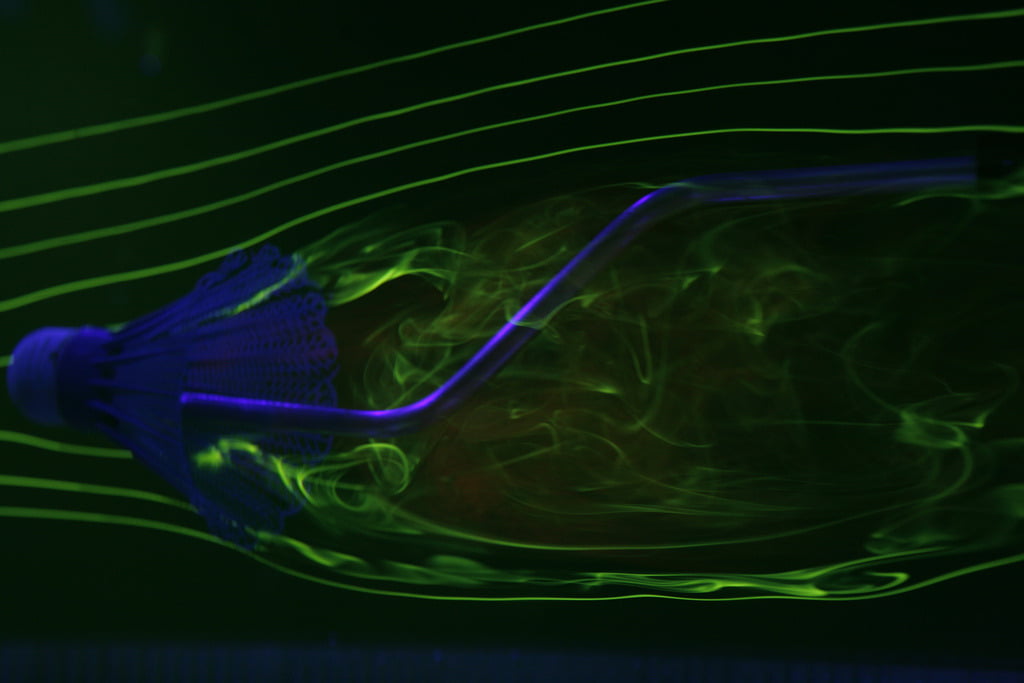
    Unlike most racket sports, badminton uses a projectile that is nothing like a sphere. The unusual shape of the shuttlecock not only creates substantial drag in comparison to a ball but increases the complexity of its flight path. The heavy head of the shuttlecock creates a moment that stabilizes its flight, ensuring that the head always points in the direction of travel. The skirt, traditionally made of feathers though many today are plastic, is responsible for the aerodynamic forces that make the shuttlecock’s behavior so interesting.

    Measuring the drag coefficient of the shuttlecock, modeling its trajectory and behavior in the four common badminton shots, and even attempting computational fluid dynamics of the shuttlecock are all on-going research problems in sports engineering. (Photo credit: Rob Bulmahn)

    FYFD is celebrating the Olympics with the fluid dynamics of sports. Check out our previous posts on how the Olympic torch works, what makes a pool fast, and the aerodynamics of archery.