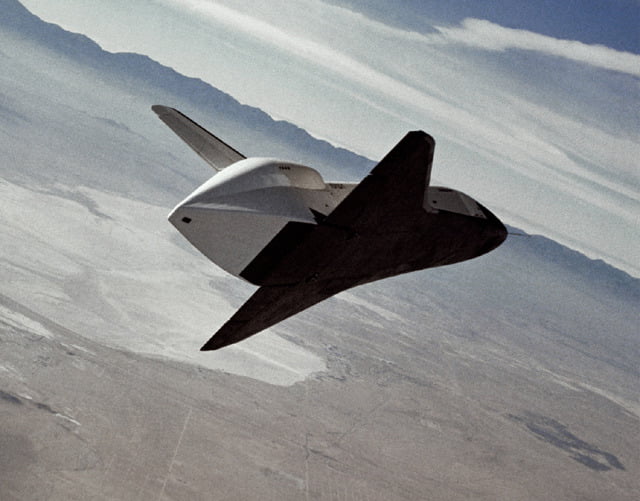
Wind tunnels are great, but there’s nothing like a flight test to learn about the aerodynamics of a new vehicle. Today in 1977, the space shuttle prototype Enterprise flew on its own for the first time. Enterprise was built purely to test the shuttle’s aerodynamic behavior during gliding and landing. Check out this video of one of Enterprise’s gliding and landing tests.
Year: 2010

Un-mixing a Flow
Laminar flow (as opposed to turbulence) has the interesting property of reversibility. In this video, physicists demonstrate how flow between concentric cylinders can be reversed such that the initial fluid state is obtained (to within the limits of molecular diffusion, of course!)
For more examples, see the first half of this video.
Floating on an Invisible Sea
Many gases may be invisible to the human eye, but that doesn’t make them the same. Sulfur hexafluoride is more than 5 times as dense as air at standard conditions, which lends itself to some fun demonstrations.
The Weissenberg Effect
Non-Newtonian fluids exhibit all kinds of odd behaviors, even climbing up a spinning rod! This is known as the Weissenberg effect and is associated with polymers in the fluid.
Bouncing into a Pool
Here is another take on what happens when a drop of water falls into a larger pool.

Automotive Wind Tunnels
Wind tunnels have been a staple of aerodynamics since the Wright brothers built one to help them test wing shapes for their gliders and airplanes. The GM Aerodynamics Laboratory’s much larger wind tunnel, pictured above, tests full-sized vehicles’ aerodynamics. It is the largest automotive wind tunnel and has been in operation since August 1980. GM estimates that it has cut the coefficient of drag on vehicles by approximately 25% in that time. The tunnel can reach speeds near 125 mph, as one hapless reporter discovered firsthand. (Submitted by @Vinnchan)
Ferrofluid Art
Magnetism and fluid dynamics collide with ferrofluids! Ferrofluids are a suspension of ferrous material in oil or water, but their behavior around magnets can elevate them into a work of art (or a car commercial). Why leave it to professionals, though, when you can make your own ferrofluid?
Fizziness in Space
Removing gravity has interesting effects on fluids. Here an astronaut aboard the ISS demonstrates what happens when Alka-Seltzer is added to water in microgravity.
Can a Squid Fly?
Evidence is mounting that several kinds of squid will use jets of water to propel themselves into the air where they can actively fly some 50 times their body length.

Turbulent Mixing in the Gulf
Sediments carried by rivers and stirred from the shallows meet the Gulf of Mexico in a vivid display of turbulent mixing. Although turbulence is not well-understood, it is a process vital to our lives. Without turbulence, it would take days for molecular diffusion to mix milk into your coffee! #


