Tag: meteor

  • Featured Video Play Icon

    Tektites and Spinning Fluids

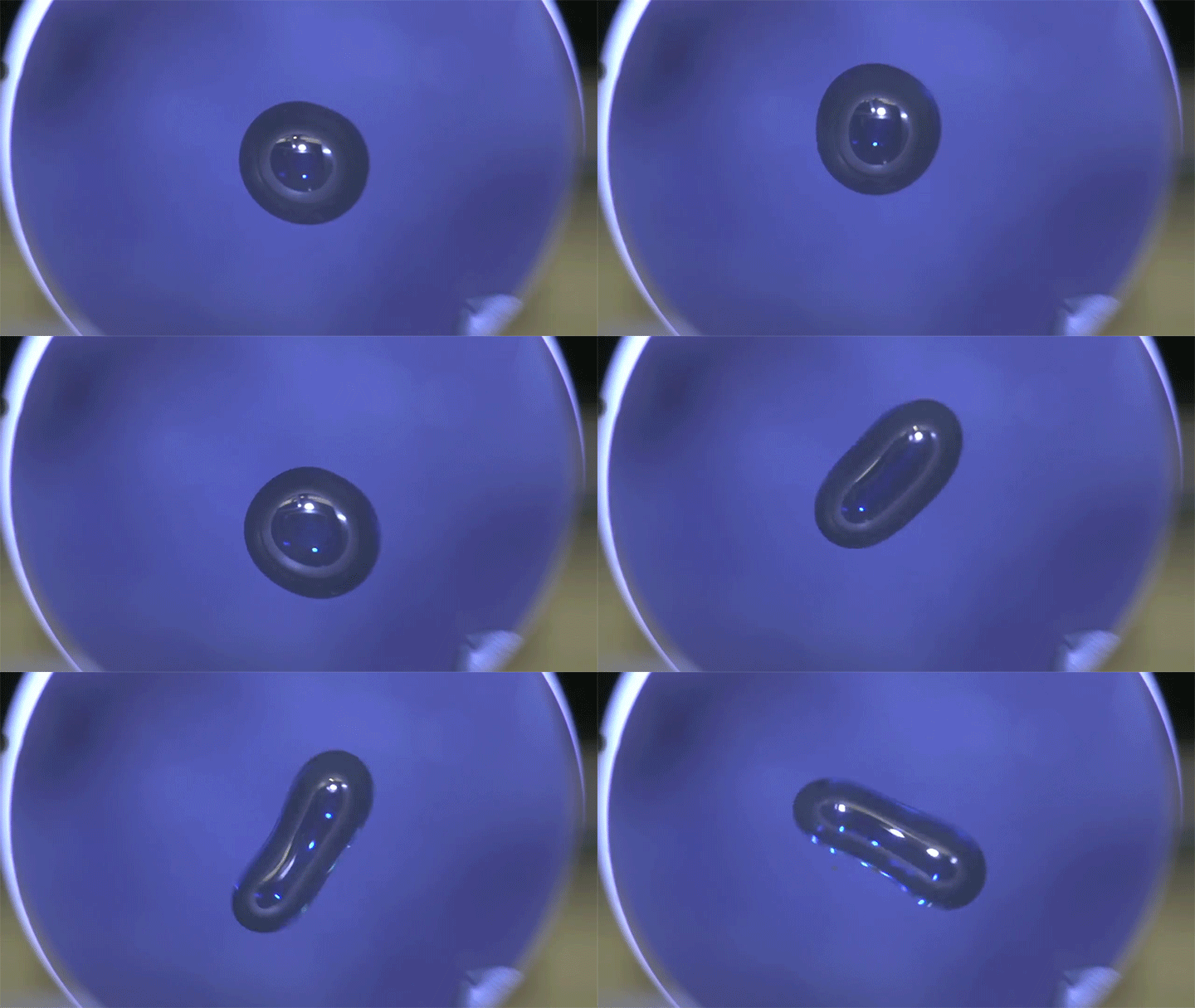
    Tektites, like obsidian, are a naturally-occurring glass formed from molten rock. But tektites are often dumbbell or figure-8-shaped because they form in midair from spinning bits of fluid sent skyward after the crash of a meteor. In this video, Steve Mould takes us through the process and discusses some recent work by scientists who’ve created artificial tektites in the lab by levitating and spinning candle wax and other fluids. (Video and image credit: S. Mould; research credit: K. Baldwin et al.)

  • Featured Video Play Icon

    Understanding Meteorite Geometry

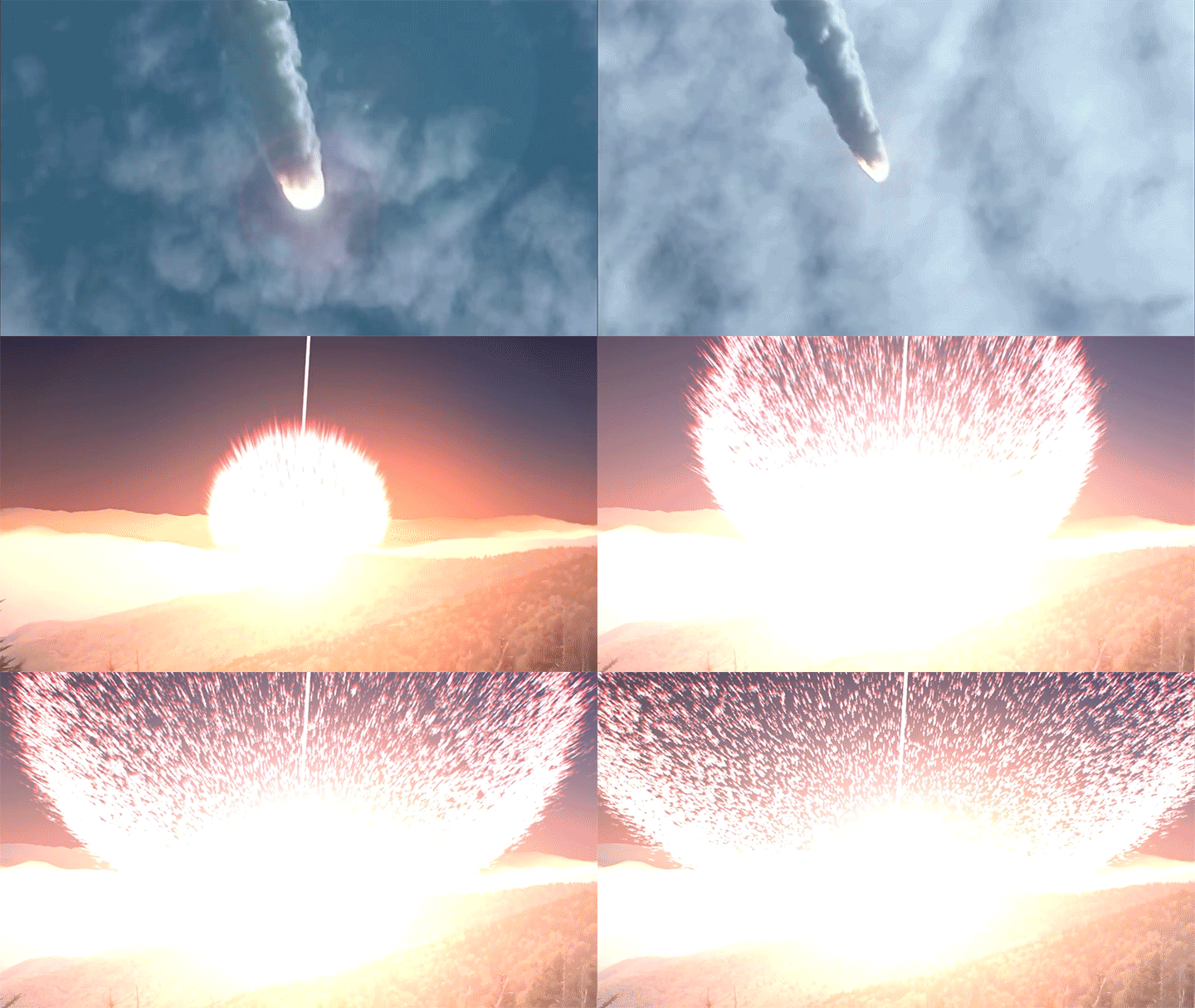
    Back in February 2013, the skies over Russia were lit by the fall and explosion of a large meteor. The scavenger hunt for meteorite pieces that followed turned up lots of conically-shaped chunks of rock, consistent with other meteors. Why do so many meteorites end up in this shape? There are a couple factors influencing it.

    The first is that erosion during flight tends to shape initially spherical meteor chunks into broad cones. And that shape, it turns out, is remarkably stable in flight. By dropping cones of various geometries, researchers can test how stable they are in flight: do they change orientation, flutter back and forth, or drop straight down? Slender cones (below) tend to invert and tumble. Very broad cones flutter back and forth as they fall. But for an intermediate cone angle – similar to the one found in meteorites – the cones stay perfectly oriented, so once the rock erodes into that cone, it will keep that shape. (Image and video credit: K. Amin et al.)

  • Prehistoric Seiche

    Prehistoric Seiche

    Sixty-six million years ago, a meteorite impact in modern-day Mexico wiped out the dinosaurs and most other living species of the time. To call the event catastrophic feels like an understatement. At the site of impact, rocks and animals were vaporized. Further away, molten rock condensed into glass beads that form a geological layer found around the world.

    Still further away, in what is now North Dakota and was then the bank of a freshwater river, scientists have discovered a deposit full of saltwater fish, sharks, and rays that would have lived in the vast inland sea (A) that stretched northward from Texas. The meteorite’s impact pushed these creatures kilometers upstream against the river’s natural flow.

    One possible explanation for the inundation is a tsunami. But geological evidence indicates the deposit took place within 15 minutes to two hours of the impact, when glass beads were still raining down. To travel the 3,000 km from the point of impact would take a tsunami on the order of 18 hours – far too long.

    Instead, the deposit is likely the result of a seiche (pronounced “saysh”) – a type of standing wave that occurs in an enclosed or partially enclosed body of water. If you imagine water sloshing in a cup or a tub, that’s essentially what a seiche is, but this was on a much larger scale. (For an example, check out this insane footage of an earthquake-induced seiche in a swimming pool.)

    What set the seiche to sloshing are the seismic waves triggered by the meteorite impact. They would have reached this site 6-13 minutes after the impact and triggered waves on the order of 10m. As the waves drove up the riverways, they carried dead and dying sea creatures with them, leaving them stranded on the riverbank until scientists uncovered them tens of millions of years later. (Image and research credit: R. DePalma et al.; via The Conversation; submitted by Kam-Yung Soh)

  • Exploding Meteors

    Exploding Meteors

    During the recent Perseid shower, photographer Petr Horálek caught an awesome timelapse of an exploding meteor and the vortex ring it created. This is a type of persistent train left when meteors pass through the upper atmosphere. The exact physics are not well understood because such events are difficult to observe; catching them at all is basically just happenstance. But one interpretation is that we’re seeing trails of plasma left by the ionization of parts of the meteor. When the meteor hits the upper atmosphere, there’s an extremely strong hypersonic shock wave. The jump in temperature across that shock wave is enough to pull atoms apart, creating a plasma. The train left by this meteor’s demise was faintly visible even an hour after the fireball. (Image credit: P. Horálek, video version; via APOD; submitted by Andrea S.)

  • Meteoroids

    Meteoroids

    Meteoroids are debris from earlier eras in our solar system. They can be leftovers from planets that never formed or remains of ancient collisions. When these bits rock and metal enter our atmosphere, they become meteors. Since they travel at speeds of several kilometers per second, they create incredibly strong shock waves off their bow once they’re in the atmosphere. These shock waves are so strong that they rip the air molecules apart and create a hot plasma that can scorch the outside of the meteor. That plasma also glows, which is why meteors look like a streak of light from the ground. Any remains that make it to the ground are known as meteorites, and they have some pretty awesome features. Check out the full Brain Scoop episode below to learn some of the typical (and not so typical!) characteristics of meteorites. (Image and video credit: The Brain Scoop/Field Museum)

  • Break-Up of the Chelyabinsk Meteor

    Break-Up of the Chelyabinsk Meteor

    In 2013, a meteor about 20-meters in diameter broke up over Chelyabinsk, Russia in a dramatic display that damaged buildings within 100 km and injured more than 1200 people. To better understand the threat presented by such objects, NASA has been conducting 3D, hypersonic simulations like the one shown here. The meteor material is shown in gray and black. Brighter colors like red and yellow indicate the hot, high-pressure shock wave caused when the meteor slams into the atmosphere. Aerodynamic effects quickly erode the meteor, ripping it into pieces that disperse energy explosively in the atmosphere. While you might think the meteor breaking up is good for us, it’s actually the blast waves from its break-up that cause the most damage.  (Image and video credit: NASA, source; via Gizmodo)

  • The Chelyabinsk Meteor

    The Chelyabinsk Meteor

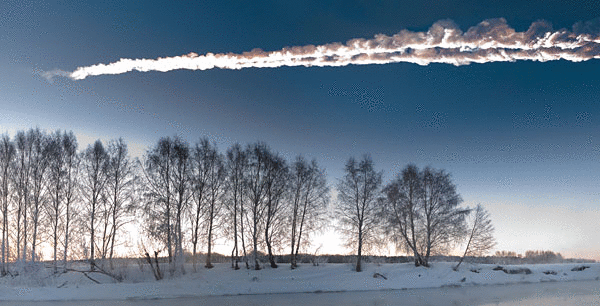
    In February 2013 a meteor streaked across the Russian sky and burst in midair near Chelyabinsk. A recent Physics Today article summarizes what scientists have pieced together about the meteor, from its origins to its demise. The whole article is well worth reading. Here’s a peek:

    The Chelyabinsk asteroid first felt the presence of Earth’s atmosphere when it was thousands of kilometers above the Pacific Ocean. For the next dozen minutes, the 10 000-ton rock fell swiftly, silently, and unseen, passing at a shallow angle through the rarefied exosphere where the molecular mean free path is much greater than the 20-m diameter of the rock. Collisions with molecules did nothing to slow the gravitational acceleration as it descended over China and Kazakhstan. When it crossed over the border into Russia at 3:20:20 UT and was 100 km above the ground, 99.99997% of the atmosphere was still beneath it.

    Because the asteroid was moving much faster than air molecules could get out of its way, the molecules began to pile up into a compressed layer of high-temperature plasma pushing a shock wave forward. Atmospheric density increases exponentially with depth, so as the asteroid plunged, the plasma layer thickened and its optical opacity rapidly increased. About one second later, at 95 km above the surface, it became bright enough to be seen from the ground. That was the first warning that something big was about to happen. #

    How often are scientific articles that gripping?! Kring and Boslough provide some excellent descriptions of the aerodynamics of the meteor and its airburst. Be sure to check it out. (Photo credit: M. Ahmetvaleev; paper credit: D. Kring and M. Boslough; via io9)