Tag: veritasium

  • Featured Video Play Icon

    Magnus Effect

    Putting a little bit of spin on an object can have a big aerodynamic effect, thanks to the Magnus effect. As demonstrated in the video above, backspin on a basketball dropped from a big height will send it flying out and away. The reason spinning objects generate these counterintuitive motions is because the air flow over them creates differential pressures. On the side of the ball spinning with the flow, air is accelerated, dropping the local pressure; whereas on the opposite side, the ball spinning against the direction of flow makes the flow separate and no longer flow smoothly along that side. This causes a high pressure on that side. Like the difference in pressure on either side of an airfoil, the pressure difference across the ball creates a force that pushes the ball toward the low pressure side. Check out some of the other places Magnus effect shows up!  (Video credit: Veritasium; submitted by Andrew C.)

    ——————

    Help us do some science! I’ve teamed up with researcher Paige Brown Jarreau to create a survey of FYFD readers. By participating, you’ll be helping me improve FYFD and contributing to novel academic research on the readers of science blogs. It should only take 10-15 minutes to complete. You can find the survey here.
  • Coriolis

    Coriolis

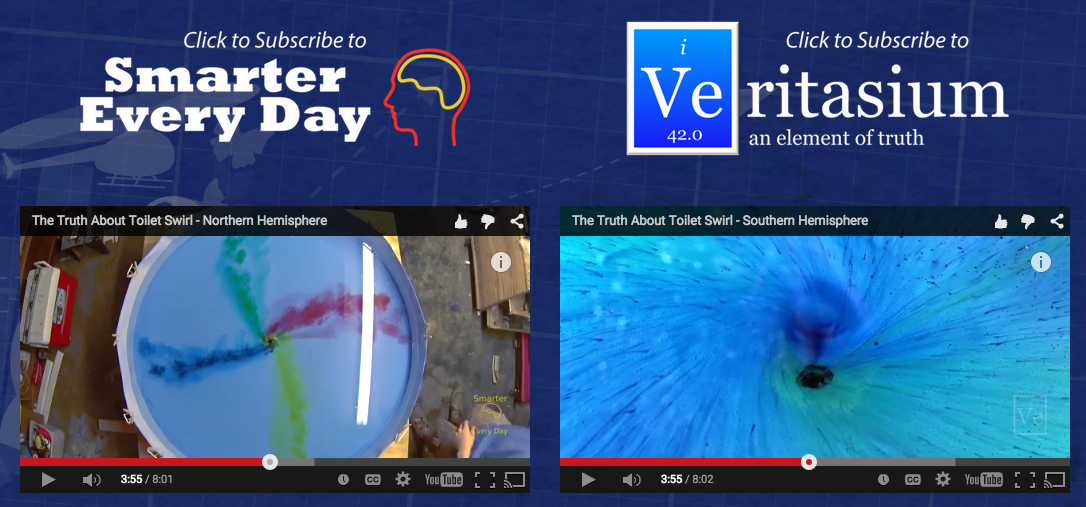
    There’s an infamous supposition about drains swirling one way in the Northern Hemisphere and the other way in the Southern Hemisphere. Destin from Smarter Every Day and Derek from Veritasium have put the claim to the test with experiments on either side of the globe. First, go here and watch their synchronized videos side-by-side. (To synchronize, start the left video and pause it at the sync point. Then start the second video and unpause the first video when the second video hits the sync point.) I’ll wait here.

    That was awesome, right?! The demonstration doesn’t work with toilets because they’re driven by the placement of jets around the circumference. And your bathtub doesn’t usually work either because any residual vorticity in the tub gets magnified by conservation of angular momentum as it drains. It’s like a spinning ice skater pulling their arms in; the rotation speeds up. So, to get around that problem, Destin and Derek let their pools sit for a day to damp out any motion before draining. At that point, the Coriolis effect is strong enough to cause the pools to rotate in opposite directions when drained. You may wonder why the effect is so slight for the pools when it’s pretty stark with hurricanes and cyclones. The answer is a matter of scale. The pools are perhaps 2 meters wide, which means that the difference in latitude across the the pool is very slight and therefore, the differential speed imparted by the Earth’s rotation is also very small. Because hurricanes and cyclones are much larger, they experience stronger influence from the Coriolis effect. (Image credits: Smarter Every Day/Veritasium; via It’s Okay To Be Smart)

  • Featured Video Play Icon

    Rubens’ Table

    Veritasium’s new video has an awesome demonstration featuring acoustics, standing waves, and combustion. It’s a two-dimensional take on the classic Rubens’ tube concept in which flammable gas is introduced into a chamber with a series of holes drilled across the top. Igniting the gas produces an array of flames, which is not especially interesting in itself, until a sound is added. When a note is played in the tube, the gas inside vibrates and, with the right geometry and frequency, can resonate, forming standing waves. The motion of the gas and the shape of the acoustic waves is visible in the flames. Extended into two-dimensions, this creates some very cool effects. (Video credit: Veritasium; via Ryan A.; submitted by jshoer)