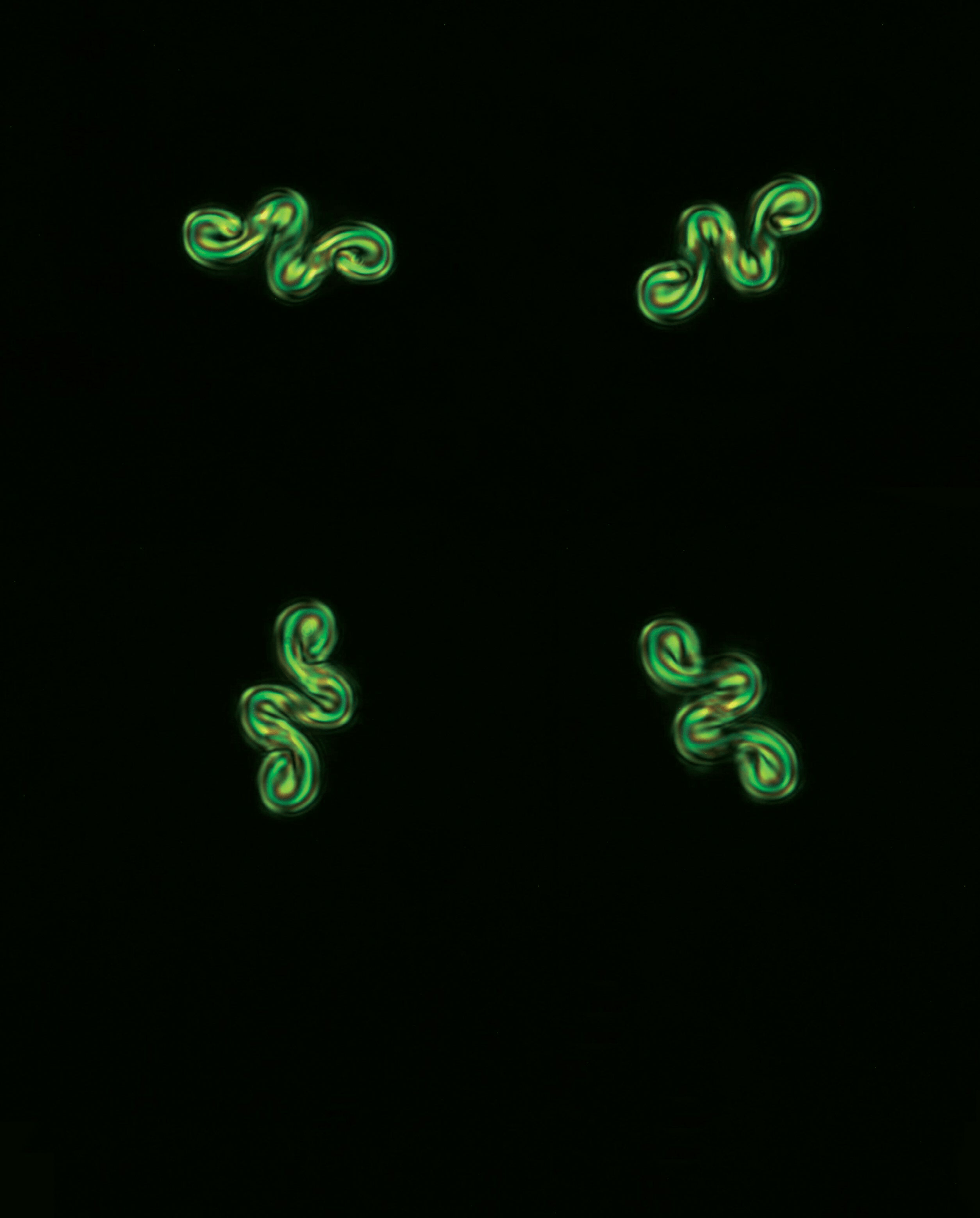
Möbius strips are nonintuitive objects. They appear multi-dimensional but are single-sided. Such topologies show up in other systems, too. Here we see a liquid crystal where molecular alignments, along with vortices in the fluid, result in tiny, three-dimensional shapes nicknamed “möbiusons,” thanks to their unusual properties. Each one is about 10 μm long. The researchers found that these möbiusons can spontaneously fold into many configurations. But under an electrical field, the möbiusons can self-propel and remain stable through many motions, including rotation. Such behaviors could be useful for transporting nano-sized cargo. (Image and research credit: H. Zhao et al.; via Physics Today)
Tag: topology

Active Foam


Geometrically, biological tissues and two-dimensional layers of foam share a lot of similarities. To try and understand how active changes in one cell affect neighbors, researchers are studying how foams shift when air is injected (below) at one or more sites. When a foam cell expands, it forces topological changes in neighboring cells, which researchers built an algorithm to track in real-time.
With some processing, they can actually visualize the radially-expanding waves of strain that pass through the foam (bottom image). This allows them to visualize the effects and interaction of multiple injection sites at once, hopefully helping unlock the mechanics behind both the foam’s shifts and those that occur in tissues. (Image and video credit: L. Kroo and M. Prakash)
Effects of Hills on Flow
Hills and other topology can have interesting and complex effects on a flowfield. With the FAITH experiment, NASA has been investigating an axisymmetric model hill using a combination of experimental methods. The video above shows flow visualization over the hill in a water channel using dye injection both upstream and downstream of the model. They’ve also done wind tunnel tests with oil-flow visualization, particle-image velocimetry, pressure sensitive paint and other measurement techniques. There are nice photos of some of these by Rob Bulmahn. By combining qualitative and quantitative flow measurement techniques, the researchers are able to capture many different aspects of the flow, which can then be shared and compared with other groups’ works. (Video credit: NASA Ames Research Center)
