
Tag: stress

  • Ultra-Soft Solids Flow By Turning Inside Out

    Ultra-Soft Solids Flow By Turning Inside Out

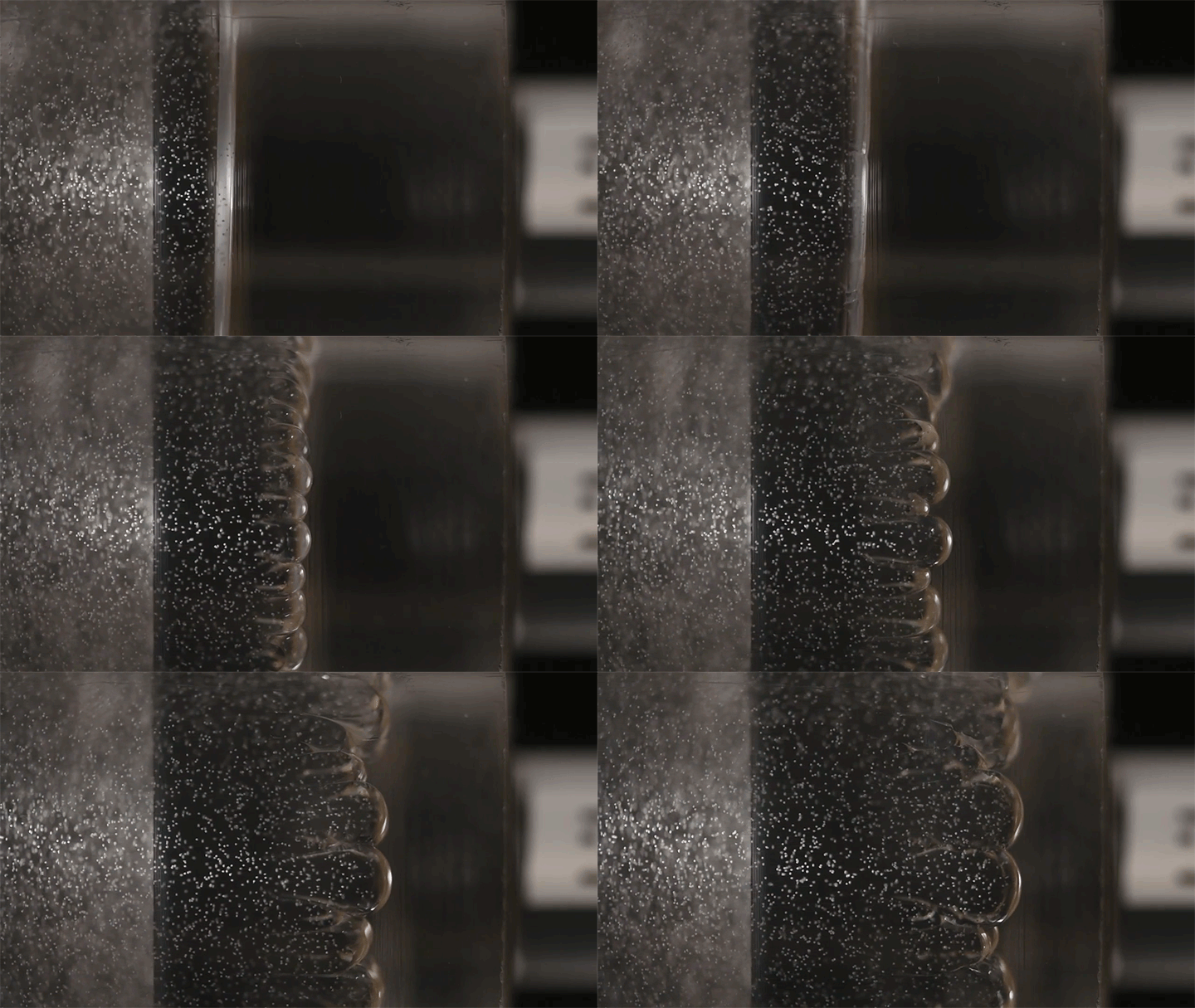
    Can a solid flow? What would that even look like? Researchers explored these questions with an ultra-soft gel (think 100,000 times softer than a gummy bear) pumped through a ring-shaped annular pipe. Despite its elasticity — that tendency to return to an original shape that distinguishes solids from fluids — the gel does flow. But after a short distance, furrows form and grow along the gel’s leading edge.

    Front view of an ultra-soft solid flowing through an annular pipe. The furrows forming along the face of the gel are places where the gel is essentially turning itself inside out.
    Front view of an ultra-soft solid flowing through an annular pipe. The furrows forming along the face of the gel are places where the gel is essentially turning itself inside out.

    Since the gel alongside the pipe’s walls can’t slide due to friction, the gel flows by essentially turning itself inside out. Inner portions of the gel flow forward and then split off toward one of the walls as they reach the leading edge. This eversion builds up lots of internal stress in the gel, and furrowing — much like crumpling a sheet of paper — relieves that stress. (Image and research credit: J. Hwang et al.; via APS News)

    Fediverse Reactions
  • Featured Video Play Icon

    Fano Flow

    Adding polymers to fluids can lead to strangely counter-intuitive behavior. Here two examples of bizarre extensional flow, sometimes called Fano flow, are shown. First, in the “tubeless siphon” fluid is drawn into a syringe from the level of the free fluid surface.  When the syringe is raised above the free surface of the fluid, the polymer-laden fluid continues to flow upward and into the syringe.  A similar effect is shown in the “open channel siphon” where, once initiated, the flow up and over the side of a beaker continues after the free surface of the fluid has fallen below the level of the beaker’s spout. In both of these cases, the cross-linking and entanglement of polymers within the fluid makes it capable of exerting normal stress when extensionally strained (e.g. stretching a rubber band). In other words, when the syringe is drawn out of the pool, the stretching of the fluid causes the polymers to exert a force that counteracts the weight of the fluid column, enabling the flow to continue upward despite gravity.