Tag: self-propulsion

  • Ice Discs Surf on Herringbones

    Ice Discs Surf on Herringbones

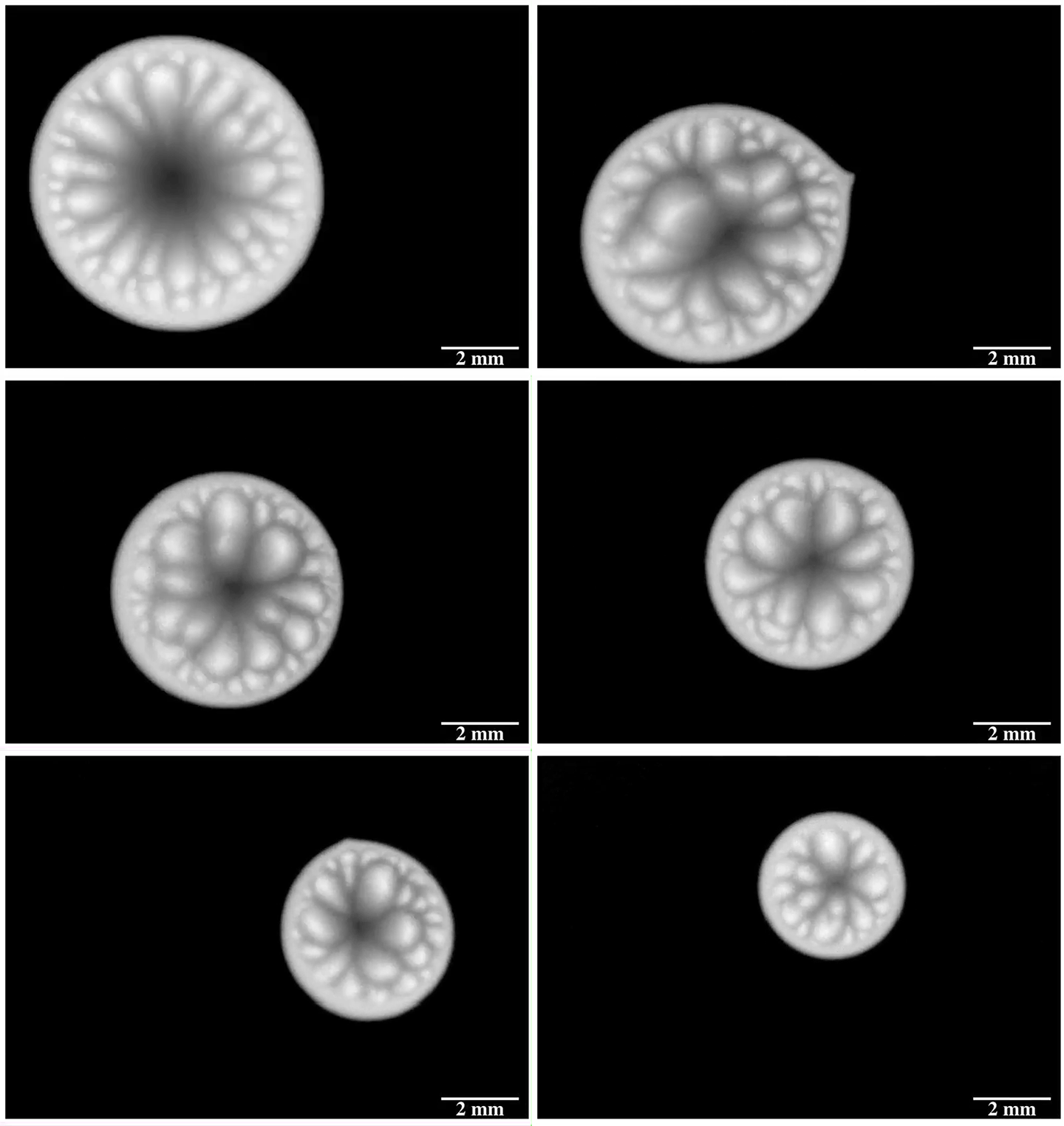
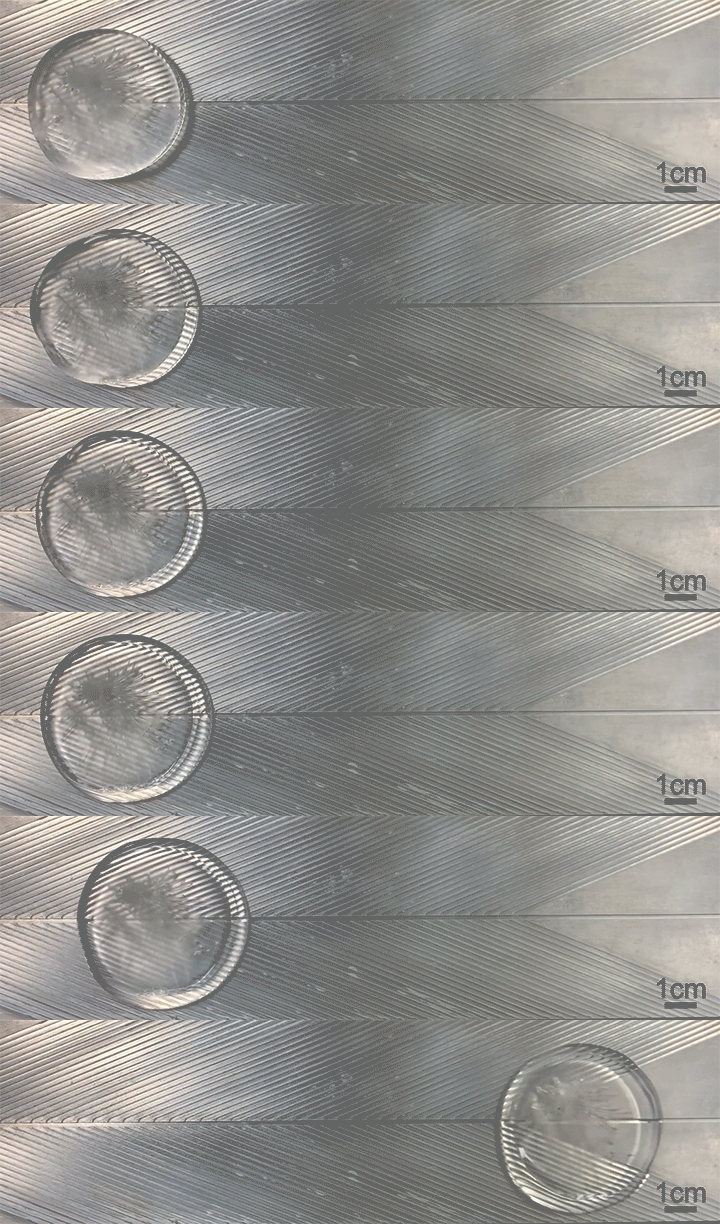
    Inspired by the roaming rocks of Death Valley, researchers went looking for ways to make ice discs self-propel. Leidenfrost droplets can self-propel on herringbone-etched surfaces, so the team used them here, as well. On hydrophilic herringbones, they found that meltwater from the ice disc would fill the channels and drag the ice along with it.

    But on hydrophobic herringbone surfaces, the ice disc instead attached to the crest of the ridges and stayed in place–until enough of the ice melted. Then the disc would detach and slingshot (as shown above) along the herringbones. This self-propulsion, they discovered, came from the asymmetry of the meltwater; because different parts of the puddle had different curvature, it changed the amount of force surface tension exerted on the ice. Thus, when freed, the ice disc tried to re-center itself on the puddle.

    The team is especially interested in how effects like this could make ice remove itself from a surface. After all, it requires much less energy to partially melt some ice than it does to completely melt it. (Image and research credit: J. Tapochik et al.; via Ars Technica)

    Fediverse Reactions
  • Skittering Drops

    Skittering Drops

    Drip some ethanol on a hot surface, and you’d expect it to spread into a thin layer and evaporate. But that doesn’t always happen, and a recent study looks at why.

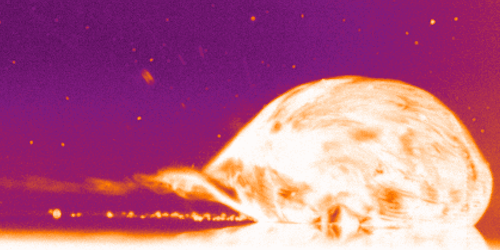
    Ethanol is what’s known as a volatile liquid, meaning that it evaporates easily at room temperatures, well below its boiling point. When dropped on a uniformly heated surface above 45 degrees Celsius, the drop contracted into a hemisphere and then began to wander randomly across the surface. Researchers trained an infrared camera on the drop from below (above image), and found an unsteady, roiling motion inside the drop. These asymmetric flows, they concluded, drive the drop’s erratic self-propulsion. They suspect the mechanism may explain why some ink droplets wind up in the wrong place on a page during ink-jet printing. (Image and research credit: P. Kant et al.; via APS Physics)

  • Swarm of Surfers

    Swarm of Surfers

    Self-propelled objects can form fascinating patterns. Here, researchers investigate how small plastic “surfers” move on a vibrating fluid. Each surfer is heavier in its stern than its bow. When the fluid vibrates, the surfer creates waves that are asymmetric — deeper in the stern than at the bow. For single surfers, this imbalance propels the surfer in the direction of its bow. But with more than one surfer, other patterns form.

    The video demonstrates five of the seven patterns pairs of surfers exhibit.
    The video demonstrates five of the seven patterns pairs of surfers exhibit.

    The team looked at groups of surfers all the way up to eight members. Among pairs, the researchers found seven distinctive patterns, including orbiting groups, tailgaters, and promenading pairs. Larger groups, they found, had similar collective behaviors. They hope their surfers will be an easily accessible platform for exploring active matter. (Image and research credit: I. Ho et al.; via APS Physics)

  • Rocket-Like Supercooled Drops

    Rocket-Like Supercooled Drops

    Many droplets can self-propel, often through the Leidenfrost effect and evaporation. But now researchers have observed freezing droplets that self-propel, too. The discovery came when observing the freezing of supercooled water drops inside a vacuum chamber. The researchers kept losing track of drops that seemingly disappeared. Upon closer inspection, though, they found that the drops weren’t shattering; they were flying away as they froze.

    Inside a drop, freezing starts at a point, the nucleation point, and spreads from there. But the nucleation point isn’t always at the center of the drop. This asymmetry, the researchers found, is at the heart of the drop’s propulsion. When ice nucleates, the phase change releases heat that increases the drop’s evaporation rate, which can impart momentum to the drop. For an off-center nucleation, that momentum is enough to send the drop shooting off at nearly 1 meter per second. (Image credit: SpaceX; research credit: C. Stan et al.; via APS Physics)

  • Sliding Along

    Sliding Along

    Robust, self-cleaning surfaces are a holy grail for many engineers, but they’re tough to achieve. One necessary ingredient for a self-cleaning surface is the ability to shed water, which is why superhydrophobic coatings and surface treatments are popular. Here, researchers prompt their droplets to move at speeds up to 16 cm/s by dropping them onto a thin layer of heated oil.

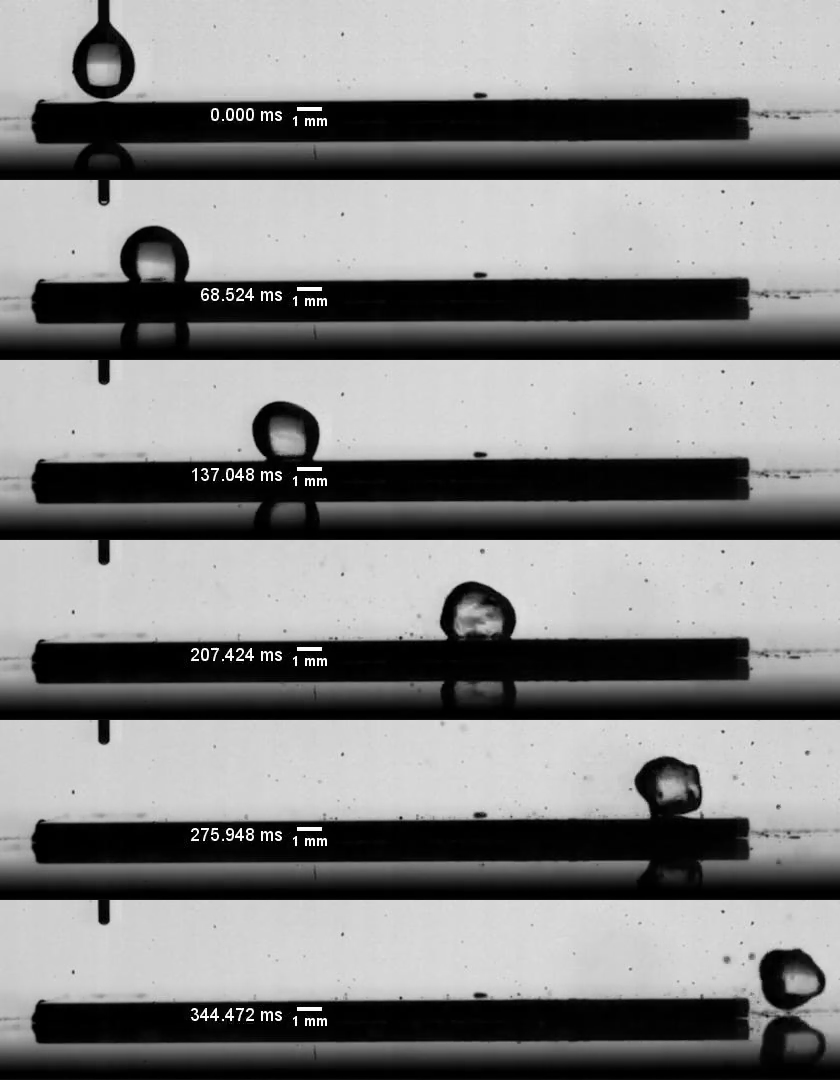
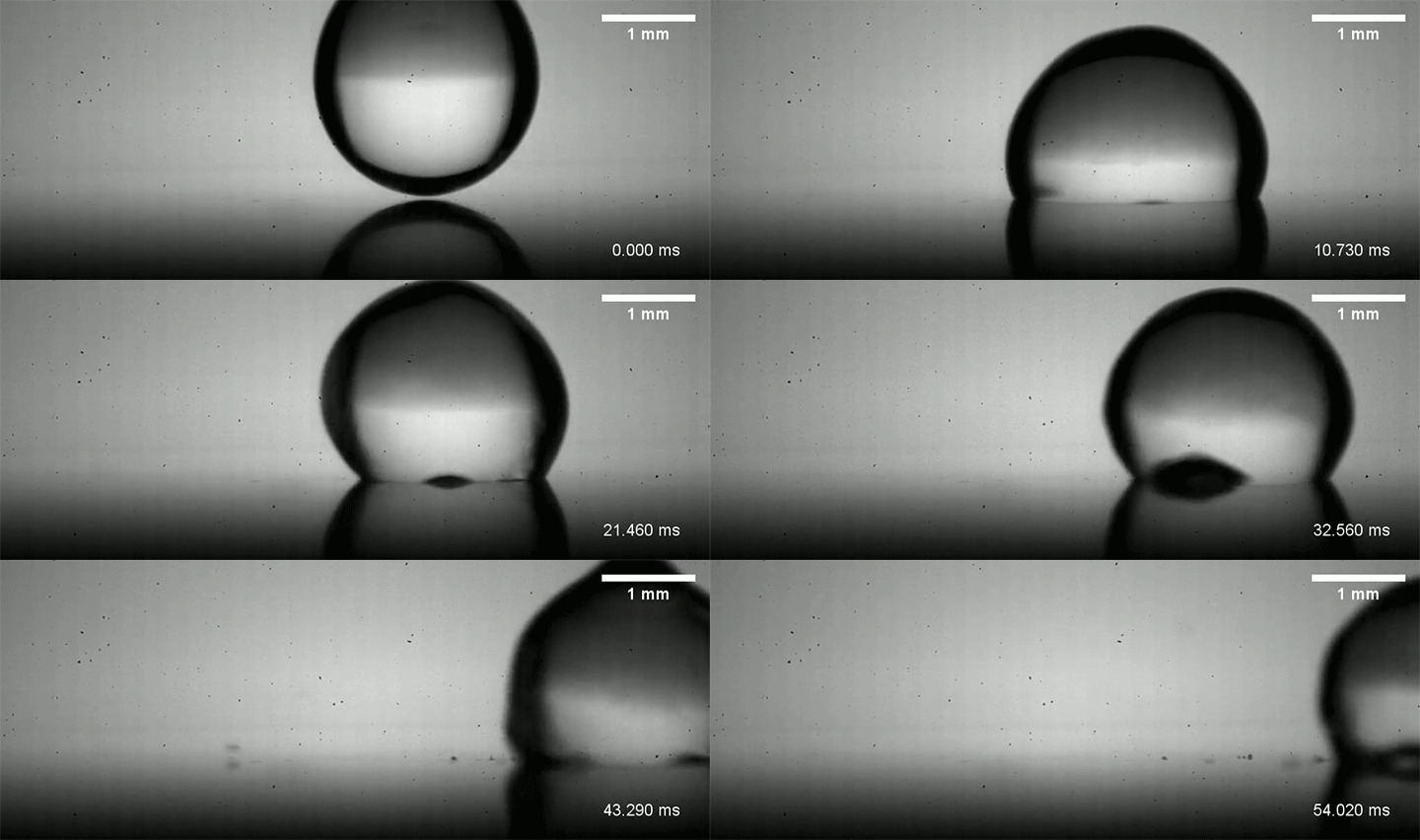
    Longtime readers will no doubt be reminded of self-propelling Leidenfrost drops, but this situation is not quite the same. In general, the oil layer suppresses the Leidenfrost effect. Instead, the oil heats the drop, evaporating its vapor. A bubble of vapor will nucleate at a random location in the droplet and eject itself, pushing the drop in the opposite direction. Because of the disruption caused by that ejection, new bubbles will preferentially form at the same spot, providing an ongoing supply of vapor that keeps the drop sliding in the same direction. It’s like a miniature rocket zooming along the oil film! (Image and research credit: V. Leon and K. Varanasi; via APS Physics)

  • Taking A Turn

    Taking A Turn

    Water droplets immersed in a mixture of oil and surfactants will move about, propelled by the Marangoni effect. Surfactant molecules congregate along the interface between the water and oil, but they do not do so uniformly. This uneven grouping causes variations in the surface tension, which in turn creates flows inside the droplet from areas of low surface tension to ones with higher surface tension. Those internal flows then dictate how the droplet as a whole moves.

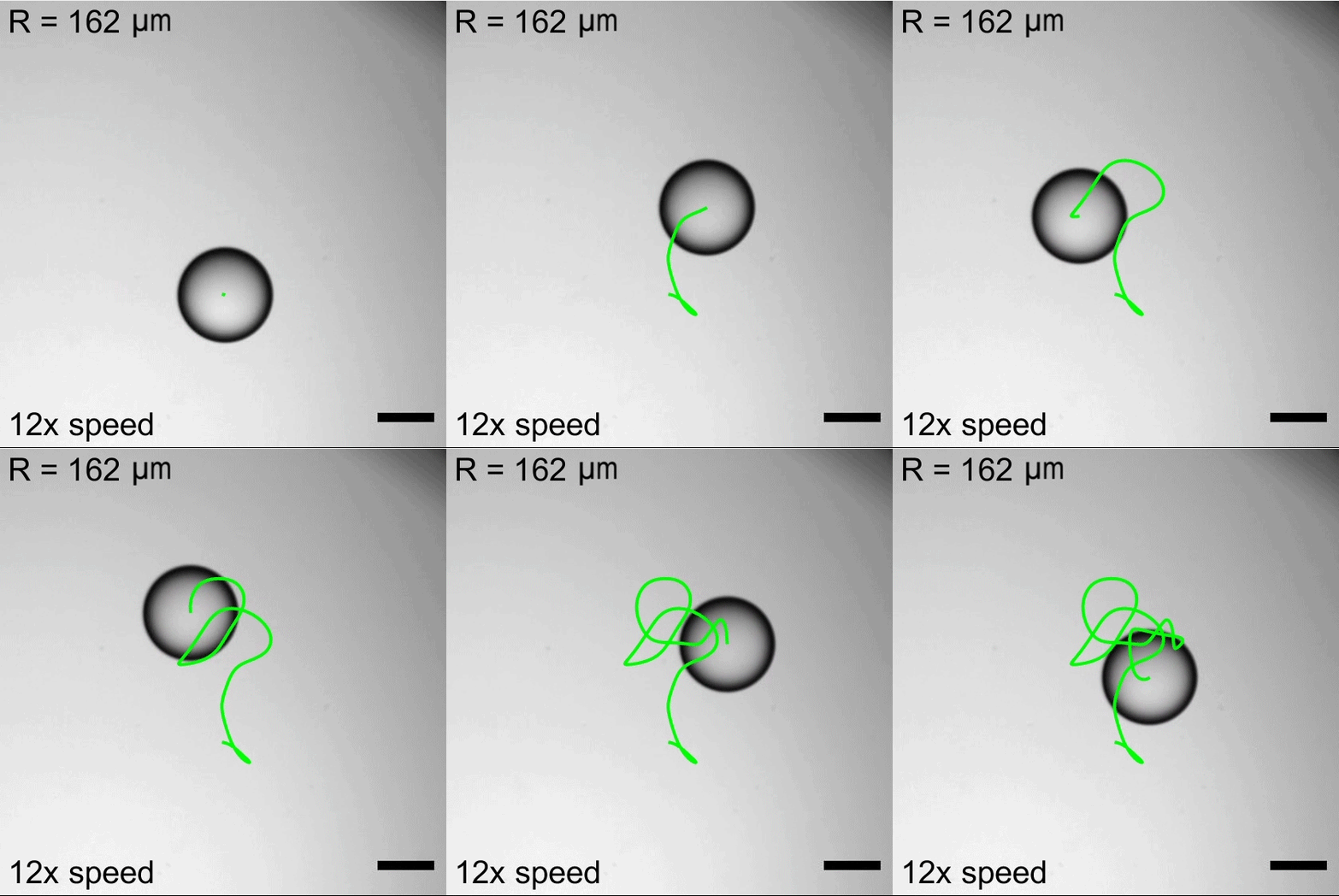
    Researchers found that droplet trajectories in these systems depend on the droplet’s size. Small droplets move in relatively straight lines, whereas larger droplets take highly curved paths. The difference comes from the way surfactants get distributed around the drop’s interface. Larger drops are more sensitive to shifts in surfactant location, making them more prone to take changeable, curving paths. (Image credits: top – P. Godfrey, others – S. Suda et al.; research credit: S. Suda et al.; via APS Physics)

  • Featured Video Play Icon

    Collective Motion in Grains

    Flocks of birds and schools of fish swarm in complicated collective motions, but groups of non-living components can move collectively, too. In this Lutetium Project video, we learn about grains that, when vibrated, self-propel and form complex collective motions similar to those seen in groups of living organisms.

    A key feature of the grains is their lack of symmetry. To be self-propelling, they must have a well-defined orientation, defined by a different front and back. The grains also have the freedom to move in a direction that is not the same as the direction they’re oriented in. This allows the grains to rotate, which enables them to perform the large-scale motions seen in the experiments. (Video and image credit: The Lutetium Project; research credit: G. Briand et al.)

  • Featured Video Play Icon

    Fizzy Droplets

    Leidenfrost drops surf on a layer of their own vapor, created by the high temperature of a nearby surface relative to their boiling point. These Leidenfrost drops can self-propel and skitter and skate across a surface, but they’re not the only droplets that do this. In this video, researchers show how a drop of carbonated water on a superhydrophobic (water-repelling) surface also avoids contact. As long as the drop has carbon dioxide to expel, it will maintain a gap relative to the surface and can even surf over a ratcheted surface the way that their Leidenfrost cousins do. (Image and video credit: D. Panchanathan et al., source)

  • An Inverted Leidenfrost Drop

    An Inverted Leidenfrost Drop

    Leidenfrost drops – liquid drops that levitate on a layer of their own vapor over a hot surface – have been all the rage in recent years. We’ve seen how they can be guided, trapped, and self-propelled. What you see here is a bit different. This is a droplet of room-temperature ethanol deposited on a bath of liquid nitrogen. What levitates the droplet in this case is vaporous nitrogen evaporating from the bath.

    The droplet is quickly cooling down; it freezes after its second or third bounce off the side walls of the beaker. What causes the droplet to self-propel is an asymmetry of the thin vapor layer beneath the droplet. As soon as some instability causes a slight difference in the thickness of the vapor layer, that triggers the propulsion, which the drop maintains even after freezing. (Image and research credit: A. Gauthier et al.)

  • A Groovy Hovercraft

    A Groovy Hovercraft

    Not long ago, researchers discovered that droplets hovering over a hot grooved surface would self-propel. The extension to this was to investigate a hovercraft on a grooved, porous surface (top half of animation)–think an air hockey table with grooves. In that case, air inside the grooves flows from the point toward the edges, and it drags the hovercraft with it, thanks to viscosity. So the hovercraft travels in the direction opposite the points. This raised an obvious question: what happens if the hovercraft is grooved instead of the surface?

    That’s the situation we see in the bottom half of the animation. Air flows from the table and interacts with the grooves on the bottom of the hovercraft. And this time, the hovercraft propels in the direction of the points. That means there’s a completely different mechanism driving this levitation. When the grooves are onboard the hovercraft, pressure dominates over viscous effects. The air still gets directed down the grooves, but now, like a rocket, the exhaust pushes the hovercraft in the other direction – toward the points. For more on this work, check out the mathematical model of the problem and our interview with one of the researchers in the video below. (Research credit: H. de Maleprade et al.; image and video credit: N. Sharp and T. Crawford)