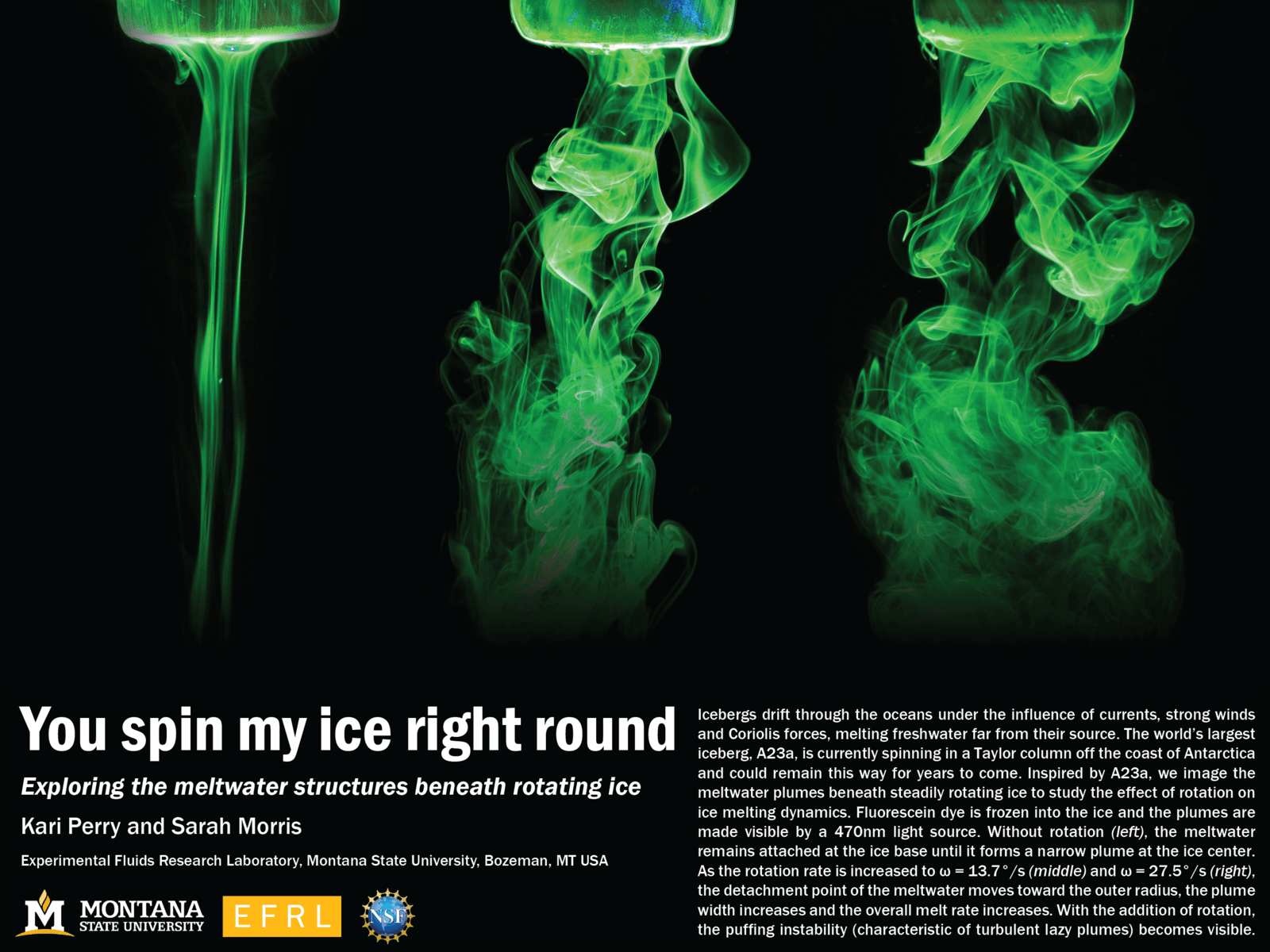
The world’s largest iceberg A23a is spinning in a Taylor column off the Antarctic coast. This poster looks at a miniature version of the problem with a fluorescein-dyed ice slab slowly melting in water. On the left, the model iceberg is melting without rotating. The melt water stays close to the base until it forms a narrow, sinking plume. In the center, the ice rotates, which moves the detachment point outward. The wider plume is turbulent compared to the narrow, non-rotating one. At higher rotation speeds (right), the plume is even wider and more turbulent, causing the fastest melting rate. (Image credit: K. Perry and S. Morris)
Tag: rotation

Paris 2024: Bouncing and Spinning
Spin, or the lack thereof, plays a major role in many sports — including tennis, golf, football, baseball, volleyball, and table tennis — because it affects whether flow stays attached around a ball, as well as how much lift or side force a ball gets. A ball’s spin doesn’t stay constant, however. During flight, a ball’s spin decays at a rate proportional to its initial spin and velocity. Researchers have found that a ball’s moment of inertia, flow regime, and surface roughness all affect that decay, but which factor is the most significant varies by ball and by sport.
Whether a ball bounces while spinning also matters. For compliant balls on a non-compliant surface — think tennis balls on a court — a bounce can actually change how much a ball spins. During impact, a tennis ball can: slide, decreasing its tangential velocity while increasing its topspin; roll, where the ball’s tangential velocity matches the tangential velocity of the surface; or over-spin, where the ball spins faster than it rolls. For a given impact angle and velocity, researchers found that stiffer and/or lighter balls were more likely to over-spin. Within tennis’s allowable range of ball stiffness and mass, manufacturers could create tennis balls that over-spin far more than conventional ones, creating another opportunity for deceptive tactics in the sport. (Image credit: J. Calabrese; research credit: T. Allen et al.)
Related topics: How flow separates from a surface, and why turbulence is sometimes preferable
Find all of our Olympics coverage — past and ongoing — here and every sports post here.

Spinning Bubbles
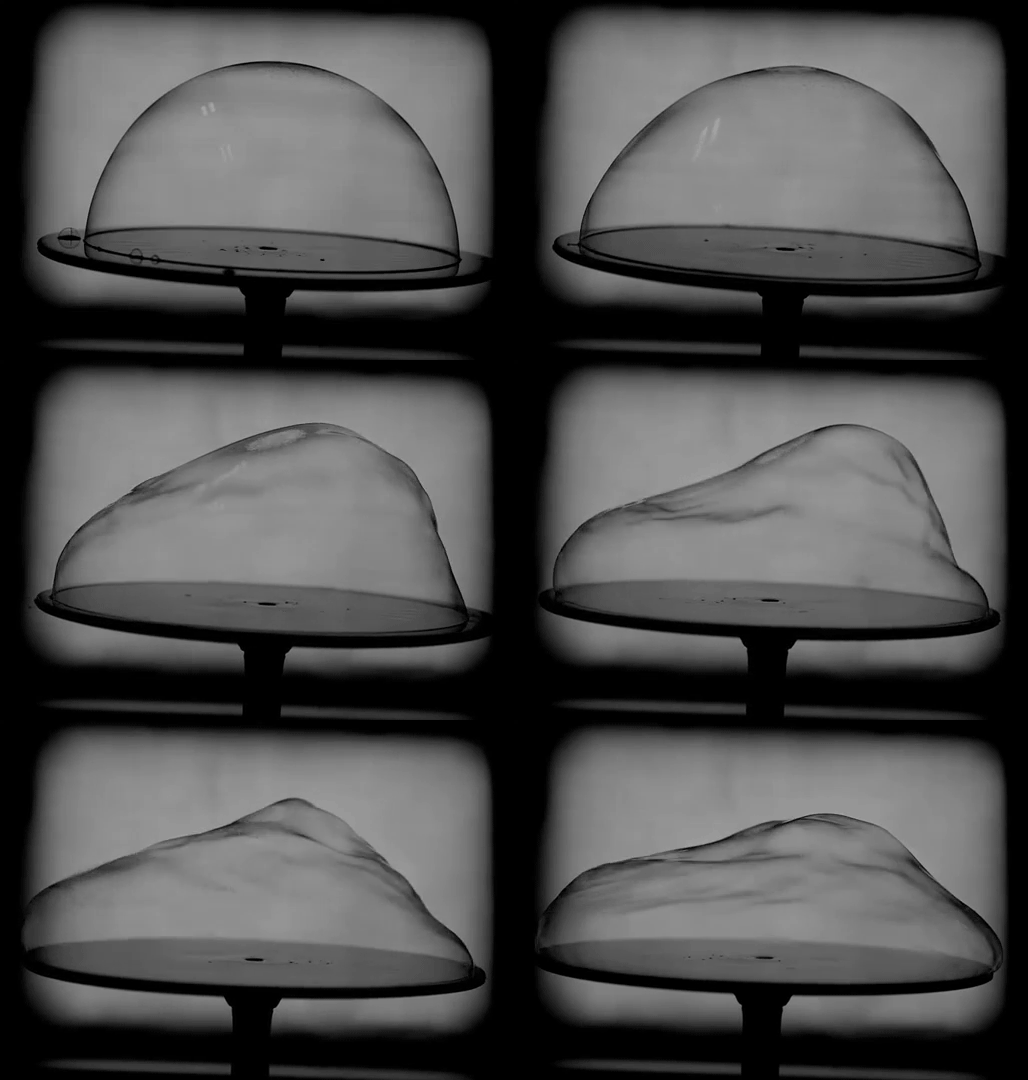
Fluid dynamics is largely about figuring out the relationship between forces. For a soap bubble sitting still, that’s primarily the effect of gravity, which makes the fluid in the soap film drain downward, and surface tension, which tries to maintain a spherical shape for the bubble.
Once you start spinning the bubble, though, there are new forces that come into play. One is the centrifugal force caused by the rotation, and another is the drag force between the rotating soap bubble and the air inside and outside of it. The addition of these forces drastically changes the bubble’s shape. It becomes wobbly and flattens out. Watch the contact line where the bubble meets the surface and you’ll also see it creeping outward toward the edge of the platform. (Image credit: C. Kalelkar and S. Paul, source)

Self-Digging Seeds
Some plants in the Pelargonium family produce seeds with long helical tails. These appendages, formally known as awns, are humidity-sensitive. On humid nights or after rainfall, the awn begins to straighten. With its end anchored on the ground, this unfurling spins the seed and helps it burrow into the soil. A study looking at the physics of this system found that rotating reduces the drag a burrowing seed experiences in a granular material. Normally much of the force that opposes motion into a granular material is the result of intergranular contacts creating what are known as force chains. (Many science museums have great displays that visualize force chains.) The rotating seed drags grains near its surface along with it, helping to break up the force chains and reduce resistance. (Image and research credit: W. Jung et al., source)