Tag: noctilucent clouds

  • Noctilucent Clouds

    Noctilucent Clouds

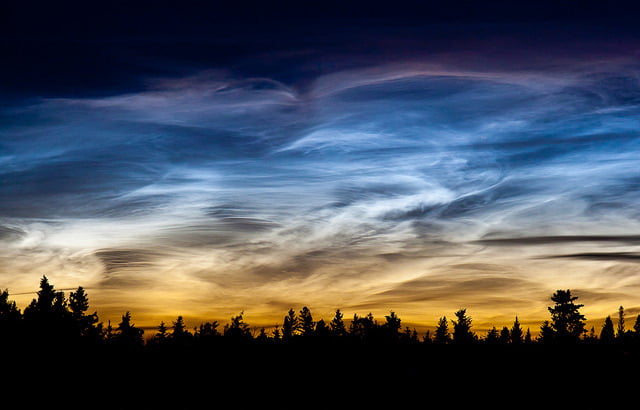
    Noctilucent clouds are the “highest, driest, coldest, and rarest clouds on Earth.” Formed in the mesosphere at altitudes over 80 kilometers, these clouds typically form at polar latitudes where they can catch sunlight hours after sunset, hence their night-shining name. The clouds take shape when water vapor in cold mesospheric air layers freezes onto dust left behind by meteors.

    Fun fact: because of their high altitude and particle size and density, noctilucent clouds were considered a hazard for space shuttle reentry, and planners explicitly avoided trajectories that would take the spacecraft near potential clouds. (Image credit: top – N. Fewings, other – J. Stevens/NASA Earth Observatory)

    Satellite image of noctilucent clouds above the North Pole.
  • Night Shine

    Night Shine

    Noctilucent – literally night-shining – clouds are a phenomenon unique to high latitudes during the summer months. Too dim and sparse to see in daylight, these clouds shine at night because their altitude of around 80 km allows them to catch sunlight long after dusk has fallen at the surface. They form when temperatures in the summer mesosphere drop to nearly -150 degrees Celsius, driven by perturbations that can originate in lower layers of the atmosphere on the opposite side of the Earth. Complex interactions and feedback between atmospheric waves, buoyancy, and Coriolis effect circulate those disturbances in such a way that the summer mesosphere can reach temperatures colder than any other place on Earth. Those frigid temperatures allow clouds to form even in this dry region near the edge of space. (Image credit: S. Stephens; see also: B. Karlsson and T. Shepard)