Tag: kaye effect

  • Featured Video Play Icon

    The Kaye Effect

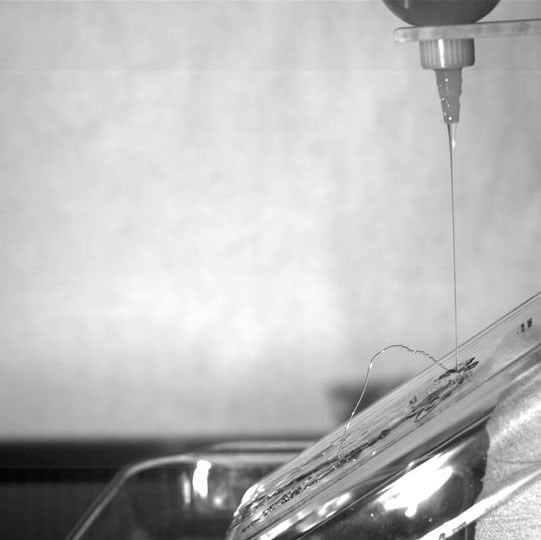
    Allow a stream of shampoo to fall into a pile and you’ll catch a glimpse of the bizarre Kaye effect. A jet of shampoo will briefly rise up before becoming chaotic and falling. The key to this behavior is the shear-thinning of the shampoo. When the shampoo is just sitting on a surface, it’s quite viscous, but slide your hand across it, and the shampoo will become much less resistant to flowing.

    When the jet of falling shampoo hits the pile, it creates a little dimple. Sometimes the incoming jet hits that dimple and slips along it, thanks to a sudden decrease in viscosity. That can send an outgoing jet of shampoo riding off the dimple like a ramp. As the dimple deepens, the outgoing streamer rises up until it hits the incoming jet and becomes unstable. The shampoo streamer collapses, only to be restarted when a new dimple forms. (Image and video credit: S. Mould; h/t to Guillaume D.)

  • The Kaye Effect

    The Kaye Effect

    Those who have poured viscous liquids like syrup or honey are familiar with how they stack up in a rope-like coil, as shown in the top row of images above. What is less familiar, thanks to the high speed at which it occurs, is the Kaye effect, which happens in fluids like shampoo when drizzled. Shampoo is a shear-thinning liquid, meaning that it becomes less viscous when deformed. Like a normal Newtonian fluid, shampoo first forms a heap (bottom row, far left). But instead of coiling neatly, the heap ejects a secondary outgoing jet. This occurs when a dimple forms in the heap due to the impact of the inbound jet. The deformation causes the local viscosity to drop at the point of impact and the jet slips off the heap. The formation is unstable, causing the heap and jet to collapse in just a few hundred milliseconds, at which point the process begins again. (Image credit: L. Courbin et al.)

  • Featured Video Play Icon

    4th Birthday: The Kaye Effect

    Today’s post continues my retrospective on mind-boggling fluid dynamics in honor of FYFD’s birthday. This video on the Kaye effect was one of the earliest submissions I ever received–if you’re reading this, thanks, Belisle!–and it completely amazed me. Judging from the frequency with which it appears in my inbox, it’s delighted a lot of you guys as well. The Kaye effect is observed in shear-thinning, non-Newtonian fluids, like shampoo or dish soap, where viscosity decreases as the fluid is deformed. Like many viscous liquids, a falling stream of these fluids creates a heap. But, when a dimple forms on the heap, a drop in the local viscosity can cause the incoming fluid jet to slip off the heap and rebound upward. As demonstrated in the video, it’s even possible to create a stable Kaye effect cascade down an incline. (Video credit: D. Lohse et al.)

  • Featured Video Play Icon

    The Kaye Effect

    The Kaye effect is particular to shear-thinning non-Newtonian fluids – that is, fluids with a viscosity that decreases under deformation. The video above includes high-speed footage of the phenomenon using shampoo. When drizzled, the viscous liquid forms a heap. The incoming jet causes a dimple in the heap, and the local viscosity in this dimple drops due to the shear caused by the incoming jet. Instead of merging with the heap, the jet slips off, creating a streamer that redirects the fluid. This streamer can rise as the dimple deepens, but, in this configuration, it is unstable. Eventually, it will strike the incoming jet and collapse. It’s possible to create a stable version of the Kaye effect by directing the streamer down an incline. (Video credit: S. Lee)

  • The Kaye Effect

    The Kaye Effect

    When a viscous fluid falls onto a surface, it will form a heap, like honey coiling. But for shear-thinning liquids like soap or shampoo something a little wild can happen as the heap grows. A dimple can form and, when the incoming jet of fluid hits that dimple, it slips against it and is ejected outward. If you wonder why you don’t see this every day in the shower, it’s because the outgoing jet usually hits the incoming jet, causing the whole system to collapse in less than 300 ms. By dropping the fluid on an inclined surface, one can keep the two jets from colliding, thereby creating a stable Kaye effect. (Photo credit: E. Eichelberger)

  • Featured Video Play Icon

    The Kaye Effect

    The Kaye effect is an instability particular to a falling stream of non-Newtonian fluids with shear-thinning properties. When these fluids are deformed, their viscosity decreases; this, for example, is why ketchup flows out of a bottle more easily once it’s moving. Like most fluids, the falling shampoo creates a heap on the surface. The Kaye effect is kicked off when the incoming jet creates enough shear on part of the heap that the local viscosity decreases, causing the streamer–or outgoing jet–to slip off the side of the heap. As the incoming jet continues, a dimple forms in the heap where the streamer originates. As the dimple deepens, the streamer will rise until it strikes the incoming jet. This perturbation to the system collapses the streamer and ends the Kaye effect. This video also has a good explanation of the physics, along with demonstrations of a stable form of the Kaye effect in which the streamer cascades down an incline. (Video credit: Minute Laboratory; inspired by infplusplus)

  • Featured Video Play Icon

    Leaping Shampoo

    The Kaye effect is a neat phenomenon associated with falling shear-thinning non-Newtonian fluids like shampoo or hand soap.  As the falling liquid piles up after hitting a solid surface, it ejects streams of fluid upwards.  The effect usually only lasts for a few hundred milliseconds, but it is possible to see it at home without a high-speed camera if you pay close attention.  More detailed physics of the effect are discussed in this previously featured video.

  • Featured Video Play Icon

    The Kaye Effect

    Non-Newtonian fluids can also be shear-thinning like shampoo. These fluids exhibit a phenomenon known as the Kaye effect. #