Tag: food

  • Food-Based Fluid Dynamics

    Food-Based Fluid Dynamics

  • Surface Fat Gives Chocolate’s Mouthfeel

    Surface Fat Gives Chocolate’s Mouthfeel

    Understanding the interactions of food and our mouths is incredibly difficult. There are lots of changes going on: shape changes from chewing, viscosity changes as saliva lubricates the food, and, sometimes, phase changes from the heat of our bodies. Add to that the sensitivity of our papillae-covered tongues, and it’s a lot to manage all at once. Recently, researchers have turned to 3D-printing to create a more realistic lab version of our mouths.

    The team 3D-printed a papillae pattern matching the size and distribution of an actual human tongue, then molded that pattern onto a silicone elastomer. The result? A replica tongue that matches a human one in terms of softness, wettability, and surface roughness. They then attached their tongue to a rheometer to measure the friction between the tongue and dark chocolate.

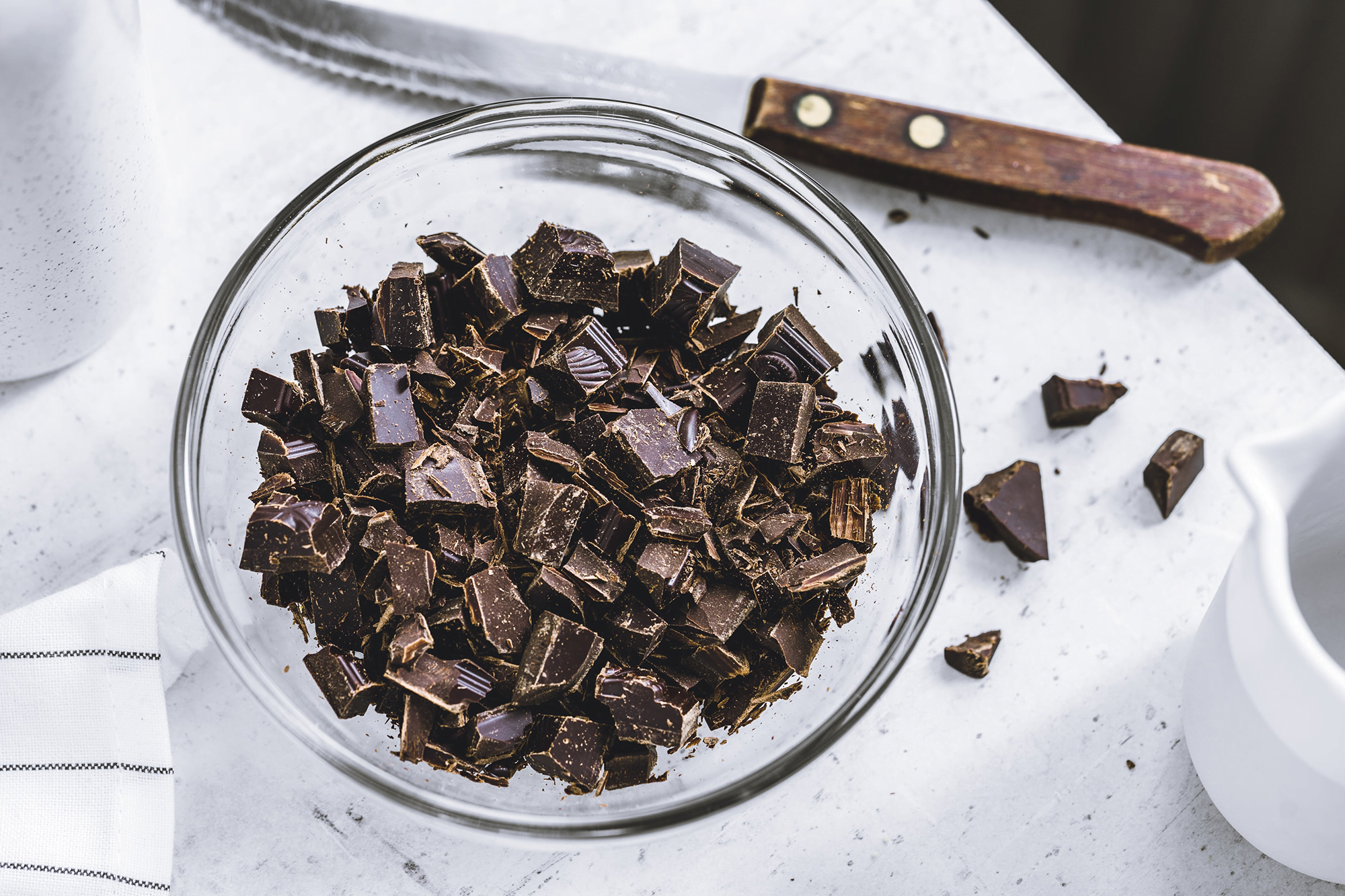
    Their experiments simulated licking, eating, and swallowing the confection. During licking and eating, they found that the chocolate was lubricated by a layer of fat directly between the tongue and the food. Their results suggest that one way to make healthier chocolate options is to concentrate fat into the surface layer of the chocolate while lowering the fat content inside the bar. (Image credit: D. Ramoskaite; research credit: S. Soltanahmadi et al.; via APS Physics)

  • Oreo Dunking Physics

    Oreo Dunking Physics

    As most people know, cookie dunking is serious business. Everyone has their own preference for cookie saturation and stiffness. Happily, scientists have examined this problem and have advice to offer those seeking cookie dunk perfection. Previously, we discussed Len Fisher’s Ig Nobel Prize-winning work on the physics of cookie dunking. In that work, Fisher found that Washburn’s equation for flow through cylindrical pores worked well to describe the uptake of tea or milk into a cookie.

    More recently, Splash Lab researchers have investigated just how much milk several common American cookies – including Oreos – take up in a given dunk. Because these cookies are quite dry, they take up liquid quickly, soaking in about 80 percent of the liquid weight within the first 2 seconds when dipped in 2% milk. Within five seconds, the cookies take on 99% of their liquid weight capacity, so there’s no point to a longer dunk – unless you like your cookie to disintegrate into the milk. The fat and sugar content of the dunking liquid does affect how quickly capillary action can whisk fluid into the cookie’s pores, but, overall, the research shows that milk users should be well-served by a three second dunk. If you like your cookie softer than that, simply pull it out of milk and let it sit for a bit while the milk soaks in. That way, your cookie doesn’t crumble! (Image credits: A. Melton; research credit: R. Hurd et al.; h/t to Randy H. and Mental Floss)