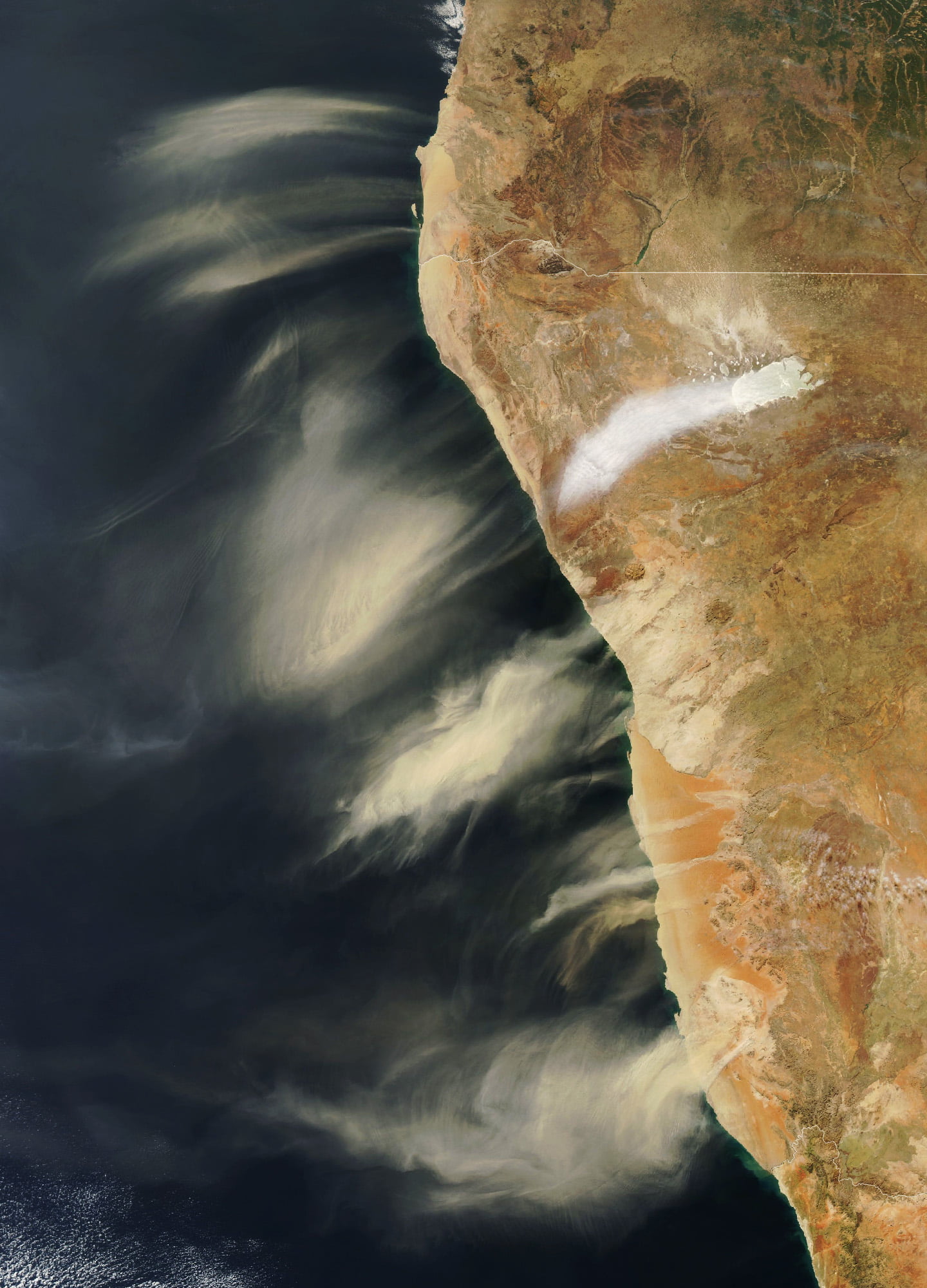
Hot, dry berg winds swept down from the Namibian highlands and sent these plumes of dust flying out to the Atlantic coast. Another plume — white instead of brown — marks salt dust from the Etosha Pan salt flat. The dust and salt become aerosol particles in the atmosphere — seeds for raindrops to form. Coastal towns sometimes need construction equipment to deal with the drifting sand from these storms, but these storms are small compared to Saharan dust storms. Those storms are so large that their dust influences the weather on the other side of the Atlantic. (Image credit: W. Liang; via NASA Earth Observatory)
Tag: dust storm

“Haboob: A Decade of Dust”


From the right vantage point, an approaching dust storm — known as a haboob — can look downright apocalyptic. In this compilation of clips a decade in the making, photographer Mike Olbinski shows these storms in all their terrifying majesty. I love seeing how the cloud front overhead densifies as the dust below advances. Without these wide perspectives, it’s hard to appreciate an approaching haboob. When one blew through Denver a few years ago, I never saw it coming. My first clue was the tree in front of my office window whipping wildly back and forth just before the sky turned brown! I much prefer Olbinski’s versions. Congratulations, Mike, on a decade of haboob-chasing! (Image and video credit: M. Olbinski; submitted by jpshoer)
“Monsoon 6”


The stunning power and beauty of our atmosphere comes to life in Mike Olbinski’s latest short film, “Monsoon 6”. Over the years, I’ve probably watched dozens of Olbinski’s videos, yet he still captures sequences that make me exclaim aloud as I watch. In this one, some of my favorites are the microburst at 2:17 and the development of mammatus clouds at 3:20. How mammatus clouds form is still very much an area of active research; I don’t know if Olbinski’s footage sheds light on their formation, but it is supremely awesome to watch! (Image and video credit: M. Olbinski)

Shedding Light on Martian Dust Storms


In 2018, Mars was enveloped by a global dust storm that lasted for months. Although such storms had been seen before, the 2018 storm offered an unprecedented opportunity for observation from five orbiting spacecraft and two operating landers. As researchers comb through that data, they’re gaining new insights into the mechanisms that drive these extreme events.
At NASA Ames, a team of researchers used observations of dust columns as input to a simulation of Mars’ global climate, then watched as the digital storm unfolded. Simulations like these have an important advantage over observations: the simulations allow scientists to track the transport of dust from one region to another.
That dust tracking is critical for some of the team’s results. They found feedback patterns between dust lifting and deposition in different regions. For example, early in the storm dust was largely supplied from the Arabia/Sabaea regions, but once that dust was deposited in the Tharsis region, it kicked off a massive lifting event from Tharsis that put twice as much dust into the atmosphere as had landed there. Later, dust deposited back in Arabia by the Tharsis lofting generated new dust uplifts. As long as more dust got lifted than deposited, the intense storms continued. (Image credits: NASA, T. Bertrand/A. Kling/NASA Ames; research credit: T. Bertrand et al.; see also JGR Planets and AGU; submitted by Kam-Yung Soh)

Titan’s Dust Storms
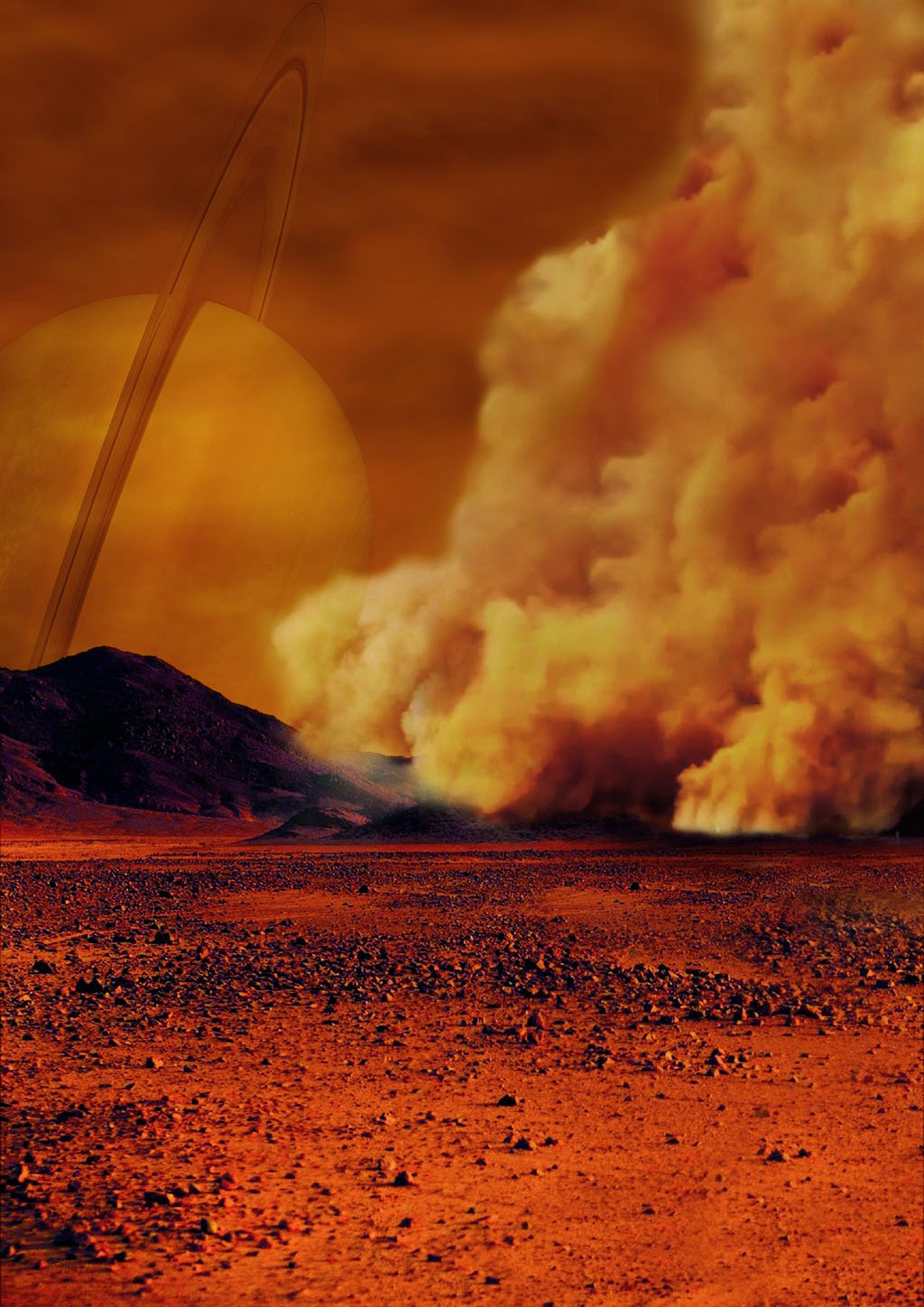
Earth and Mars are well-known for their dust storms, but a new source of extraterrestrial dust storms is joining them: Saturn’s moon Titan. Titan already shares unusual similarities to Earth: it is the only other place known to currently have stable liquid bodies at its surface. On Earth, water makes up our lakes and oceans; on Titan, it’s methane.
The evidence that Titan may also have dust storms dates from several Cassini flybys in 2009 and 2010. Cassini observed short-lived infrared bright spots in a dune-covered equatorial region. After considering several other possible sources for these temporary bright spots, researchers concluded that the most likely explanation was dust clouds suspended by high winds. This suggests that the dune fields on Titan are still actively changing, just like those on Earth and Mars! (Image credit: artist’s concept for Titan dust storm – NASA/ESA/IPGP/Labex UnivEarthS/University Paris Diderot; research credit: S. Rodriguez et al.; submitted by jpshoer)

Dust Envelopes Mars
Day has turned into night for NASA’s Opportunity rover as a massive dust storm envelopes Mars. The first signs of the dust storm were reported May 30th, and over the last two weeks, the storm has grown to an area larger than North America and Russia combined. Despite the low pressure and density of Mars’ atmosphere, solar heating can create fairly strong winds – they don’t reach hurricane-force speeds, but they’d qualify as a very windy day here on Earth. With the lower gravity on Mars, this can lift dust well into the atmosphere, choking out the sunlight Opportunity needs to continue operating. The rover has entered a low-power mode and is no longer responding to communications. Martian dust storms have been known to last for weeks or even months, and this may be the last we hear from the intrepid rover on its fifteen year journey. Here’s hoping that Opportunity makes it through the storm and can eventually get the solar power needed to phone home again. (Image credit: NASA JPL)