Tag: dinoflagellates

  • Quantifying Bioluminescence

    Quantifying Bioluminescence

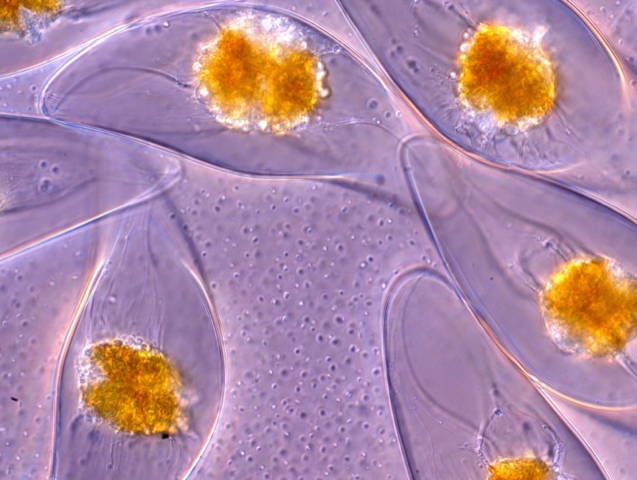
    Some single-celled organisms, like dinoflagellates, light up when disturbed. This bioluminescence is considered a defense mechanism, triggered by threats to the organism. Now researchers are quantifying just what it takes to light up a single dinoflagellate.

    Dinoflagellates respond both to stress caused by the fluid flow around them and to mechanical deformation — in other words, getting poked. Both methods involve bending and stretching the dinoflagellate’s cell wall, which stretches calcium-ion channels connected to bioluminescence. The researchers found that the intensity of the light produced depended both on the amount and speed of cell wall deformation.

    The model built from their observations should help scientists better understand what forces cause a specific response. That means dinoflagellates could be used as a non-invasive means of understanding fluid flow around swimmers like dolphins or sea lions! (Image and research credit: M. Jalaal et al.; via APS Physics)

  • Bioluminescent Plankton

    Bioluminescent Plankton

    In nutrient-rich marine waters, dinoflagellates, a type of plankton, can flourish. At night, these tiny organisms are responsible for incredible blue light displays in the water. The dinoflagellates produce two chemicals – luciferase and luciferin – that, when combined, produce a distinctive blue glow. The plankton use this as a defense against predators, creating a flash of blue light when triggered by the shear stress of something swimming nearby. The dinoflagellates respond to any sudden application of shear stress this way, so they glow not only for predators, but for any disturbance – mobula rays (above), sea lions, boats, or even just a hand splashing in the water. In person, the experience feels downright magical. I had the opportunity to experience bioluminescence in the Galapagos last year. The light from the dinoflagellates is incredibly difficult to film because it can be so dim, but as the BBC demonstrates, it’s well worth the effort it takes to capture. (Image credit: BBC from Blue Planet II and Attenborough’s Life That Glows; video credit: BBC Earth)

  • Bioluminescent Plankton

    Bioluminescent Plankton

    The blue-outlined dolphins you see above get their glow from microorganisms called dinoflagellates. They are a type of bioluminescent plankton, shown in the lower image, that can be found in oceans around the world. Their glow comes from combining two chemicals: luciferase and luciferin. The dinoflagellates suspended in the ocean do this when they are disturbed–specifically, when the water around them transmits a shear stress above a certain threshold. Typically, this is caused by something larger–a potential predator–moving past, although it can also be stimulated by breaking waves. The higher the shear stress, the more intense the glow, but the dinoflagellates only use their bioluminescence sparingly. If you apply shear stress and keep applying it, their glow fades away without reactivating. After all, they can only produce so much chemical fuel. (Image credit: BBC from Attenborough’s Life That Glows; h/t to Gizmodo; research credit: E. Maldonado and M. Latz)