Tag: crowds

  • Crowd Vortices

    Crowd Vortices

    The Feast of San Fermín in Pamplona, Spain draws crowds of thousands. Scientists recently published an analysis of the crowd motion in these dense gatherings. The team filmed the crowds at the festival from balconies overlooking the plaza in 2019, 2022, 2023, and 2024. Analyzing the footage, they discovered that at crowd densities above 4 people per square meter, the crowd begins to move in almost imperceptible eddies. In the animation below, lines trace out the path followed by single individuals in the crowd, showing the underlying “vortex.” At the plaza’s highest density — 9 people per square meter — one rotation of the vortex took about 18 seconds.

    Animation of the crowd in motion, with overlaid lines showing the circulating path followed by individual crowd members.

    The team found similar patterns in footage of the crowd at the 2010 Love Parade disaster, in which 21 people died. These patterns aren’t themselves an indicator of an unsafe crowd — none of the studied Pamplona crowds had a problem — but understanding the underlying dynamics should help planners recognize and prevent dangerous crowd behaviors before the start of a stampede. (Image credit: still – San Fermín, animation – Bartolo Lab; research credit: F. Gu et al.; via Nature)

    Fediverse Reactions
  • Lanes in Crowds

    Lanes in Crowds

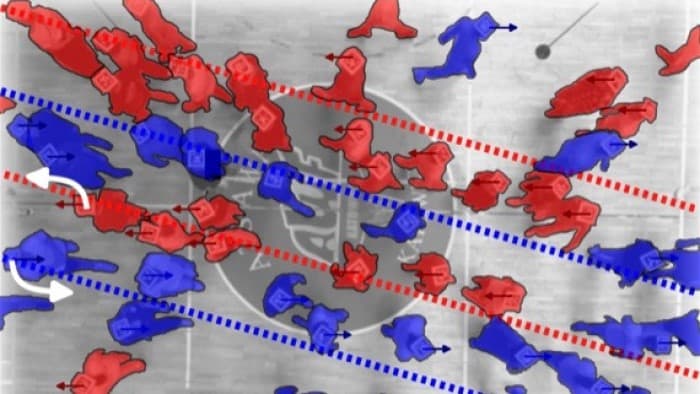
    In nature — from atoms to human crowds — two groups moving in opposite directions often spontaneously organize into interwoven lanes flowing in their respective directions. Now researchers have built a mathematical model for this behavior, building on Einstein’s observations of Brownian motion.

    To test their model, the researchers performed numerical simulations and experiments with pedestrians. Intriguingly, they found that introducing rules like “always pass on the right” created unexpected results, such as tilted lanes. With their model verified — at least for low-density crowds — the group hope to uncover other hidden patterns within crowds. (Image and research credit: K. Bacik et al.; via Physics World)

    An animation showing one pedestrian experiment.
    In their validation experiments, the researchers filmed groups of pedestrians walking past one another under different conditions. Note the lanes that form as the two groups interleave.
  • Crowds as a Fluid

    Crowds as a Fluid

    At a low density, crowds of people can behave like a fluid, which has led to numerous hydrodynamically-based crowd models. At higher densities, though, crowds are more like a soft solid, and researchers are adapting models developed for granular materials like sand to describe these crowds. In granular materials, these models help scientists identify how vibrations move through the complex network of grains and what circumstances might cause sudden reorganizations. In a large crowd, this could tell scientists the difference between the innocuous shuffle at a rock concert and the trigger for a deadly stampede. Getting real-world data for comparison is tough – obviously, it’s unethical to intentionally cause a crowd to panic – so thus far the models remain relatively untested. (Image credit: M. Lebrun; research credit: A. Bottinelli and J. Silverberg)

  • Collective Motion: Crowds

    Collective Motion: Crowds

    It’s sometimes taken for granted that, in groups, people can behave a lot like a fluid or a granular material. This allows scientists to adapt models developed for those materials to understand how crowds move. But in doing so, it’s always important to test just how far the comparison holds; in other words, just how much does a crowd of people behave like a fluid or granular material?

    That’s the purpose behind the experiment you see above, where a dense crowd of people shift in response to a “cylindrical intruder”. This is a classic experiment for something like a granular material, and there are clear similarities. Most of the crowd’s shifting comes only a short way from the intruder, and their passage leaves a small, empty wake that slowly fills back up.

    But other aspects of the experiment are very different from the granular equivalent. Instead of moving only when contact forces cause them to, the crowd shifts in anticipation of the intruder’s passage. They also use a more confined motion; crowd members primarily shift to the side to allow the intruder by, whereas grains tend to follow a more circular pattern of motion. Interestingly, if the intruder approaches from behind – and thus crowd members cannot anticipate them – the crowd’s motions will actually better match a granular material. (Image and research credit: A. Nicholas et al., source)

    All this week at FYFD we’re looking at collective motion. Check out our previous posts here and here.