Tag: boat

  • Superhydrophobic Drag

    Superhydrophobic Drag

    Using air or bubbles to reduce drag on boats is a popular idea, whether using supercavitation, the Leidenfrost effect, or superhydrophobic coatings. But most of the experiments done thus far use spheres rather than realisitic boat shapes. In this study, the researchers used two model boats — one with a hydrofoil and the other in a conventional motorboat shape — and applied superhydrophobic coatings to different parts of the model to see how superhydrophobicity affected the overall drag.

    Perhaps surprisingly, they found that superhydrophobic coatings can actually increase the drag! The effect was particularly stark for the hydrofoil boat (Image 2), where the surface jets (lower half) caused by the superhydrophobic coating slowed the boat by 30% compared to its unmodified speed (upper half).

    For the speedboat, a superhydrophobic hull made no overall difference in its drag, though it changed how water splashed in its wake. And coating the boat’s propeller was particularly detrimental, resulting in a speed up to three times slower. Overall, the study suggests that superhydrophobic coatings may be useful in some circumstances, but they have to be applied carefully, as they can have negative impacts, too. (Image credits: top – S. Anghan, others and research credit: I. Vakarelski et al.)

  • Featured Video Play Icon

    Inside the Blockage of the Suez Canal

    In March 2021, the world watched as the Ever Given container ship got stuck in the Suez Canal, disrupting global shipping for more than a week. In this Practical Engineering video, Grady delves into some of the phenomena that may have played a role in the incident of the ship that launched a thousand memes.

    Heavy container ships displace a lot of water, and in a narrow, shallow canal, there isn’t much space left for that water to go. To squeeze by, the water must speed up, which (per Bernoulli’s law) creates a pressure drop and suction force on the ship. For a ship too close to a canal bank, that suction will pull the ship further to the side, increasing its chances of lodging in the bank. (Video and image credit: Practical Engineering)

  • Hydrofoils and Stability

    Hydrofoils and Stability

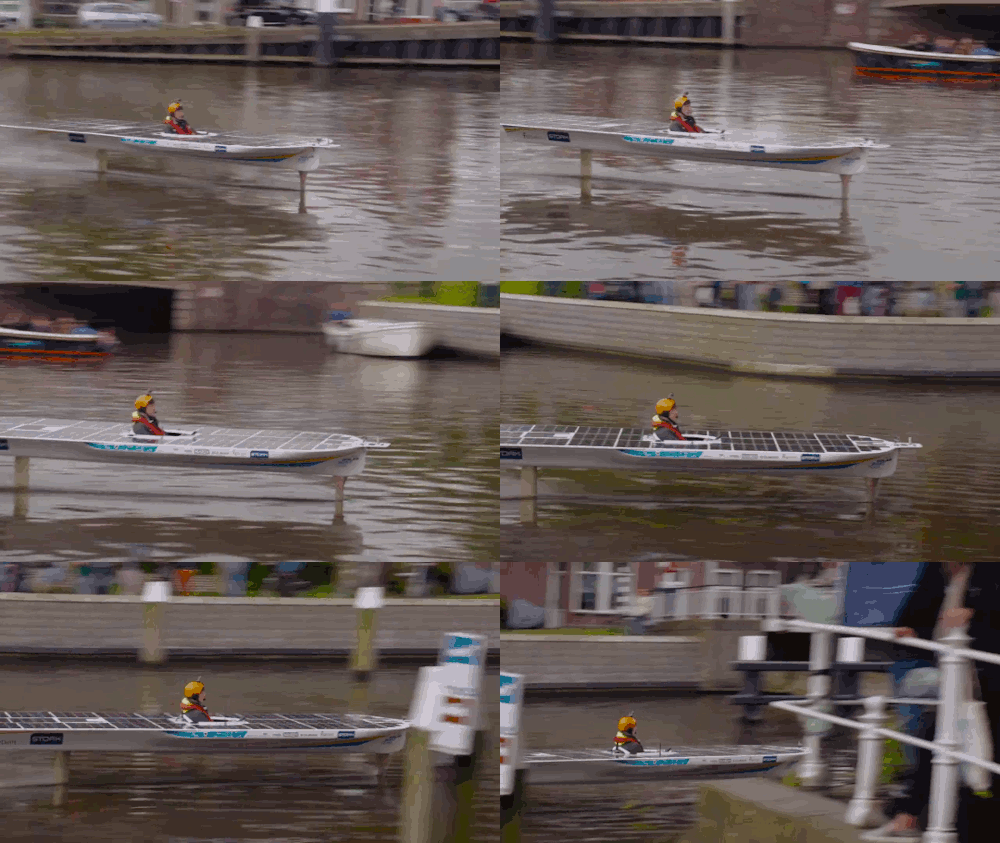
    Today’s fastest boats use hydrofoils to lift most of a boat’s hull out of the water. This greatly reduces the drag a boat experiences, but it can also make the boat difficult to handle. One style of hydrofoil boat, called a single-track hydrofoil, uses two hydrofoils in line with one another to support and steer the boat. The pilot can steer the lead hydrofoil into the direction of a fall to correct it. Stability-wise, this is the same way that you keep a bicycle upright. On a boat, the situation is a bit tougher to manage, and, like riding a bike, it takes practice. A group of students published a full mathematical model for the dynamics of this kind of boat, which allows designers to test a prototype’s stability early in the design process and enables student teams to use computer simulators to train their pilots to drive a boat before putting them out on the water, similar to the way that airplane pilots train. (Image credit: TU Delft Solar Boat Team, source; research credit: G. van Marrewijk et al., pdf; via TU Delft News; submitted by Marc A.)