Tag: ballooning

  • Albuquerque: Balloonist Paradise

    Albuquerque: Balloonist Paradise

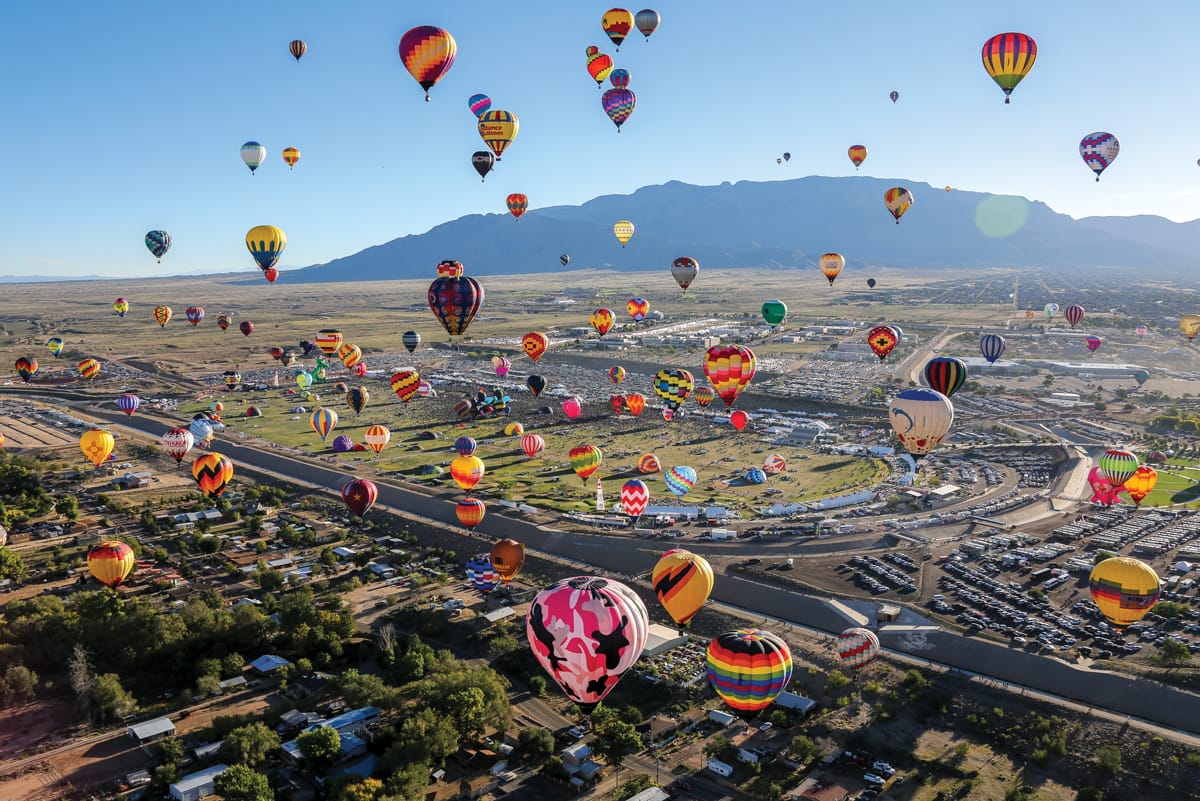
    Albuquerque, New Mexico’s unique weather characteristics make it a popular destination for hot-air balloonists. While balloonists can control their altitude by warming or venting the air in their balloon, their horizontal travel comes at the mercy of the wind. (Just ask the erstwhile Wizard of Oz.) What makes Albuquerque special is a combination of topography, dry air, and altitude. Together, these features create the “Albuquerque box,” a circulation that gives south-flowing drainage winds below north-flowing prevailing winds.

    The key to the box’s flow is a temperature inversion, where cooler, denser air is trapped near the surface and lighter, warmer air sits above. This typically occurs after a night of clear skies when much of the ground layer’s warm gets radiated away to space — something that’s easily done in high, dry altitudes.

    Temperature inversions like this don’t last very long, though; by late morning, the sun’s warmth will dismantle the Albuquerque box. Still, it is a frequent enough occurrence, especially in the stable atmospheric conditions common in the autumn, that the city hosts an International Balloon Fiesta every October. (Image credit: B. Bos; via Physics Today)


    Fediverse Reactions
  • Featured Video Play Icon

    Flying Spiders Use Electric Fields

    Many species of spider fly with a technique calling ballooning. We’ve touched on spider flight before, but more recent research adds a new dimension to the phenomenon. Researchers showed that spiders can actually use electrical fields in their flight. When isolated from flow or outside electrical fields, researchers found that spiders would still begin ballooning behaviors when subjected to electrical fields similar to those found in nature. The spiders were even able to take off in the artificial environment, using the electrostatic force between the surrounding fields and their negatively charged silk strands. While electrical fields alone were enough to get spiders aloft, the team thinks spiders in nature likely still use a combination of electrostatic force and aerodynamic drag in order to travel the vast distances spiders have been known to cover. (Video and image credit: BBC; research credit: E. Morley and D. Robert)

  • Fly Away!

    Fly Away!

    Spiders are often among the first colonists on newly formed volcanic islands. Thanks to their aerial skills, they are able to travel nearly anywhere by ballooning on strands of their own silk. Exactly how spiders as large as 20 milligrams manage this is still relatively known. A new study shows that crab spiders, like any careful aviator, use a foreleg to monitor wind conditions for 5 or more seconds before attempting take-off. The spiders will only spool out ballooning threads if the wind is warm and gentle. Wind speeds higher than 3 meters per second are an automatic no-go. When the spider decides conditions are favorable, they release as many as 60 nanoscale fibers that are several meters in length. The wind catches the silks and lifts them away to their next adventure. (Image credit: Science Magazine, source; research credit: M. Cho et al.)