
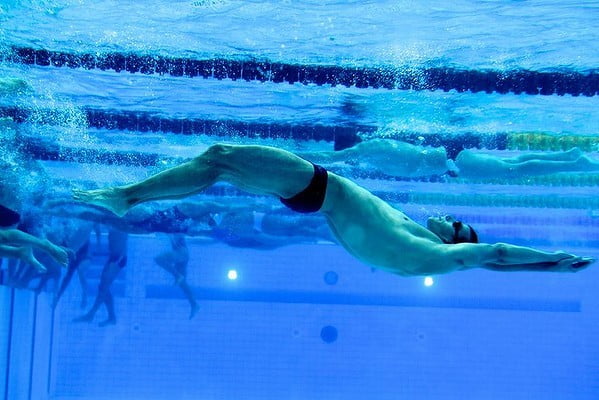
 Strange as it seems, elite swimmers are faster when swimming underwater than they are at the surface. So much so, in fact, that they’re restricted to being underwater only 15 m after a dive or turn. To see just how stark a difference this makes, check out this crazy video. (I know, right?!)
To understand how this is possible, it helps to look at the three types of drag a swimmer experiences: pressure drag, skin friction, and wave drag. Pressure drag is probably the most familiar; it’s the drag that comes from the swimmer’s shape and how the fluid moves around it. Skin friction is the drag that comes from viscous friction between the swimmer and the water. The final type, wave drag, comes from the energy expended to create waves at the surface of the water. As you might expect, energy that goes into splashing is energy that isn’t going into propulsion.
When swimming at the surface, swimmers experience a lot of wave drag. At least one experiment showed that wave drag accounted for most of a surface swimmer’s drag. In contrast, at a depth of more than 0.5 m, a swimmer’s wave drag is virtually negligible. The submersion does come at the cost of higher skin friction (since more of the swimmer is in contact with the water), but there is also more opportunity for useful propulsion since both sides of a kick can move water (and not air.) Bonus read for those interested in more: Is the fish kick the fastest stroke yet? (Image credits: AP; B. Esposito)
Previously: what makes a pool fast?
Join us throughout the Rio Olympics for more fluid dynamics in sports. If you love FYFD, please help support the site!


