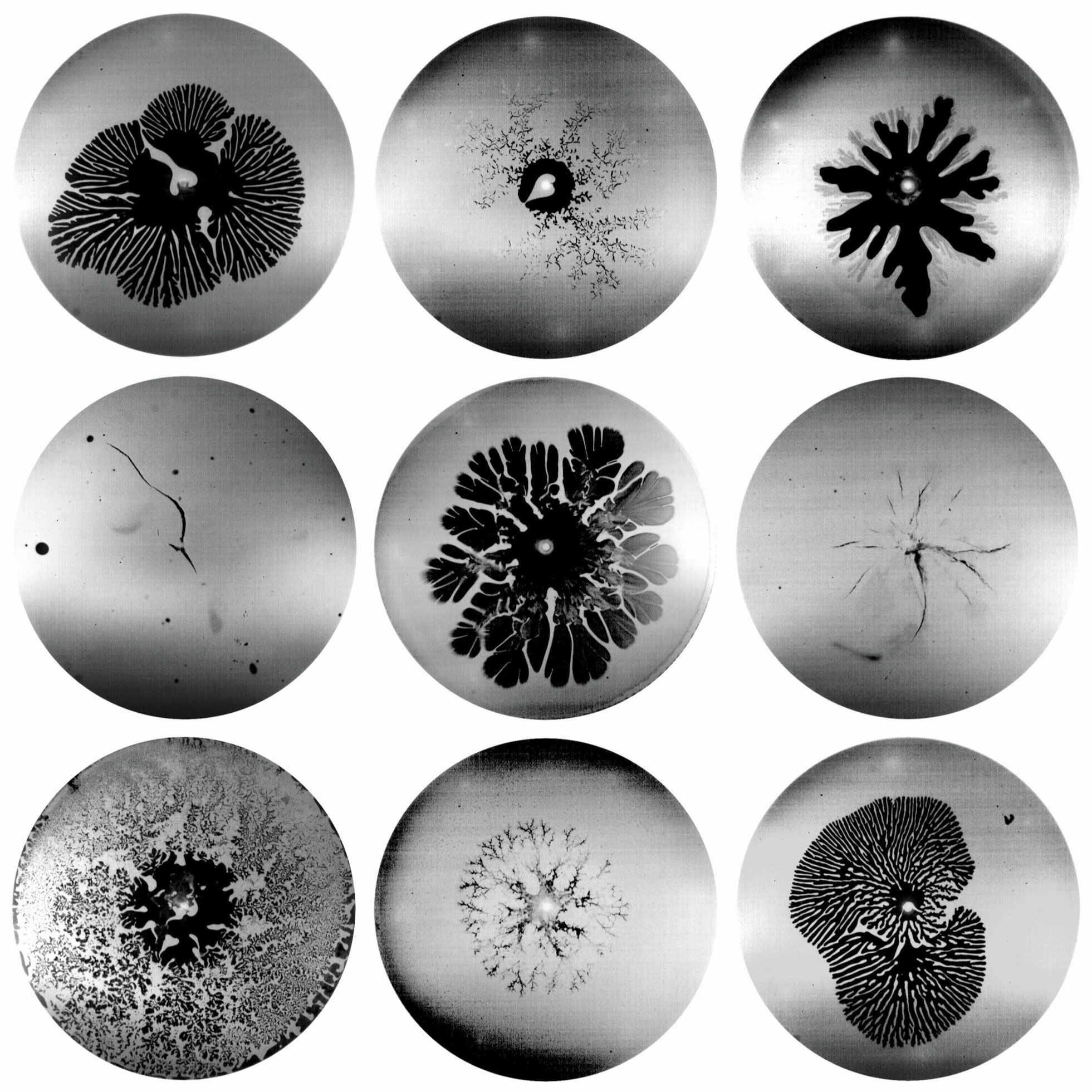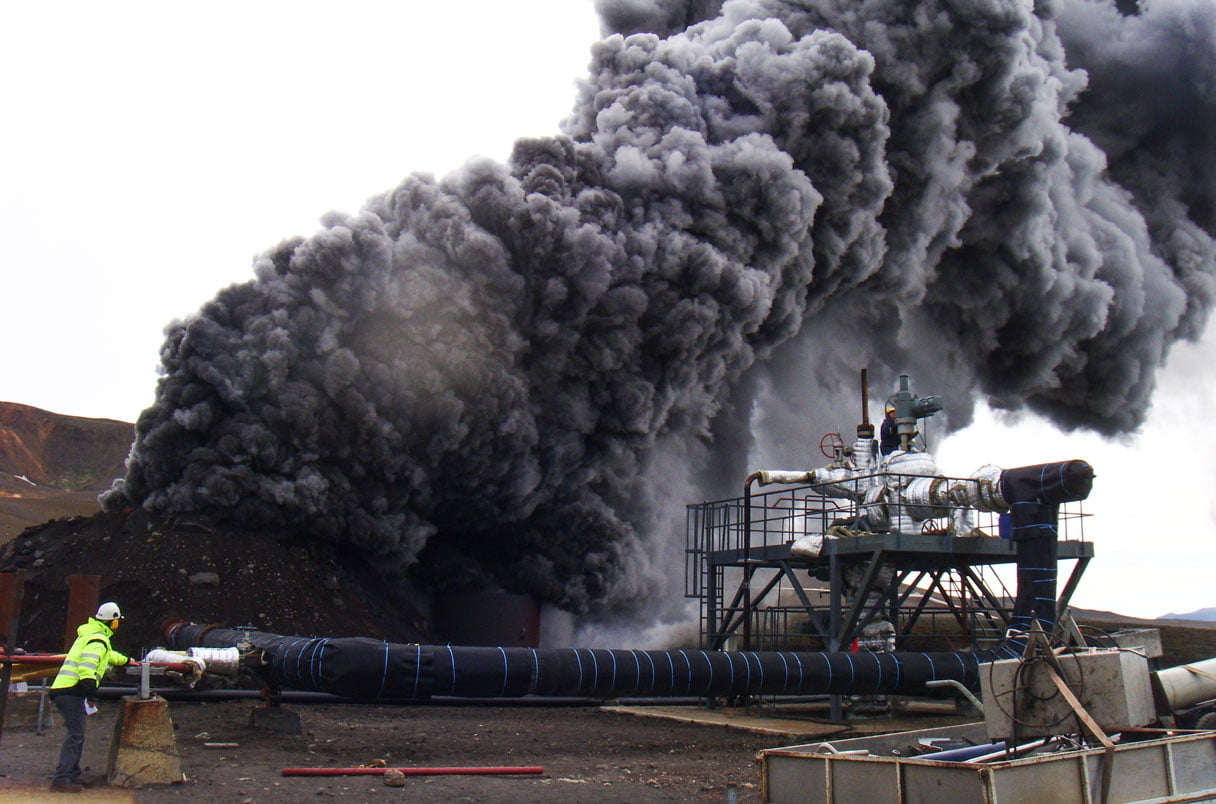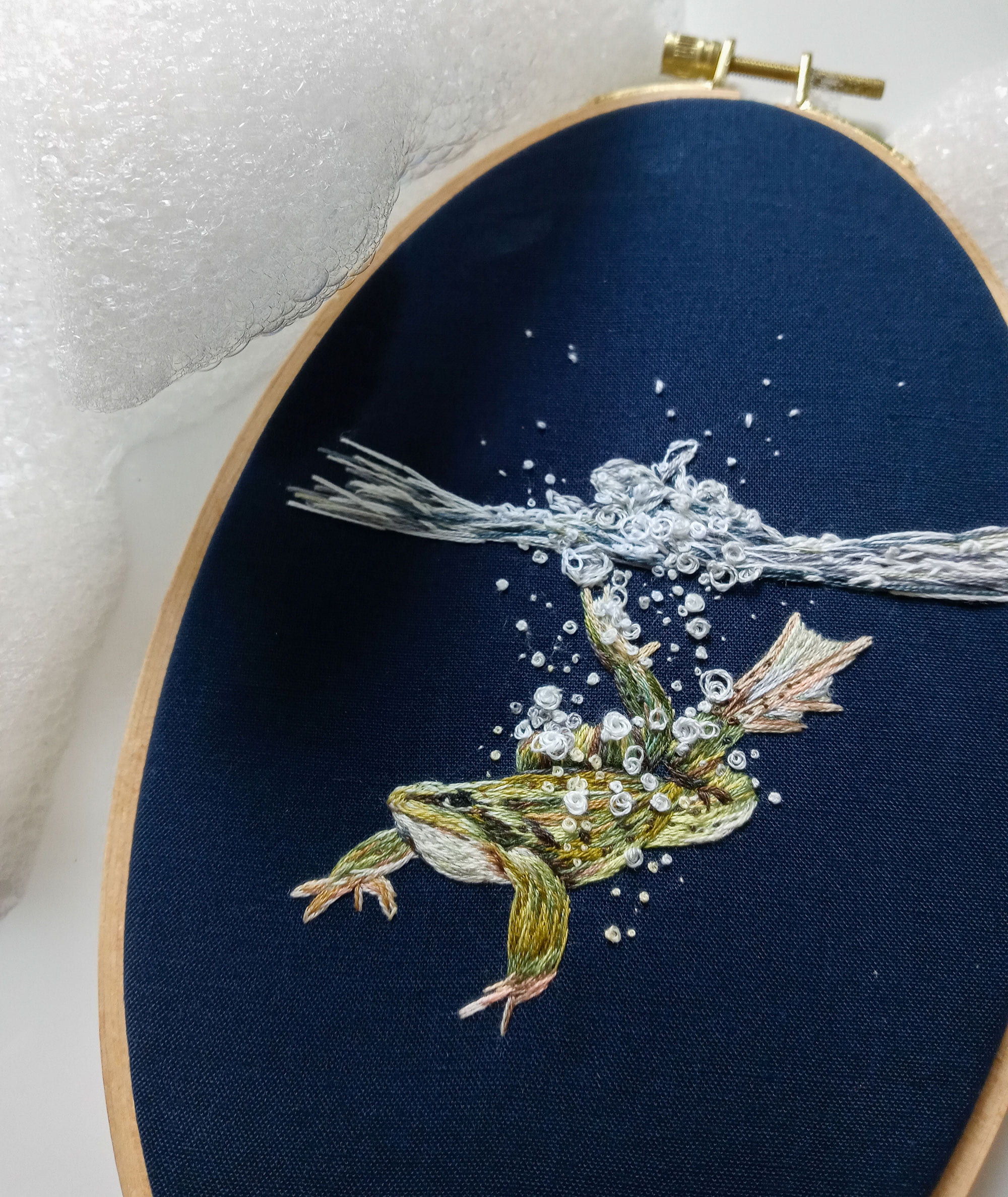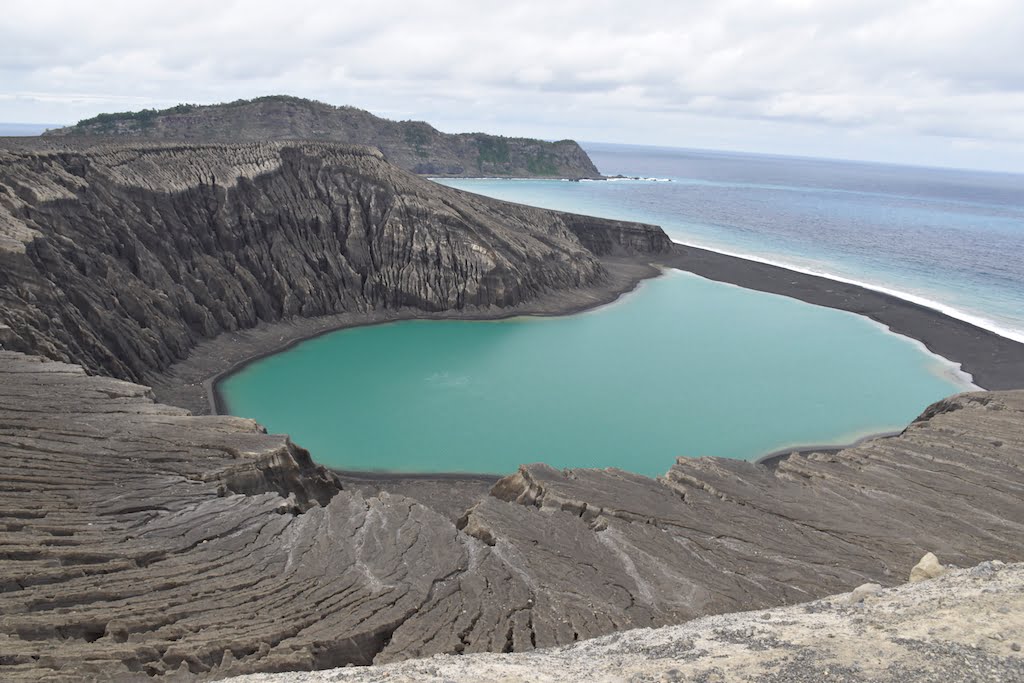
Rivers often change their course, but they do not always do so gradually. River avulsions are a bit like earthquakes — they happen suddenly and with disastrous potential. Researchers find that these sudden course changes happen when silt builds up in a river and reduces the amount of water it can carry. Eventually, the resistance to flow is large enough that the river bursts its banks in search of an easier route to the sea. That’s a deadly problem for the communities that live nearby and rely on the river’s sedimentation for their fertile farmland. But using small-scale models, scientists are beginning to unravel the physics behind avulsions, bringing hope that they can be predicted or even sustainably averted. (Video and image credit: Science)
Search results for: “art”

When Squids Fly
Some species of squid fly at speeds comparable to a motorboat for distances of 50 meters. The cephalopods get into the air the same way they swim underwater: by expelling a jet of water through the center of their body. Once aloft, the squids spread their tentacles to form a semi-rigid wing-like surface for lift. They can also use fins on their mantle as a canard for additional lift or control of their altitude. Researchers suspect the squids use flight as an escape mechanism to put distance between themselves and predators, but it could also be a low-energy migration strategy since a single pulse carries a squid farther in air than in water. (Video and image credit: TED-Ed)

The Variable Venusian Day
Venus is a thoroughly unpleasant place thanks to its hellish temperatures and acidic clouds, but a new study adds another wrinkle to our strange sister planet: Venus’s day varies by up to 21 minutes in length. This peculiar factoid is the result of 15 years spent monitoring Venus’s rotation via radar. Previous attempts to pin down the exact length of Venus’s day produced differing answers; those disagreements make more sense in light of the new study, where individuals measurements of Venus’s rotation rate could differ by 3 minutes just from one (Earth) day to the next!
So why does Venus’s rotation rate change so dramatically? Venus’s atmosphere is massive — 100 times more massive than Earth’s — and it spins incredibly fast. The upper layers of Venus’s atmosphere can complete a rotation in 4 Earth days, while the solid ground requires 243 Earth days. As the atmosphere spins and sloshes, some of its angular momentum gets transferred to the ground, changing the planet’s rotation rate. (Image credit: NASA/JPL-Caltech; research credit: J. Margot et al.; via AGU Eos; submitted by Kam-Yung Soh)

Levitating Cylinders by Lubrication
Here’s a surprising example of defying gravity: if you coat a vertical treadmill in oil, a cylinder held next to it will levitate! A new paper delves into the mathematics behind this surprising situation, showing that the key to keeping the cylinder aloft is the pressure that forms where the oil layer splits around the disk. For a given cylinder size and mass, there’s a unique treadmill speed that will levitate it. By experimentally testing a range of cylinder sizes and masses, the authors validated their model and showed a simply scaling argument for predicting the belt speed needed for levitation. (Image and research credit: M. Dalwadi et al.; via Nature; submitted by Kam-Yung Soh)

Kinetic Sculptures by Anthony Howe
These mesmerizing kinetic sculptures built by Anthony Howe are entirely wind-driven. It’s not necessarily apparent in these images, but these sculptures are several meters tall and weigh hundreds of kilograms, but they’re engineered so precisely that the slightest breeze sets them silently spinning. See more of Howe’s art in action on his YouTube channel. (Video and image credits: A. Howe; via Colossal)

Brace For Impact
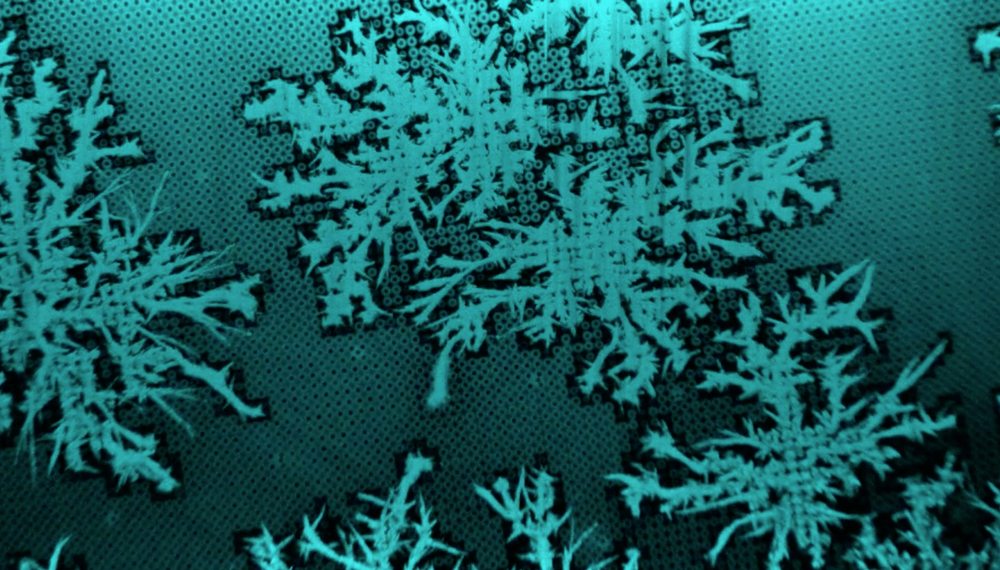
What happens in the moment before an object hits the water? That’s the question at the heart of a new study exploring how water deforms before an object’s impact. The researchers dropped circular disks onto a pool of water and, using a new reflection-based technique, measured micron-sized deflections in the water’s surface before impact, as seen below.

Movie of the water surface’s deflection as the circular disk approaches. Look for distortions in the grid pattern. The deflections are caused by the air getting squeezed out of the space between the oncoming object and the water surface. The team found that the deformation isn’t uniform. The air squeezing out along the edges moves fast enough to trigger a Kelvin-Helmholtz instability and actually pull up the water surface. So when the disk hits, it impacts along its edges first and traps an air bubble underneath. (Image credits: divers – E. Carter, experiment – U. Jain et al.; research credit and submission: U. Jain et al.)

Blue Dunes
This false-color image shows a Martian dune field near the northern polar cap. The image itself covers an area 30 kilometers wide, but the dune field stretches over an area the size of Texas. In the photo cooler areas have been rendered in bluer tints, while warm areas are shown in yellow and orange. The sun warms the wind-sculpted dunes more than in the valleys that lie between. Complex dune networks like these build up over time as consistent winds push sand and create interactions between individual dunes. (Image credit: NASA/JPL-Caltech/ASU; via Colossal)

Tiny Symmetric Swimmers
Microswimmers live in a world dominated by viscosity, and in viscous fluids, symmetric motion provides no propulsion. That’s why bacteria and other tiny organisms use cilia, corkscrew flagella, and other asymmetric means to swim. But a new study decouples the symmetry of a swimmer’s motion from the motion of the fluid, thereby creating a tiny symmetrically-driven swimmer that does swim.
Their microswimmer consists of two beads, which attract one another via surface tension and are repelled using external magnetic fields. This effectively creates a spring-like connection between the two beads, making them move in and out symmetrically in time. But since one bead is larger than the other, its greater inertia makes it slower to start moving and slower to coast to a stop. This inertial imbalance between the two is significant enough for the beads to swim. The key here is that though the beads’ motion relative to one another is symmetric, their motion relative to the fluid is not! (Image and research credit: M. Hubert et al.; via Science; submitted by Kam-Yung Soh)

“Stream”
Roman De Giuli’s short film “Stream” explores a macro world of color and flow, with a few glimpses behind-the-scenes at how the visuals get made. The artistic canvas here is a glass plate; the materials are oil, ink, and water. As simple as the ingredients are, though, the view is complex and enchanting. It’s amazing to see just how much goes on in an area the size of one’s thumb. (Image and video credit: R. De Giuli)