As material collapses onto a protostar, these young stars often form stellar jets that point outward along their axis of rotation. Made up of plasma, these jets shoot into the surrounding material, their interactions creating bright parabolic cavities like the one seen here. This is half of LDN 1471; the protostar’s other jet and cavity are hidden by dust but presumably mirror the bright shape seen here. (The protostar itself is the bright spot at the parabola’s peak.) Although the cavity is visibly striated, it’s not currently known what causes this feature. Perhaps some form of magnetohydrodynamic instability? (Image credit: NASA/Hubble/ESA/J. Schmidt; via APOD)
Tag: stellar wind

Stellar-Wind-Shaped Nebula
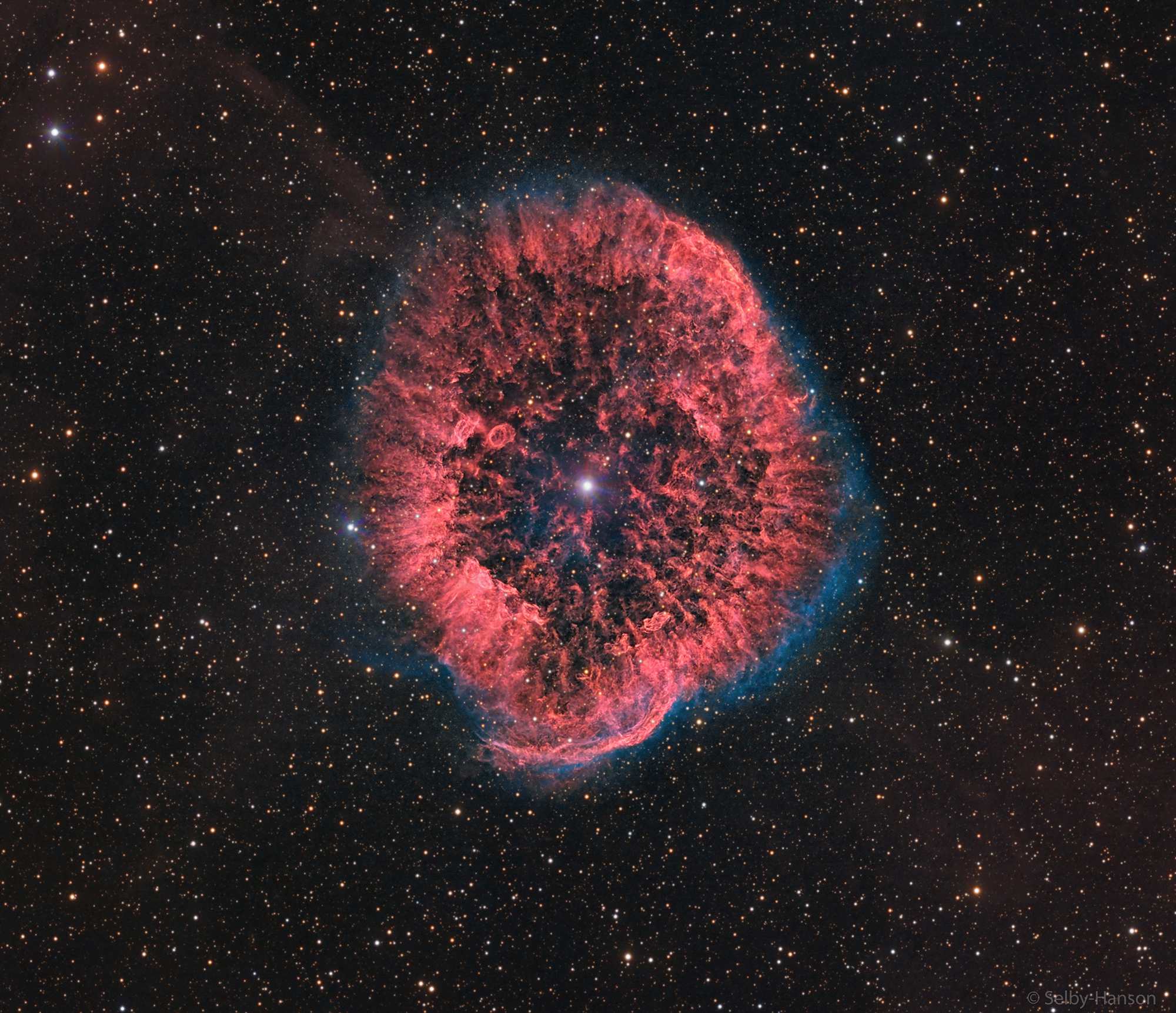
Stars about 100 times more massive than our sun live fast and die young. They burn through their hydrogen supply quickly, then start fusing heavier elements. As they do, their strong stellar winds start blowing off the exterior layers of the star. That’s the story behind WR 40, the star at the center of Nebula RCW 58. The nebula itself is made up of material blown off the star, carved into turbulent filaments by stellar winds. (Image credit: M. Selby and M. Hanson; via APOD)

Eye of the Stellar Storm
AG Carinae is a bright, unstable luminous blue variable star. This rare type of star lives fast and dies young (by stellar standards) over only a few million years. During that time, it will occasionally blow off its outer layers in a violent eruption as a result of the ongoing tug of war between its radiation pressure and gravity. That’s the source for the nebula we see surrounding the star in this image. The red areas of the image are a mixture of hydrogen and nitrogen gas; the blue clumps are cooler pockets of dust shaped by the hotter, faster-moving stellar wind. Zoom in on the image and you can see amazing structural detail in the nebula, evidence of turbulence on a scale of light-years. (Image credit: NASA/ESA/STScI; via Gizmodo)

Chaos in the Lagoon Nebula
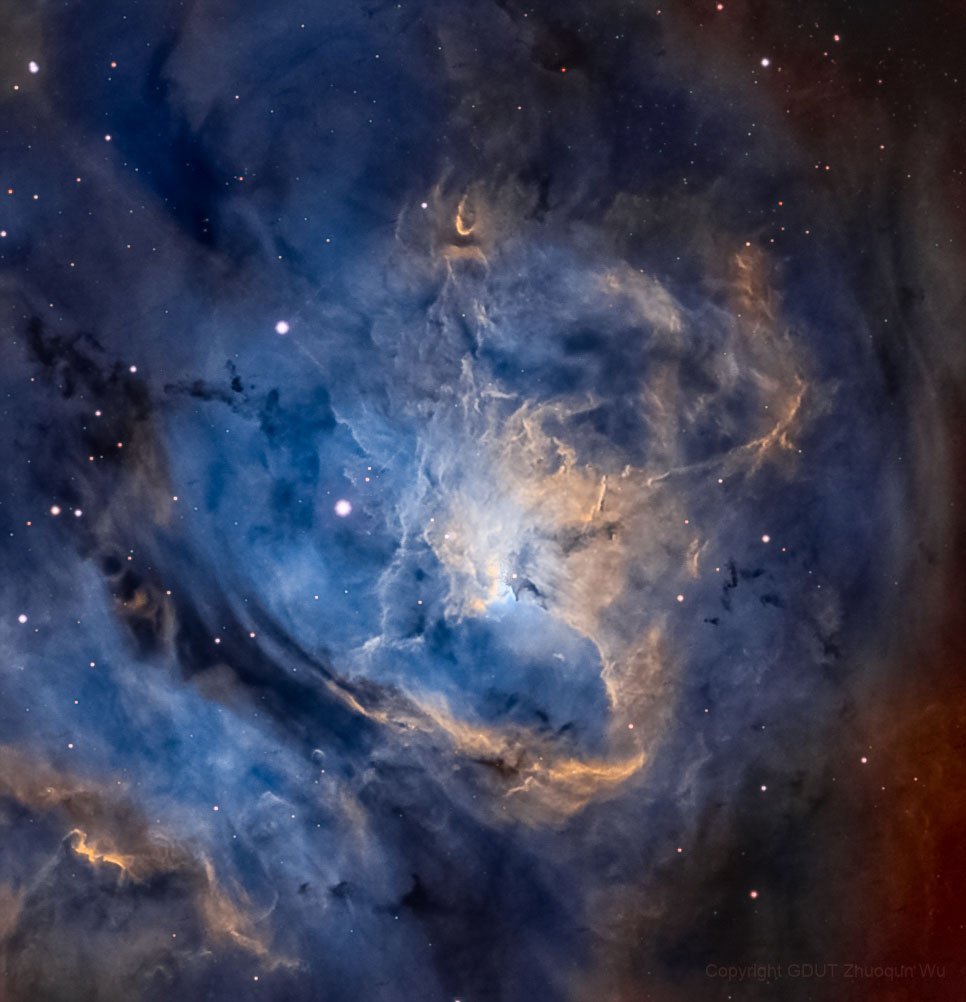
Even on the scale of light-years, fluid dynamics plays a role in our universe. This photograph shows the Lagoon Nebula, where stars, gas, and dust are battling for supremacy. Jets from young stars push the dust left from supernova remnants into a chaotic patterns, and the high-energy particles streaming from the youthful stars illuminate interstellar gases, creating the nebula’s distinctive glow. This section of the nebula is about 50 light-years across, so every picture we capture is only the tiniest snapshot of the true scale of its turbulence. (Image credit: Z. Wu; via APOD)

Stellar Bow Shock
This Hubble image shows a young star in the Orion Nebula and the curved bow shock arcing around it. Despite its age, the star LL Orionis is energetic, producing a stellar wind that exceeds our sun’s. When that wind collided with the flow in the Orion Nebula, it formed this bow shock that is about a half a light-year wide. We don’t often think about fluid dynamics applying in space, but if we consider a lengthscale that is large enough, even space contains enough matter to behave like a fluid. LL Orionis’s bow shock is in many ways comparable to ones we see form around re-entering spacecraft. (Image credit: NASA/Hubble, via APOD; submitted by jshoer)



![Droppie [infosec] 🐨:archlinux: :kde: :firefox_nightly: :thunderbird: :vegan:](https://fyfluiddynamics.com/wp-content/uploads/activitypub/actors/25672/63a1717fb18de1a021d0d202b3cdff65.webp)