Tag: cactus

  • Withstanding Windstorms

    Withstanding Windstorms

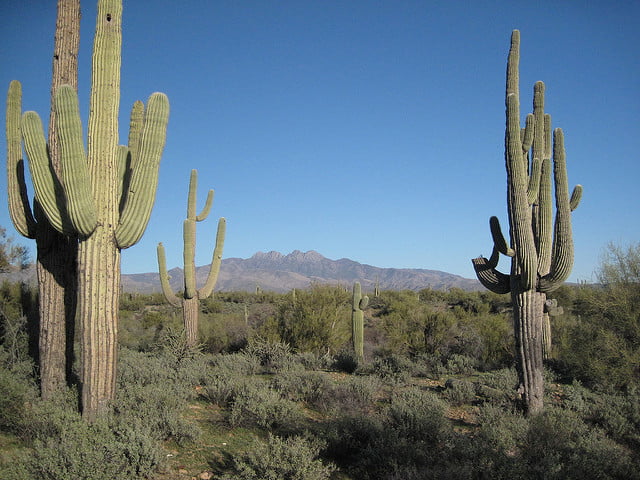
    Saguaro cacti can grow 15 meters tall, and despite their shallow root systems can withstand storm winds up to 38 meters per second without being blown over. Grooves in the cacti’s surface may contribute to its resilience, by adding structural support and/or through reducing aerodynamic loads. The latter theory mirrors the concept of dimples on a golf ball; namely, grooves create turbulence in the flow near the cactus, which allows air flow to track further around the cactus before separating. The result is less drag for a given wind speed than a smooth cactus would experience.

    Indeed, recent experiments on a grooved cylinder with a pneumatically-controlled shape showed exactly that; the morphable cylinder’s drag was consistently significantly lower than fixed samples. Cacti do change their shapes somewhat as their water content changes, but they don’t have the ability for up-to-the-minute alterations. Nevertheless, their adaptations can inspire engineered creations that morph to reduce wind impact. (Image credit: A. Levine; research credit: M. Guttag and P. Reis)

  • Collecting Water in the Desert

    Collecting Water in the Desert

    Desert-dwelling plants like cactuses have to be efficient collectors of water. Many types of cactus are particularly good at gathering water from fog that condenses on their spines. Droplets that form near a spine’s tip move slowly but inexorably toward the base of the spine so that the cactus can absorb them. The secret to this clever transport lies in the microstructure of the spine’s surface. The

    Gymnocalycium baldianum cactus, for example, has splayed scales along its spines. Capillary interactions with the scales result in differences in curvature on either side of the droplet. Curved fluid surfaces generate what’s known as Laplace pressure, with a tighter radius of curvature causing a larger Laplace pressure. Because the curvature of the droplet varies from the base side to the tip side of the spine, the difference in Laplace pressures across the droplet creates a force that drives the droplet toward the spine’s base. (Image credit: C. Liu et al., source)