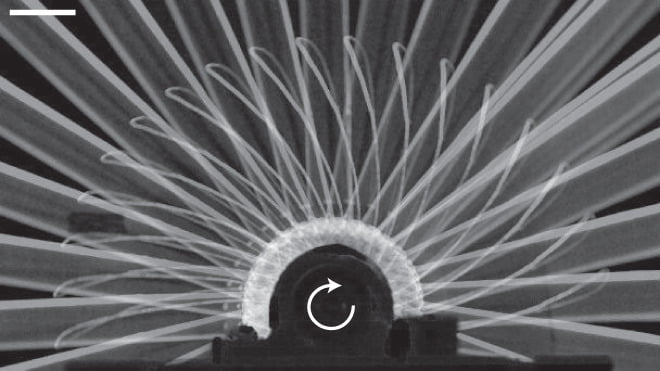
Researchers have used high-speed video and numerical simulation to capture the effects of aerodynamics on jump roping. After videoing an athlete jumping rope and constructing a jump roping robot (shown above imaged multiple times with a strobe light), they found that the U-shaped tip of the jump rope bends away from the direction of motion. When they built a computer model capable of deforming the jump rope based on its drag, they found the same behavior. They concluded that the “best” jump ropes are lightweight, short, and have small diameters to maximize speed and minimize the drag. #
Tag: wired science

Drafting Flags
Wired Science has published a gallery of fluid dynamics photos and videos, several of which have been featured here previously. There’s some neat stuff there, well worth checking out. #
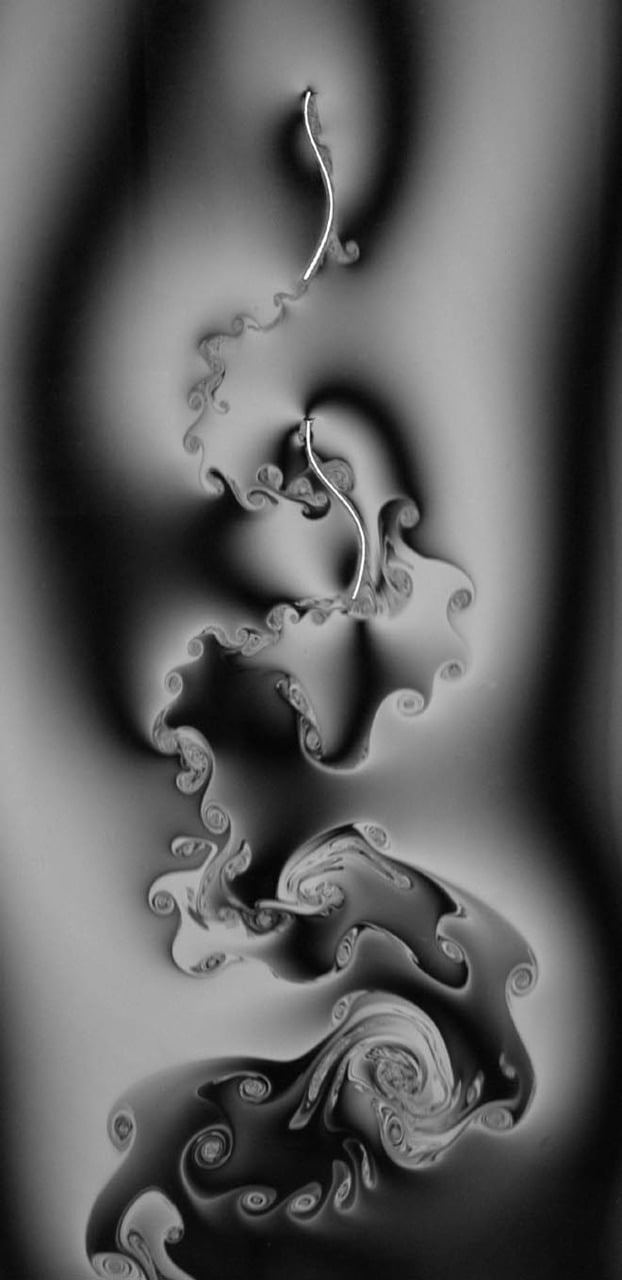
This image shows two flags oriented in line with a film flowing top to bottom. The second flag interrupts the wake of the first one, which reduces the drag experienced by the first flag and increases that on the second. This is called inverted drafting and occurs because the flags are passive objects that bend to every change in the flow. #
Dr. Seussian Mystery Fluid Could Have Saved Top Kill
Dr. Seussian Mystery Fluid Could Have Saved Top Kill
Wired article about using non-Newtonian fluids to plug leaking oil wells as we featured previously.

The White Hole in Your Sink
Ever notice the distinctive ring that forms in your kitchen sink when you turn the water on? This phenomenon is known as a hydraulic jump; it occurs when a fast moving fluid (the water just discharged from the faucet) runs into a slow moving fluid (the water that’s been sitting in the sink) and transfers some of its kinetic energy into potential energy by increasing its elevation. Researchers have recently shown that this everyday occurrence is actually a physical analog to a white hole, the cosmological inverse of a black hole. (In theory, a white hole cannot be entered, but light and matter can escape it.) Check out Wired’s article for an explanation of the clever experiment that showed the equivalence of the two. #

How to Grow Straight Icicles
New research suggests that icicles grow straighter when exposed to moving air while exposure to still air can cause icicles to sprout at their tips. To grow icicles, the researchers built a refrigerated box that dripped water from the top while the growing icicle rotated. Understanding ice growth is important for flight aerodynamics and icing on airplane wings. For videos and more on icicle growth, see the article at Wired Science. #