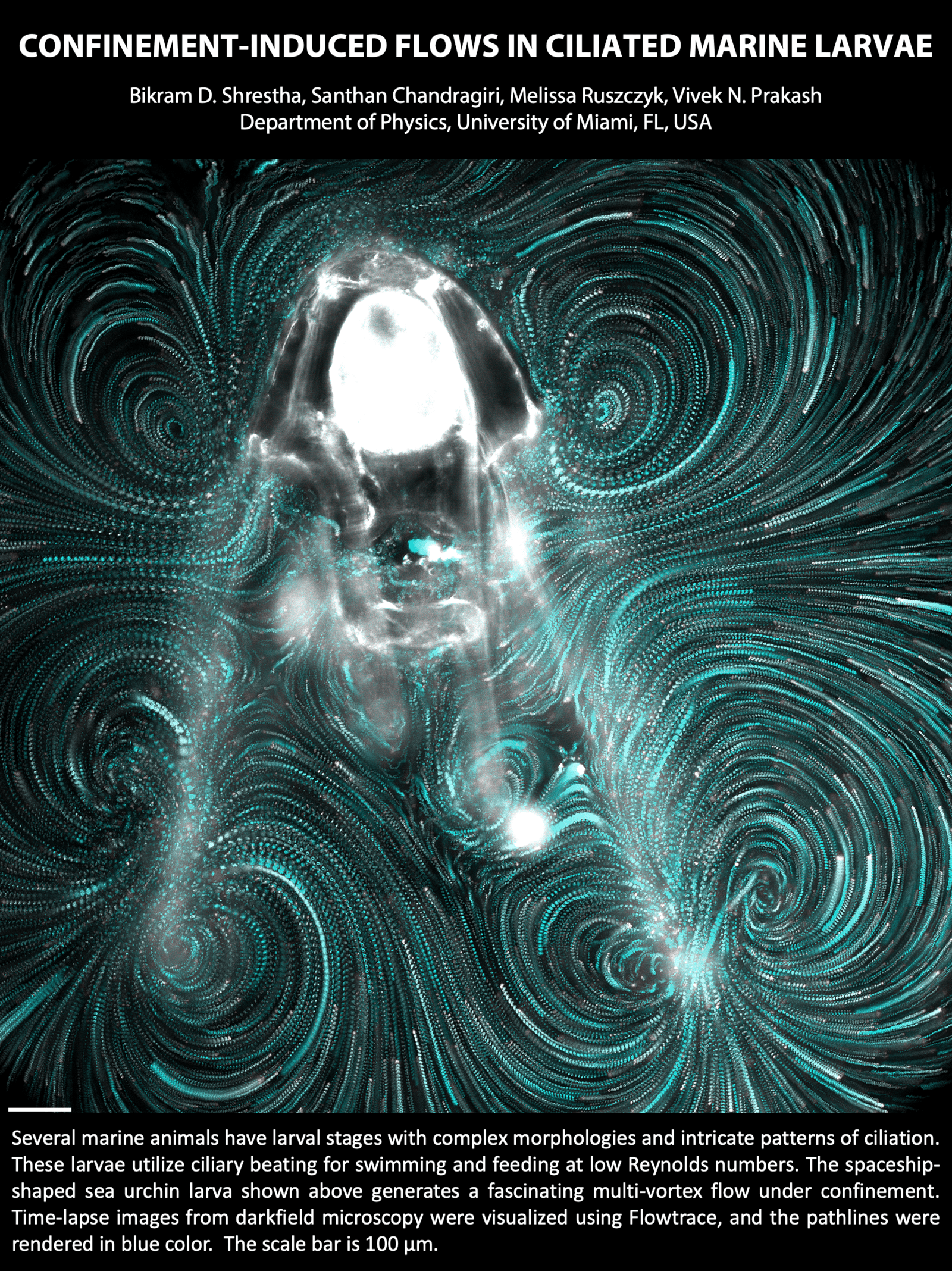
For tiny creatures, swimming through water requires techniques very different than ours. Many, like this sea urchin larva, use hair-like cilia that they beat to push fluid near their bodies. The flows generated this way are beautiful and complex, as shown above. Importantly for the larva, the flows are asymmetric; that’s critical at these scales since any symmetric back-and-forth motion will keep the larva stuck in place. (Image credit: B. Shrestha et al.)
Tag: stokes flow
Reader Question: Creeping Flow
[original media no longer available]
David asks:
I’m taking an undergraduate fluid dynamics course, and I’m having trouble understanding what a Creeping Flow exactly is. The only thing I understand about that is that the Re should be 0 or close to 0 for the flow… Could you post an example of a creeping flow please? Thank you!
Absolutely! Creeping flow, also called Stokes flow, is, like you said, a very low Reynolds number flow. It would be hard to say that the Reynolds number is zero because that would seem to imply no flow at all. Think of it instead as a Reynolds number much, much less than one. When the Reynolds number is very low, it means that viscous forces are dominating the flow. The video above shows creeping flow around a cylinder; notice how the streamlines stay attached all the way around the surface of the cylinder. There’s no separation, no turbulent wake, no von Karman vortex street. Viscosity is so dominant here that it’s damped out all of that inertial diffusion of momentum.
We’ve posted some other great examples of creeping flow, as well, though not by that name. There are the reversible laminar flow demos and various experiments in Hele-Shaw cells, all of which qualify as creeping flow because of their highly viscous nature. If you have the time, there’s also a great instructional video from the 1960s called “Low Reynolds Number Flow” (Parts 1, 2, 3, 4) starring G. I. Taylor (a famous fluid dynamicist) that is full of one demo after another.

Reversing a Flow
The reversibility of laminar mixing often comes as a surprise to observers accustomed to the experience of being unable to separate two fluids after they’ve been combined. As you can see above, however, inserting dye into a highly viscous liquid and then mixing it by turning the inner of two concentric cylinders can be undone simply by turning the cylinder backwards. This works because of the highly viscous nature of Stokes flow: the Reynolds number is much less than 1, meaning that viscosity’s effects dominate. In this situation, fluid motion is caused only by molecular diffusion and by momentum diffusion. The former is random but slow, and the latter is exactly reversible. Reversing the rotation of the fluid undoes the momentum diffusion and any distortion remaining is due to molecular diffusion of the dye.
