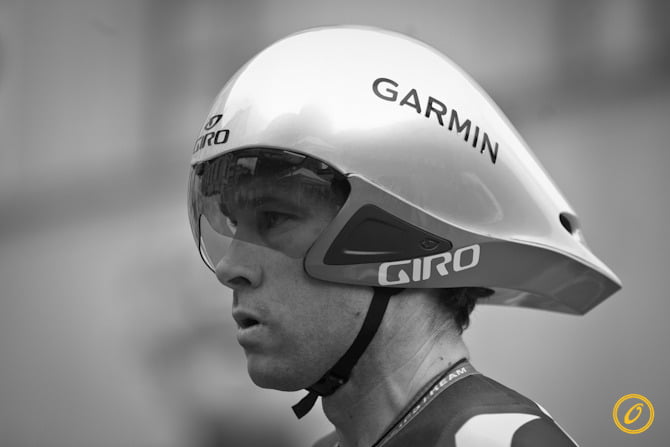
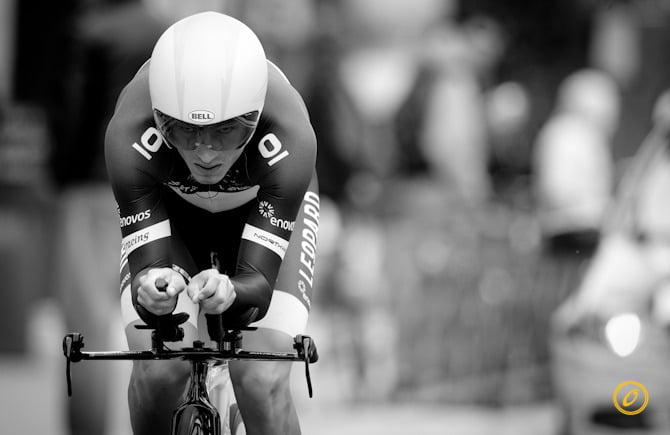
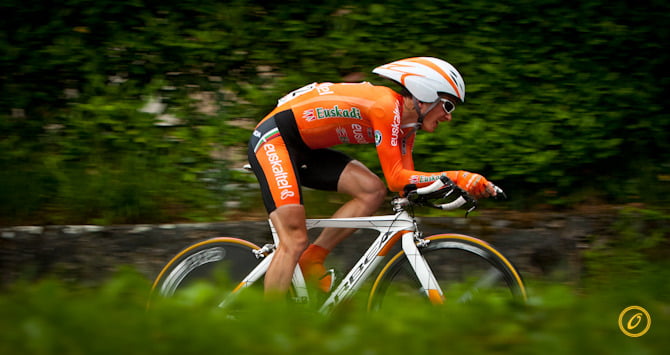
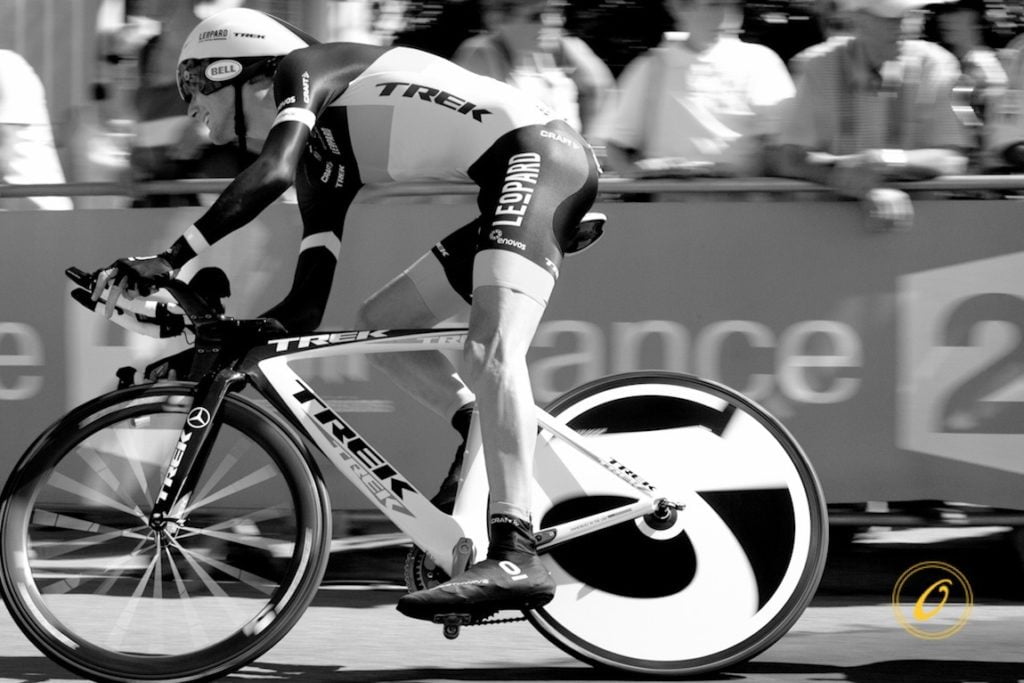
In no discipline of cycling is more emphasis placed on fluid dynamics than in the individual time trial. This event, a solo race against the clock, leaves riders no place to hide from the aerodynamic drag that makes up 70% or more of the resistance riders overcome when pedaling. Time trial bikes are designed for low drag and light weight over maneuverability, using airfoil-like shapes in the fork and frame to direct airflow around the bike and rider without separation, which creates an area of low pressure in the wake that increases drag. Riders maintain a position stretched out over the front wheel of the bike, with their arms close together. This position reduces the frontal area exposed to the flow, which is proportional to the drag a rider experiences.
Special helmets, some with strangely streamlined curves, are used to direct airflow over the rider’s head and straight along his or her back. Both helmets and skinsuits are starting to feature areas of dimpling or raised texturing. These function in much the same way as a golf ball; the texture causes the boundary layer, the thin layer of air near a surface, to become turbulent. A turbulent boundary layer is less susceptible to separating from the surface, ultimately leading to lower drag than would be observed if the boundary layer remained laminar. Wheels, skinsuits, gloves, shoe covers, and even the location of the brakes on the bike are all tweaked to reduce drag. In an event that can be decided by hundredths of a second between riders, every gram of drag counts. (Photo credits: Stefano Rellandini, POC Sports, Reuters, Paul Starkey, Louis Garneau)
FYFD is celebrating the Olympics by featuring the fluid dynamics of sports. Check out our previous posts on how the Olympic torch works, what makes a pool fast, the aerodynamics of archery, and the science of badminton.