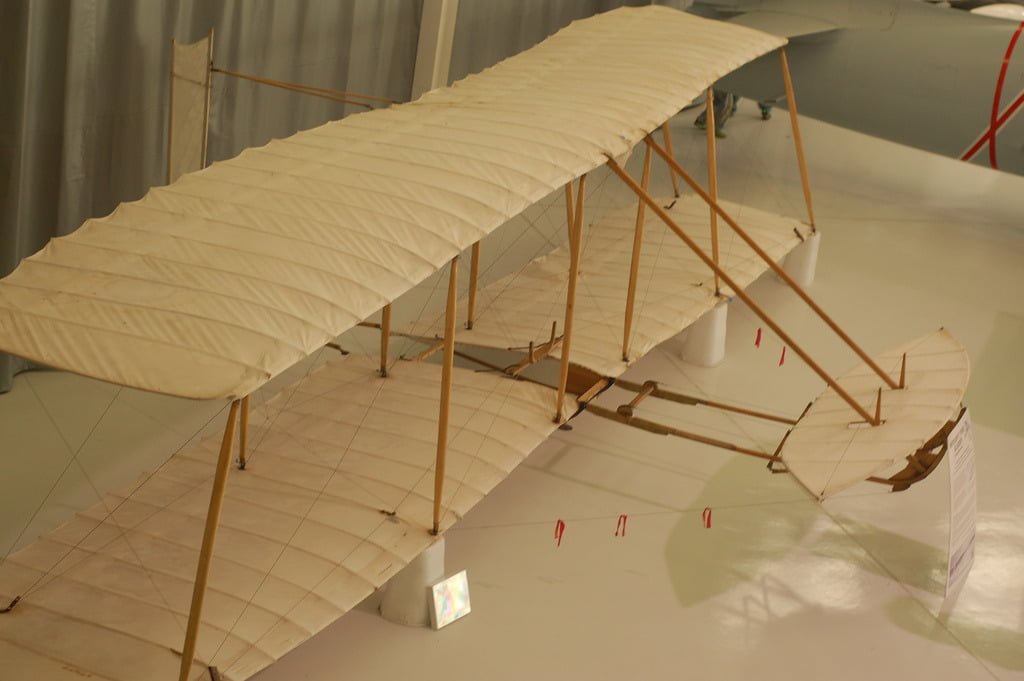
This replica of the Wright brothers’ 1902 glider demonstrates one of the important innovations the brothers contributed toward powered heavier-than-air flight. To control an aircraft in roll, the Wright brothers developed the idea of wing-warping. The pilot would lie in the cradle (center of image) and shift his body to one side. A system of wires and pulleys would then twist the wings from their rear edge, pulling one side down and the other up. This deflection is akin to changing the wing’s angle of attack. Deflecting the right wingtip downward increased the lift on the right side of the glider, while simultaneously the upward deflection on the left decreased the lift on that side. This causes the glider to bank, or roll, with the right wing up, thereby generating a leftward turn. The lift differential also caused a drag differential, though, with increased drag on the lifted (right, in this case) wing. That extra drag tended to pull the aircraft’s nose rightward, a condition known as adverse yaw. To counter it, the Wright brothers installed a steerable rudder and linked it to the wing-warping mechanism, allowing them to turn with much less effort than other conventional craft. Although wing-warping has been replaced with ailerons, the control principles remain the same. For more, watch this demo of the wing warping mechanism on a 1903 Wright Flyer replica. (Image credit: C. Devers)
Tag: Wright brothers

Wright Brothers’ Wind Tunnel
A large part of the Wright Brothers’ ultimate success in creating the first powered heavier-than-air craft came as a result of work done in their homemade wind tunnel, shown above. In the aftermath of the failure of their 1901 Glider, the brothers decided that the lift and drag data they had used from Otto Lilienthal must be inaccurate. They built this wind tunnel and its force balances to measure lift and drag on two hundred different airfoils themselves and were rewarded with far more successful flights with their 1902 Glider, which led directly to the Wright Flyer in the following year. #
