Soap films are ephemeral and ever-changing. The shifting concentration of surfactants along the surface of the film, combined with thermally-driven convection, keeps the fluid in motion. The shifting colors reflect subtle changes in the soap film’s thickness. Over time, gravity drains fluid from the top of the film, thinning it to the point that it appears black. This photo from Bruno Militelli captures all of that detail in a striking and fascinating image that earned him 2nd place in the Manmade category of the Close-Up Photographer of the Year awards. You can find more winners of the competition here, and more of Militelli’s work on his website and Instagram. (Image credit: B. Militelli)
Month: March 2022

Vortex Arms


A fixed cylinder will shed alternating vortices in its wake, but one allowed to oscillate forward and backward in the flow instead sheds simultaneous vortices. The shape of the wake still depends on the flow’s velocity. At low flow speeds, the two vortices are the same size when they shed. At higher velocities, the two vortices still shed simultaneously, but one will be large while the other is small. The larger vortex moves faster and travels downstream, but the smaller, slower vortex drifts inward. In the next shedding cycle, the small and large vortices switch positions, creating alternating symmetric shedding. (Image and video credit: P. Boersma et al.)

The Shapes of Melting Ice


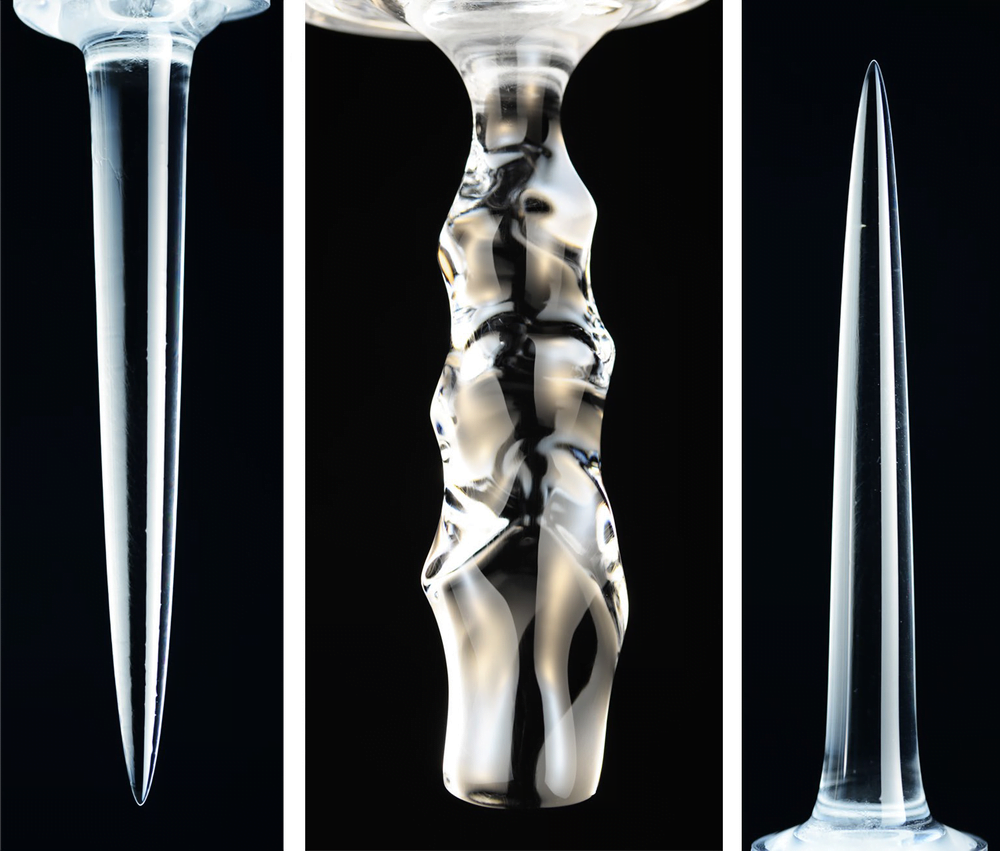
Water is an odd substance because it is densest at 4 degrees Celsius, well above its melting point at 0 degrees Celsius. This density anomaly means that melting ice takes on very different shapes, depending on the temperature of the water surrounding it. At low temperatures (under 4 degrees Celsius), the cold water melting off the ice is denser than the surroundings, so it sinks. The sinking fluid melts lower portions of the ice faster, leading to an inverted pinnacle (Image 1).
In contrast, at higher temperatures (above 7 degrees Celsius), the meltwater is lighter than the surroundings and therefore rises, creating an upward-pointing pinnacle (Image 3). At intermediate temperatures, some areas of the ice see rising meltwater and some see sinking. This complicated flow pattern sets up vortices that result in a scalloped edge along the ice (Image 2). (Image and research credit: S. Weady et al.; via APS Physics)

Ship Tracks in the Sky
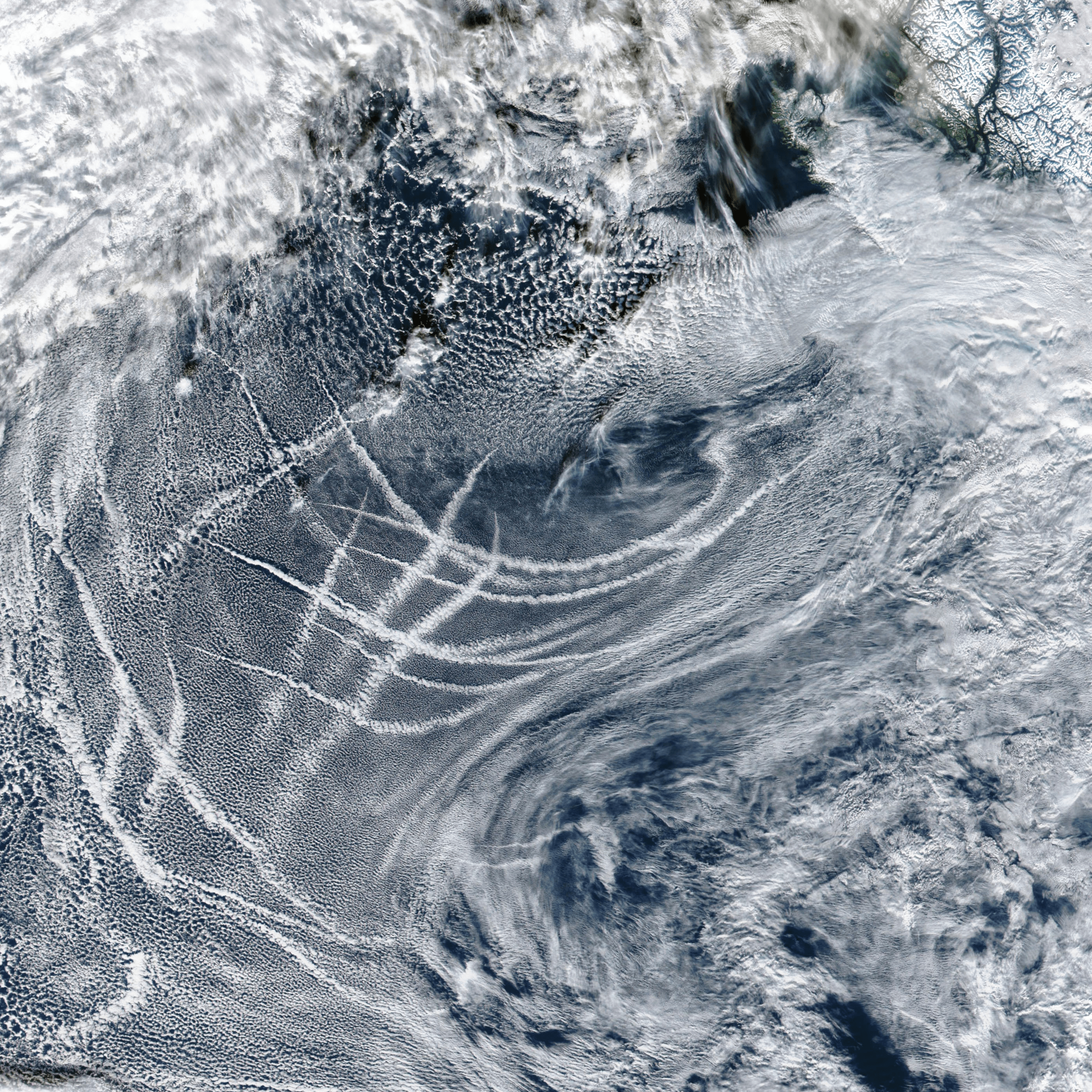
Line-like clouds criss-cross the Pacific Ocean in this satellite image. Each one is a ship track, a remnant left behind a passing ship. As they travel, ships leave a trail of exhaust that seeds the atmosphere with aerosols that serve as additional nucleation sites for clouds. The tiny particles interact with existing low-level clouds, making them brighter. Of course, the aerosols are present in the wake of ships regardless of whether they seed clouds that we can observe. (Image credit: J. Stevens; via NASA Earth Observatory)