This aerial photo of Lake Owens by Paul Hoelen won a 2020 Drone Photo Award in the Abstract category. As Hoelen notes, “The phoenix rising is a symbol of re-emergence from the ashes of fire.” Lake Owens was used for years in mining and other industries, which left the lake desiccated and depleted. But nature is beginning to recover; migratory birds have returned to the lake, and life is beginning anew. (Image credit: P. Hoelen; via Colossal)
Year: 2021

Flamingo Filter-Feeding


Flamingoes are strange and ungainly creatures, but their hooked bills make much more sense when you see them eating underwater. The birds are filter feeders, and they suck water, mud, and silt in through the front of their bills and pump it back out the sides. In between hairy structures called lamellae help them separate algae, brine shrimp and other food from the mix. Be sure to turn the sound up on the video so that you can hear the sound of flamingoes at work. (Image and video credit: San Diego Zoo; via Colossal)

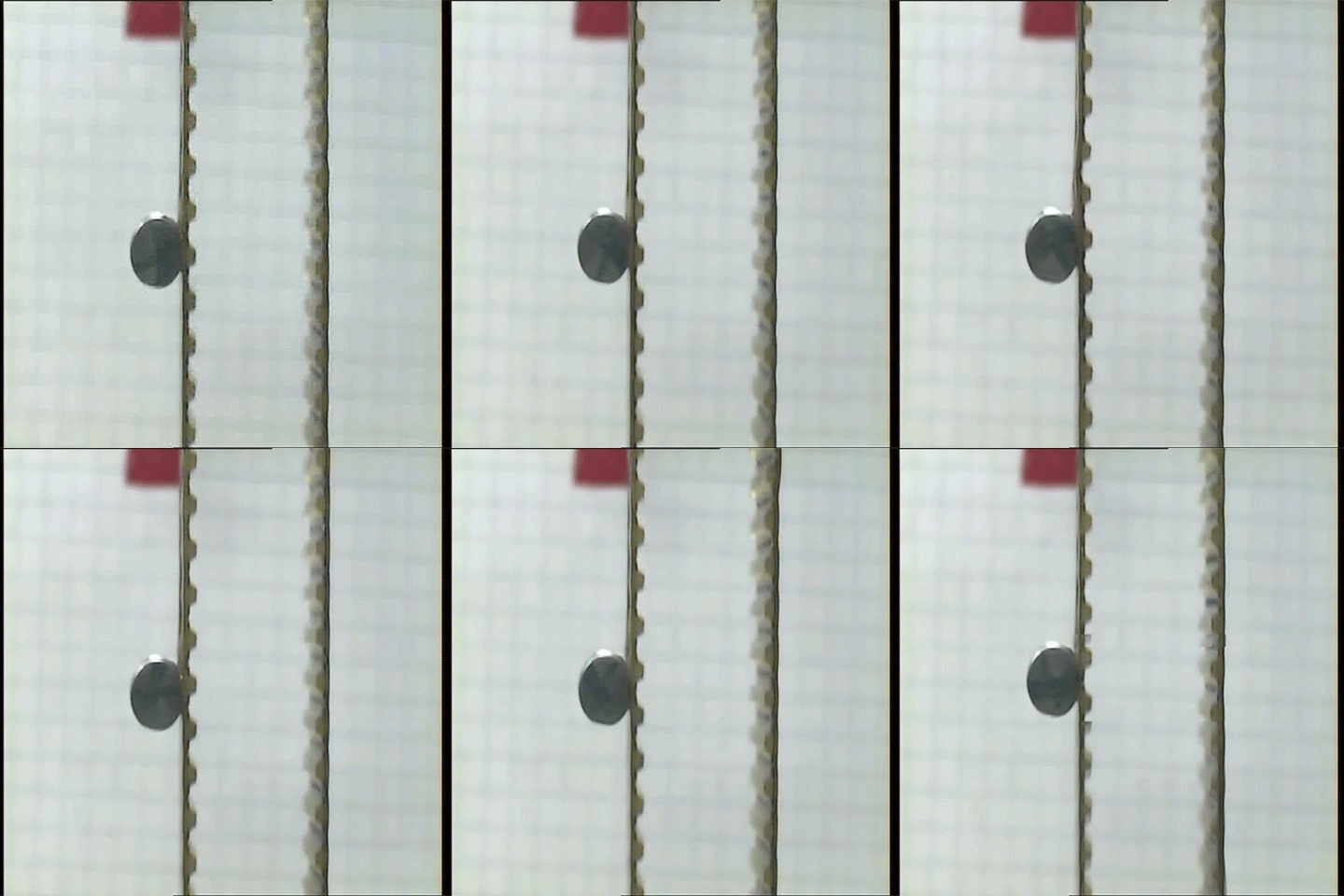
Levitating Cylinders by Lubrication
Here’s a surprising example of defying gravity: if you coat a vertical treadmill in oil, a cylinder held next to it will levitate! A new paper delves into the mathematics behind this surprising situation, showing that the key to keeping the cylinder aloft is the pressure that forms where the oil layer splits around the disk. For a given cylinder size and mass, there’s a unique treadmill speed that will levitate it. By experimentally testing a range of cylinder sizes and masses, the authors validated their model and showed a simply scaling argument for predicting the belt speed needed for levitation. (Image and research credit: M. Dalwadi et al.; via Nature; submitted by Kam-Yung Soh)
Pipe Flow and Pressure


Whether you’re a homeowner or an engineer, at some point you’ll have to deal with pipe flow and the challenges inherent to getting water from Point A to Point B. This Practical Engineering video provides a great basic overview of pipe flow and pressure loss, whether you’re looking for an introduction to the topic or a little refresher. It’s also got some small-scale demos in an actual system to help you build intuition for what changing pipe length, diameter, and fittings does to the flow. (Video and image credit: Practical Engineering)
Ferrovolcanism


Beyond Earth, scientists expect to find objects formed by a volcanism much different than what we typically see here. Researchers used Syracuse University’s Lava Project apparatus to simulate ferrovolcanism — in this case with a mixture containing both metallic lava and silicate lava. Interestingly, the team found that the two types of lava flow largely independently of one another. The silicate lava is much more viscous but less dense and flows relatively slowly. The metallic lava is far less viscous and flows about 10 times faster, but it’s also denser, so most of it flows beneath the silicate lava, with only a few fingers that burst out atop the other lava or erupt in braided flows from the leading edge of the flow.
The upcoming Psyche mission will explore a metal asteroid (of the same name) that’s thought to be the remains of an early planet’s nickel-iron core. Studies like this one are giving planetary physicists new insight into the kinds of geological features await us there. (Video and research credit: A. Soldati et al.; via AGU Eos; submitted by Kam-Yung Soh)
Kinetic Sculptures by Anthony Howe


These mesmerizing kinetic sculptures built by Anthony Howe are entirely wind-driven. It’s not necessarily apparent in these images, but these sculptures are several meters tall and weigh hundreds of kilograms, but they’re engineered so precisely that the slightest breeze sets them silently spinning. See more of Howe’s art in action on his YouTube channel. (Video and image credits: A. Howe; via Colossal)
Challenges of Commercial Supersonic Flight


Years ago as I sat on a plane taxiing at Heathrow, I caught a glimpse of a Concorde out on the tarmac. My classmates couldn’t understand why I was so excited to see that funny looking plane, but even as a high schooler, I was fascinated by the prospect of flying faster than sound.
Unfortunately, there are a lot of challenges to overcome in making supersonic flight widely available — fuel efficiency, cost effectiveness, and sonic boom control, to name a few. This video delves into some of the major issues and touches on some of the recent work at NASA and other organizations studying the problem. Perhaps as new technologies develop and mature we’ll once again see faster-than-sound air travel outside of rocket launches and military jets. (Video and image credit: TED-Ed)

Brace For Impact
What happens in the moment before an object hits the water? That’s the question at the heart of a new study exploring how water deforms before an object’s impact. The researchers dropped circular disks onto a pool of water and, using a new reflection-based technique, measured micron-sized deflections in the water’s surface before impact, as seen below.

Movie of the water surface’s deflection as the circular disk approaches. Look for distortions in the grid pattern. The deflections are caused by the air getting squeezed out of the space between the oncoming object and the water surface. The team found that the deformation isn’t uniform. The air squeezing out along the edges moves fast enough to trigger a Kelvin-Helmholtz instability and actually pull up the water surface. So when the disk hits, it impacts along its edges first and traps an air bubble underneath. (Image credits: divers – E. Carter, experiment – U. Jain et al.; research credit and submission: U. Jain et al.)

Blue Dunes
This false-color image shows a Martian dune field near the northern polar cap. The image itself covers an area 30 kilometers wide, but the dune field stretches over an area the size of Texas. In the photo cooler areas have been rendered in bluer tints, while warm areas are shown in yellow and orange. The sun warms the wind-sculpted dunes more than in the valleys that lie between. Complex dune networks like these build up over time as consistent winds push sand and create interactions between individual dunes. (Image credit: NASA/JPL-Caltech/ASU; via Colossal)

Tiny Symmetric Swimmers
Microswimmers live in a world dominated by viscosity, and in viscous fluids, symmetric motion provides no propulsion. That’s why bacteria and other tiny organisms use cilia, corkscrew flagella, and other asymmetric means to swim. But a new study decouples the symmetry of a swimmer’s motion from the motion of the fluid, thereby creating a tiny symmetrically-driven swimmer that does swim.
Their microswimmer consists of two beads, which attract one another via surface tension and are repelled using external magnetic fields. This effectively creates a spring-like connection between the two beads, making them move in and out symmetrically in time. But since one bead is larger than the other, its greater inertia makes it slower to start moving and slower to coast to a stop. This inertial imbalance between the two is significant enough for the beads to swim. The key here is that though the beads’ motion relative to one another is symmetric, their motion relative to the fluid is not! (Image and research credit: M. Hubert et al.; via Science; submitted by Kam-Yung Soh)