Month: March 2021

  • Featured Video Play Icon

    Wind Turbine Physics

    Over the years, wind turbines have gotten tall with long, thin blades. This MinutePhysics video delves into the reasons for those changes. They’re all aimed at generating more wind power and doing so with greater efficiency.

    I’ll add one caveat to the video, though, because you may wonder how modern wind turbines can be fast when they appear to rotate so slowly. That’s a trick of the reference frame. The power a turbine blade generates depends on the flow speed over it, and the relative air speed is greatest near the tip of the turbine blades.

    Think of the circle the blade tip traces. For a given rotation rate – say once revolution a minute – the blade tip has a much larger distance to travel than the blade’s base does. Divide that large distance by the rotation time and you get a large velocity. So even though the wind turbine appears to be rotating slowly, the flow the blade sees is quite fast. And the longer the wind turbine’s blades, the larger this effect. (Image and video credit: H. Reich/MinutePhysics)
  • The Sounds of Leidenfrost Stars

    The Sounds of Leidenfrost Stars

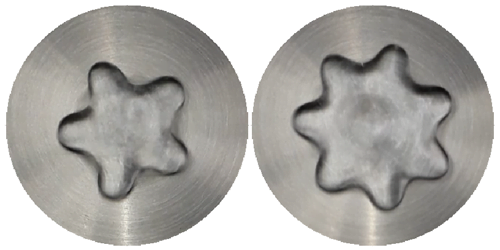
    On a hot surface, droplets can float on a layer of their own vapor and vibrate in star-like shapes. These so-called Leidenfrost stars also make noise, with distinct beats that match the oscillations of the vapor layer beneath them. Researchers found that the frequency of the sound shifts with droplet size, increasing as the drop size decreases. Physically, the droplets act much like a wind instrument! (Image and research credit: T. Singla and M. Rivera; via APS Physics)

  • Blue Jets

    Blue Jets

    Blue jets are a mysterious form of lightning that shoots upward from intense thunderstorms. The image above comes from one of the first color videos of blue jets, taken by an astronaut aboard the International Space Station. Scientist think blue jets form during an electric breakdown between the positively-charged upper region of a cloud and the negative charge at its boundary. Once the discharge starts, it can shoot to the stratopause in less than a second, forming a glowing, blue, nitrogen-based plasma. (Image credit: ESA/NASA/DTU Space; via NASA Earth Observatory)

  • “Liquid Skies”

    “Liquid Skies”

    “Liquid Skies” by Roman De Giuli is full of colorful but nebulous fluid imagery. The visuals consist of liquids like paint, ink, and alcohol filmed in macro atop paper. You can catch a behind-the-scenes glimpse of De Giuli at work here. (Image and video credit: R. De Giuli)

  • Acidic Sea Spray

    Acidic Sea Spray

    As waves crash and break, they generate a spray of droplets — known as aerosols — that make their way into the atmosphere. Researchers investigated the chemistry of these aerosol droplets by generating spray in a wave tank filled with ocean water. They found that aerosol droplets are far more acidic than the ocean they come from, and the smaller the droplet, the more acidic it is. This acidification happens in a matter of minutes, as acidic gases interact with the spray. Their findings will be critical for accurately modeling the climate connections between our oceans and atmosphere. (Image credit: Elle; research credit: K. Angle et al.; via OceanBites; submitted by Kam-Yung Soh)

  • Spiderwebs and Stratocumulus Clouds

    Spiderwebs and Stratocumulus Clouds

    Stratocumulus clouds cover about 20% of Earth’s surface at any given time, and they form distinctive patterns of lumpy cells separated by thin slits. Because of their interconnectedness, researchers nicknamed these narrow regions spiderwebs. New simulations show that evaporative cooling along the cloud tops drives the formation of these spiderwebs (Image 2). Without it (Image 3), the cloud pattern looks very different. (Image credits: featured image – L. Dauphin/MODIS, others – UConn ME 3250; research credit: G. Matheou et al.)

  • Featured Video Play Icon

    The Unsinkable Pygmy Gecko

    The Brazilian pygmy gecko is a tiny inhabitant of the Amazon rainforest, growing to no longer than 24 mm. But these tiny lizards have some incredible superpowers when it comes to surviving the rainforest’s deluges. The gecko’s surface is superhydrophobic — water repellent — thanks to millions of tiny hairs that create air pockets between water and the gecko’s skin. This superhydrophobic surface, combined with the gecko’s tiny stature, allow it to sit atop water, supported entirely by surface tension. (Image and video credit: BBC Earth)

  • The Fluidity of Worm Blobs

    The Fluidity of Worm Blobs

    The aquatic blackworm forms blobs composed of thousands of individual worms for protection against evaporation, light, and heat. The worms braid themselves together (Image 1). Once a blob forms, it is extremely viscoelastic, displaying properties both solid and fluid in nature (Image 2).

    The worm blobs act like a collective; they bunch up to prevent evaporation that would desiccate the worms. Under intense light, the blob contracts (Image 3). The worms also prefer colder temperatures (again, to prevent evaporation) and will move toward the colder side of a temperature gradient. Under dim light, they’ll move individually, but in brighter light, the worms move collectively as a blob (Image 4).

    To do so, worms on the colder side of the blob pull toward the cold, whereas worms elsewhere in the blob wiggle (Image 5). Their wiggling helps lift the blob and reduce its friction so that the pulling worms can move the blob in the right direction. For more, check out this excellent thread by one of the authors. (Image and research credit: Y. Ozkan-Aydin et al.; via S. Bhamla; submitted by Maximilian S.)

  • Featured Video Play Icon

    “Flux Capacitor”

    Sandro Bocci’s short film “Flux Capacitor” explores the geometry and dynamics of soap films. When you dip wire models into soapy solution, the films that cling to the model can form complicated shapes as surface tension works to minimize the overall surface area. Bocci’s macro photography highlights the intense flows going on in the narrow regions where films meet. It’s a different take on soap films and neat to see! (Image, video, and submission credit: S. Bocci et al.)

  • Gathering Droplets

    Gathering Droplets

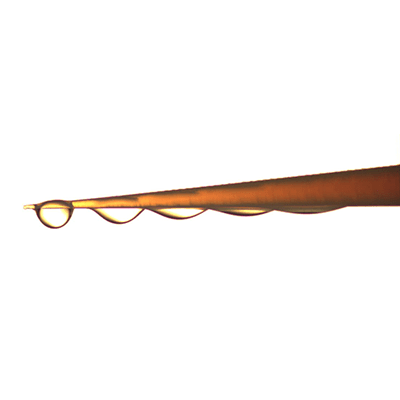
    In deserts around the world, plants have adapted to collect as much moisture as they can. Geometry aids them in this endeavor because droplets on the tip of a cone will move toward its thicker base. The motion takes place due to a imbalance in surface tension forces on either end of the droplet.

    As the droplet moves up a cone, it changes shape from a barrel-like drop that fully covers the conical surface to a clamshell-shaped droplet that hangs only from the bottom of the cone. (Image and research credit: J. Van Hulle et al.)