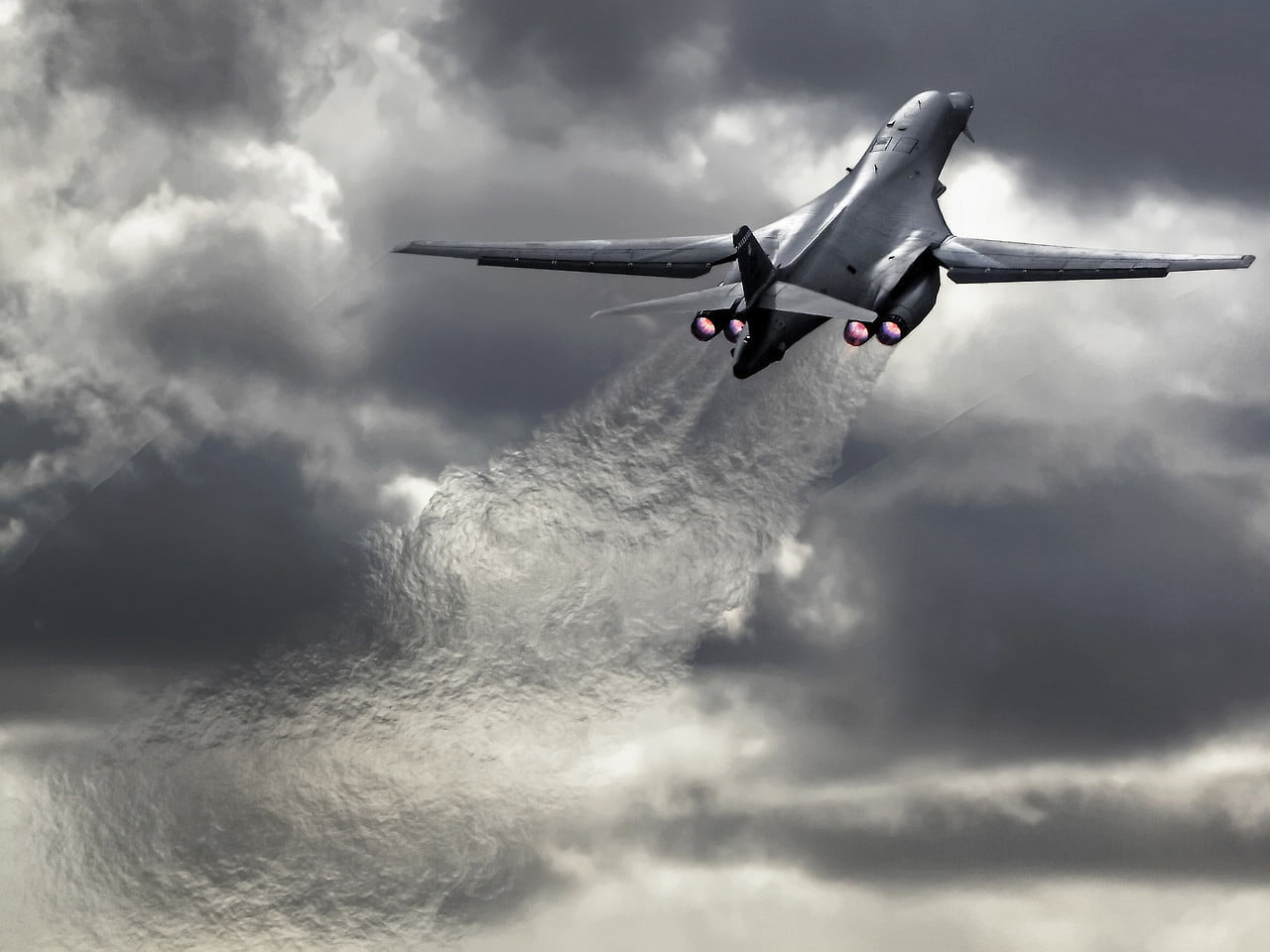
Hot exhaust gases churn in the wake of this climbing B-1B Lancer. The high temperature of the exhaust changes the density and, thus, the refractive index of the gases relative to the atmosphere. Light traveling through the exhaust gets distorted, making the highly turbulent flow visible to the human eye. Note how the four individual engine exhaust plumes quickly combine into one indistinguishable wake. This is typical for turbulence; it’s hard to track where any given fluctuations originally came from. The airplane’s wingtip vortices are just visible as well, if you look closely. (Image credit: T. Rogoway; submitted by Mark S.)
Year: 2018

Pilot-Wave Hydrodynamics: Resources
This is the final post in a collaborative series with FYP on pilot-wave hydrodynamics. Previous posts: 1) Introduction; 2) Chladni patterns; 3) Faraday instability; 4) Walking droplets; 5) Droplet lattices; 6) Quantum double-slit experiments; 7) Hydro single- and double-slit experiments; 8) Quantum tunneling; 9) Hydrodynamic tunneling; 10) de Broglie’s pilot-wave theory
Thanks for joining us this week as we explored nearly two centuries’ worth of scientific discoveries around vibration, fluid dynamics, and quantum mechanics. For those who’d like to learn more about these and related topics, we’ve compiled some helpful resources below.
Other Videos, Articles, and Resources by Topic
Chladni Patterns
- ANSYS, “Chladni Plates”
- Brusspup, “Amazing Resonance Experiment!”
- Kenichi Kanazawa, “Color Sound”
- Microfluidic Chladni patterns
- Nigel Stanford, “Cymatics”
- Peter Remco, “Chladni patterns in a violin plate”
- Steve Mould, “Random couscous snaps into beautiful patterns”
Faraday Instability
- FYFD, Alligators and water dancing
- FYFD, Liquid crystals vibrating on a tuning fork
- Gallery of Fluid Motion, “The Tibetan singing bowl”
- Nigel Stanford, “Cymatics”
- Slow Mo Guys, “Chinese spouting bowl in slow motion.”
Quantum Mechanics
Pilot-wave Hydrodynamics
- Dual Walkers, learn about the physics from the researchers themselves
- Gallery of Fluid Motion, “The pilot-wave dynamics of walking droplets.”
- Gallery of Fluid Motion, “Shedding light on pilot-wave phenomena.”
- The Lutetium Project, “Never-ending bouncing droplets.”
- The Lutetium Project, “Dual walkers: drops and waves.”
- Through the Wormhole, Interview with Y. Couder
- Wired, “Have we been interpreting quantum mechanics wrong this whole time?”
- Veritasium, “Is this what quantum mechanics looks like?”
Selected (Academic) Bibliography by Topic
Articles marked with an asterisk (*) are recommended for their approachability and/or broad overview of the subject.
Chladni Patterns
- (*) M. Faraday, “On a peculiar class of acoustical figures; and on certain forms assumed by groups of particles upon vibrating elastic surfaces,” 1831.
- Lord Rayleigh, “On the circulation of air observed in Kundt’s tubes, and on some allied acoustical problems,” 1884.
- H. van Gerner et al., “Air-induced inverse Chladni pattern,” 2011.
Faraday Instability
- (*) M. Faraday, “On a peculiar class of acoustical figures; and on certain forms assumed by groups of particles upon vibrating elastic surfaces,” 1831.
Pilot-wave Hydrodynamics
- Y. Couder and E. Fort, “Single-particle diffraction and interference at a macroscopic scale,” 2006.
- A. Eddi et al., “Unpredictable tunnel of a classical wave-particle association,” 2009.
- (*) Y. Couder et al., “Walking droplets: A form of wave-particle duality at macroscopic scale?”, 2010.
- J. Molacek and J. Bush, “Droplets bouncing on a vibrating bath,” 2013.
- J. Molacek and J. Bush, “Droplets walking on a vibrating bath: toward a hydrodynamic pilot-wave theory,” 2013.
- D. Harris et al., “Wave-like statistics from pilot-wave dynamics in a circular corral,” 2013.
- O. Wind-Willassen et al., “Exotic states of bouncing and walking droplets,” 2013.
- (*) J. Bush, “Pilot-wave hydrodynamics,” 2015.
- D. Harris et al., “Visualization of hydrodynamic pilot-wave phenomena,” 2016.
(Image credit: A. Labuda and J. Belina)

Pilot-Wave Hydrodynamics: Droplet Tunneling


This post is part of a collaborative series with FYP on pilot-wave hydrodynamics. Previous posts: 1) Introduction; 2) Chladni patterns; 3) Faraday instability; 4) Walking droplets; 5) Droplet lattices; 6) Quantum double-slit experiments; 7) Hydro single- and double-slit experiments; 8) Quantum tunneling
Quantum tunneling is a strange subatomic behavior that was first described to explain how alpha particles escape a nucleus during radioactive decay. Classically, a particle trapped in a well can only escape if its energy is sufficiently high, but in quantum mechanics, even a particle with lower-than-necessary energy can occasionally “tunnel” out.
To test whether hydrodynamic walkers can tunnel, researchers built corrals. In the central region, the pool on which the walker moves is relatively deep. Over the walls, the pool is much shallower. In this shallow area, the wave from the droplet’s bouncing decays quickly, creating a partially reflective barrier. For most collisions, the walker reflects off the barrier. Other times, apparently at random, a collision results in the walker crossing the wall and tunneling out of its well.
Over many experiments, researchers were able to construct a probabilistic view of walker tunneling. In quantum mechanics, a particle’s likelihood of tunneling out of a well depends on the particle’s energy and the well’s thickness. The analogs for a walker are velocity and barrier thickness. The thicker the barrier, the harder it is for a walker to tunnel through. Conversely, a faster walker has a higher probability of tunneling through a barrier of a given thickness. As the authors themselves observe:
“Although our experiment is foreign to the quantum world, the similarity of the observed behaviors is intriguing.” #
As we wrap up our series tomorrow, we’ll consider some of those similarities more deeply.
(Image credits: A. Eddi et al., sources)

Pilot-Wave Hydrodynamics: Slit Experiments


This post is part of a collaborative series with FYP on pilot-wave hydrodynamics. Previous entries: 1) Introduction; 2) Chladni patterns; 3) Faraday instability; 4) Walking droplets; 5) Droplet lattices; 6) Quantum double-slit experiments
In quantum mechanics, the single and double-slit experiments are foundational. They demonstrate that light and elementary particles like electrons have wave-like and particle-like properties, both of which are necessary to explain the behaviors observed. Similarly, a hydrodynamic walker consists of both a particle and a wave, so, perhaps unsurprisingly, researchers tested them in both single-slit and double-slit experiments.
When a walker passes through a single-slit (top row), it’s deflected in a seemingly random direction due to its waves interacting with the slit. But if you watch enough walkers traverse the slit, you can put together a statistical representation of where the walker will get deflected. Compare that with the results for a series of photons passing through a slit one-at-a-time, and you’ll see a remarkable match-up.
If you test the walker instead with two slits, the droplet can only pass through one slit, but its accompanying wave passes through both (bottom row). Let enough walkers through the system one-by-one, and they, like their photonic cousins, build up interference fringes that match the quantum experiment. Diffraction and interference are only a couple of the walkers’ tricks, however. In the next posts, we’ll take a look at another analog to quantum behavior: tunneling.
(Image and research credits: Couder et al., source, selected papers 1, 2; images courtesy of E. Fort)

Pilot-Wave Hydrodynamics: Walking Drops
This post is a collaborative series with FYP on pilot-wave hydrodynamics. Previous entries: 1) Introduction; 2) Chladni patterns; 3) Faraday instability
If you place a small droplet atop a vibrating pool, it will happily bounce like a kid on a trampoline. On the surface, this seems quite counterintuitive: why doesn’t the droplet coalesce with the pool? The answer: there’s a thin layer of air trapped between the droplet and the pool. If that air were squeezed out, the droplet would coalesce. But it takes a finite amount of time to drain that air layer away, even with the weight of the droplet bearing down on it. Before that drainage can happen, the vibration of the pool sends the droplet aloft again, refreshing the air layer beneath it. The droplet falls, gets caught on its air cushion, and then sent bouncing again before the air can squeeze out. If nothing disturbs the droplet, it can bounce almost indefinitely.

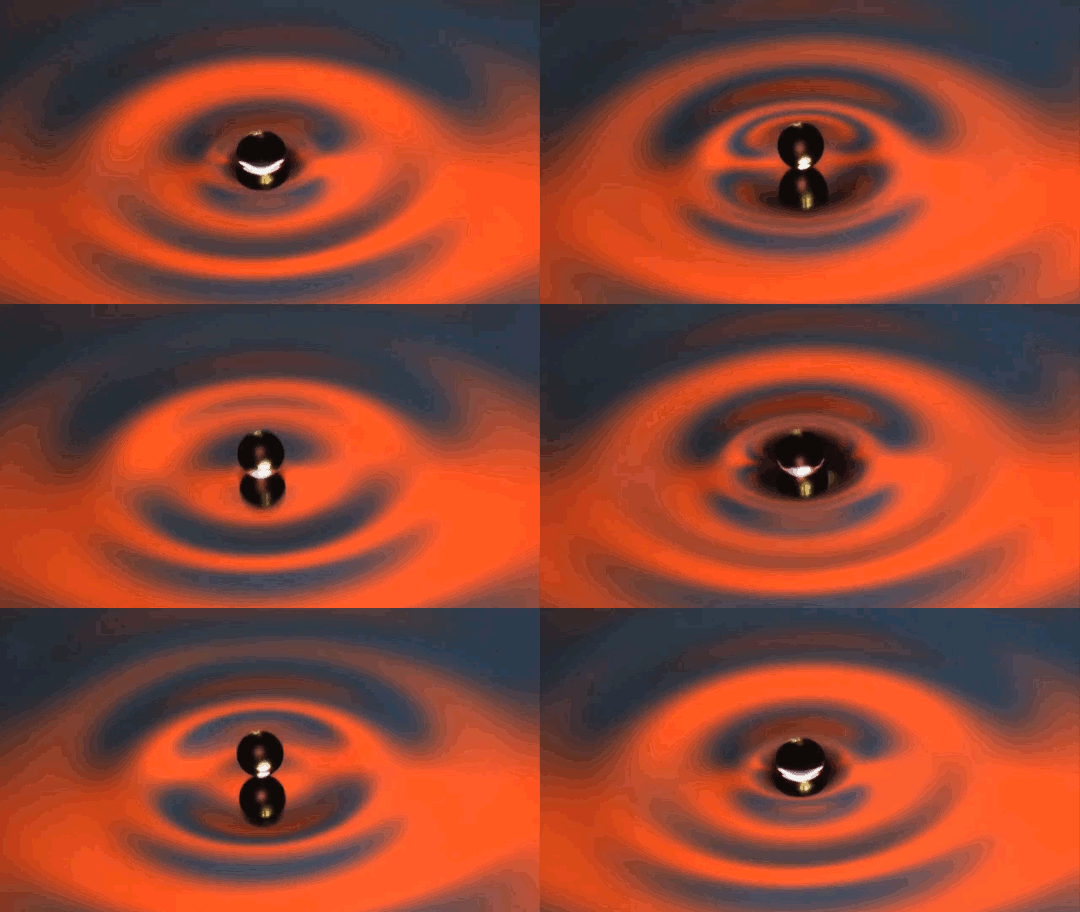
Droplets don’t always bounce in place, though. When forced with the right frequency and acceleration, a bouncing droplet can transition to walking. In this state, the droplet falls and strikes the pool such that it interacts with the ripple from its previous bounce. That sends the droplet aloft again but with a horizontal velocity component in addition to its vertical one. In this state, the droplet can wander about its container in a way that depends on its history or “memory” in the form of waves from its previous bounces. And this is where things start to get a bit weird – as in quantum weirdness – because now our walker consists of both a particle (droplet) and wave (ripples). The similarities between quantum behaviors and the walking droplets, the collective behavior of which is commonly referred to as “pilot-wave hydrodynamics,” are rather remarkable. In the next couple posts, we’ll take a look at some important quantum mechanical experiments and their hydrodynamic counterparts.
(Image credit: D. Harris et al., source)
Pilot-Wave Hydrodynamics: Faraday Instability
This post is part of a collaborative series with FYP on pilot-wave hydrodynamics. Previous entries: 1) Introduction; 2) Chladni patterns
In 1831, in an appendix to a paper on Chladni plate patterns, physicist Michael Faraday wrote:
“When the upper surface of a plate vibrating so as to produce sound is covered with a layer of water, the water usually presents a beautifully crispated appearance in the neighborhood of the centres of vibration.” #
Faraday was not the first to notice this, as he himself acknowledged, but it was his many clever observations and tests of the phenomenon that led to its naming as the Faraday instability. Like Chladni patterns, Faraday waves can take many forms, depending on the geometry of the vibrator and the frequency and amplitude of its vibration.
Beneath the “crispations” at the air interface, the liquid inside the pool is also moving, driven by the vibrations into streaming patterns. Sprinkling particles into this flow reveals discrete recirculation zones that depend on the vibrations’ characteristics, as seen above. This behavior can even be used to assemble particles into distinct formations.

When the vibrations are large enough at resonant frequencies, the rippling waves at the surface become violent enough to start ejecting droplets. You can experience this for yourself using a Chinese spouting bowl or a Tibetan singing bowl with some water. It’s also, bizarrely enough, a factor in alligator mating behaviors!
Next time, we’ll explore what happens to a droplet atop a Faraday wave.
(Image credits: N. Stanford, source; L. Gledhill, source; The Slow Mo Guys, source)

Pilot-Wave Hydrodynamics: Introduction
For the next week on FYFD, I’ll be doing something a little different. I’ve teamed up with FYP to produce a joint series of posts on pilot-wave hydrodynamics, a recent area of investigation on fluid systems that display quantum mechanical behaviors. We’ve touched on some aspects of this previously, but this series will get into more details, building from nineteenth century explorations of vibration all the way to current research. Each weekday FYP and FYFD will each feature a new post in the series, so you can look forward to ten entries total next week. I’ll start each FYFD entry with a recap of links to previous posts so you can be sure you haven’t missed any.
To give you a taste of what’s to come, check out Nigel Stanford’s awesome “Cymatics” music video below. On Monday, we’ll start our exploration of pilot-wave hydrodynamics by examining some of the phenomena featured in the video. (Image credit: D. Harris, original; video credit: N. Stanford)

Hair-Washing in Microgravity
I imagine that the most common questions astronauts get come in the form, “How do you do X in space?” In this video, astronaut Karen Nyberg demonstrates how she washes her hair in space. Using no-rinse shampoo, the process is not terribly different from on Earth: wet the hair, work in the shampoo, add a little more water, and use a towel and comb to work it through all the hair. The big difference is that Nyberg’s hair sticks almost straight up the whole time. That’s an effect of microgravity, obviously, but there are fluid forces at play, too, namely elastocapillarity.
Hair typically feels quite different when it’s wet. Strands bunch together and feel stiffer. This is because of the water trapped in the narrow space between individual hairs. The water’s fluid characteristics (capillarity) affect the solid hairs and change their elastic properties – hence elastocapillarity. We see this on Earth, of course, but the effect is especially noticeable without gravity pulling the wet hair down. (Video credit: K. Nyberg/NASA; via APOD; submitted by Guillaume D.)

Gliding Lizards
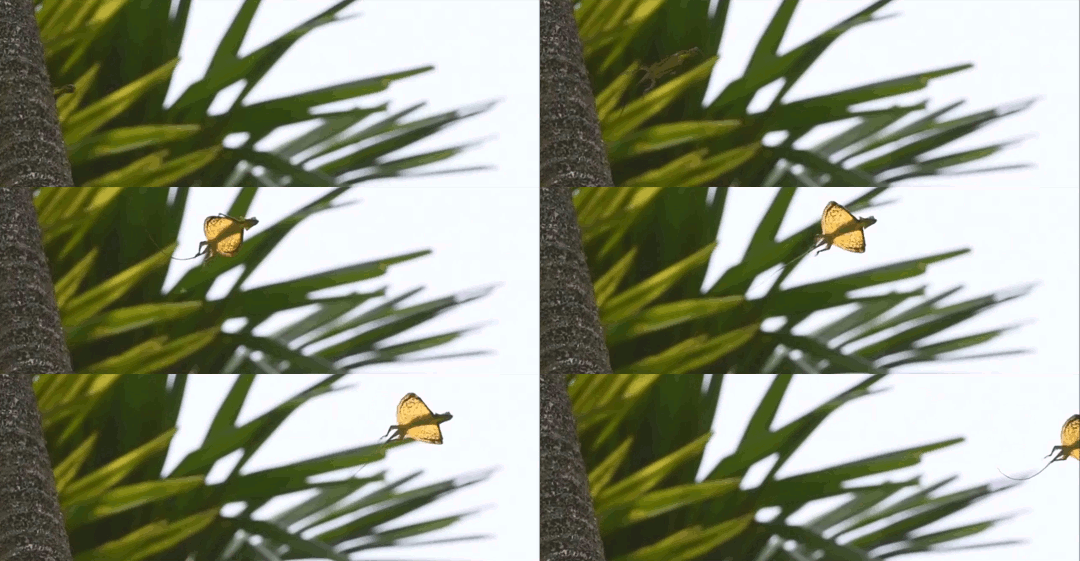
Flying lizards are truly gliders, but that doesn’t mean they’re unsophisticated. Newly reported observations of the species in the wild show that flying lizards don’t simply hold their forelimbs out a la Superman. Instead, they reach back with their forelimbs, pressing their arms into the underside of the thin patagium that serves as their flight surface while rotating their hands to grasp the upper side of the patagium. This forms a composite wing with a thicker leading edge and seems to be how the lizards control their glide. Close observation of their flight shows that, while holding their patagium, the lizards actively arch their backs to camber their composite wing. This can increase their maximum lift coefficient, allowing them to glide longer distances. (Image and research credit: J. Dehling, source)
DIY Acoustic Levitation
Acoustic levitation is a technique where multiple speakers are positioned to create standing waves that can levitate small objects using sound. It’s even possible to manipulate the levitating objects in three-dimensions with the right set-up, but until now, the technology has been confined to the laboratory. Now a group from the University of Bristol has created kits and instructions allowing the curious to build their own acoustic levitators at home. In the video, Dianna shares some of her own adventures in building and playing with these DIY levitators and travels to the U.K. to see more from the creators.
I know what I’m adding to my list of electronics projects to try out! (Video credit: Physics Girl)