Like many sharks, the great hammerhead shark is negatively buoyant, meaning that, absent other forces, it would sink in water. To compensate, sharks generate lift with their pectoral (side) fins to offset their weight. Their dorsal (top) fin is used to generate the horizontal forces needed for control and turning. However, both captive and wild great hammerhead sharks tend to swim rolled partway onto their sides. The reason for this unusual behavior is hydrodynamic – it is more efficient for the shark. Unlike other species, the great hammerhead has a dorsal fin that is longer than its pectoral fins. By tipping sideways, the shark effectively creates a larger lifting span and is able to induce less drag than when it swims upright. Models show that swimming on their sides requires ~8% less energy than swimming upright! (Image credit: N. Payne et al., source)
Month: August 2016

Spillway Waves
Earlier this summer, the spillway of the Banja Dam was opened for the first time, releasing a stream of excess water from the reservoir. As you can see above, waves quickly formed at the surface of the falling water. You’ve likely noticed this yourself in the run-off along the street after a storm. It turns out that shallow water running down an incline is unstable. A disturbance to the flow – from surface roughness, vibration, or a change in curvature – will grow, just like a ball sitting at the top of a hill will roll down as soon as it’s prodded. For more about this kind of instability, check out this post or my video about boundary layer stability and the Space Shuttle. (Image credit: Guillaume TYTECA, source; via Gizmodo)

Starting a Lighter
Lots of fluids are transparent, which makes it hard for us to appreciate their motion. One technique for making these invisible motions visible is schlieren photography, which makes differences in density visible. Here it’s combined with high-speed video to show what happens when you use a lighter (minus the spark!). When the fuel starts flowing, it’s unstable and turbulent, but after that initial start-up, you can see the jet settle into a smooth and laminar flow. Wisps of fuel diffuse away from the jet as the fluid disperses. As the valve shuts off, the flow becomes unstable again, and the remains of the lighter fluid diffuse away. (Video credit: The Missing Detail)

Hagfish Escape Mechanisms

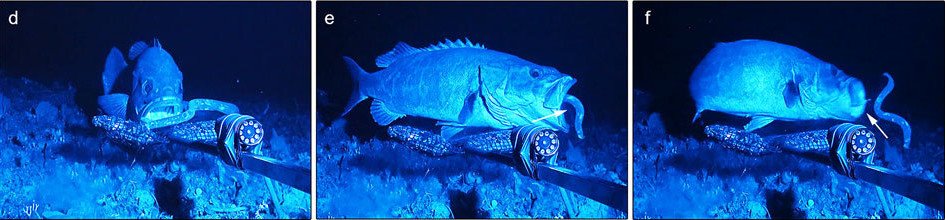
The hagfish is an eel-like creature that has not changed much in the past 300 million years in part because the hagfish is very good at escaping would-be predators. When attacked, the hagfish excretes mucins that combine with seawater to form slime. This gel-like viscoelastic fluid forms quickly and has some handy properties. For example, when stretched, the slime becomes extremely viscous. Many fish feed using a suction method, in which they thrust their jaws forward and enlarge their mouths to suck water and prey inside. This strong unidirectional flow stretches the slime, which thickens it and clogs the fish’s gills. Suddenly, the fish is much more concerned with being unable to breathe, allowing the hagfish to flee.
Being surrounded by all that slime could smother the hagfish, too, if it were not for another clever feature of the slime. When sheared, hagfish slime collapses, losing its viscosity. The hagfish actually ties itself in a knot to create this shear and slide the slime right off. (Image credit: V. Zintzen et al.; L. Böni et al., source)