Month: August 2016

  • Leidenfrost Atop Gasoline

    Leidenfrost Atop Gasoline

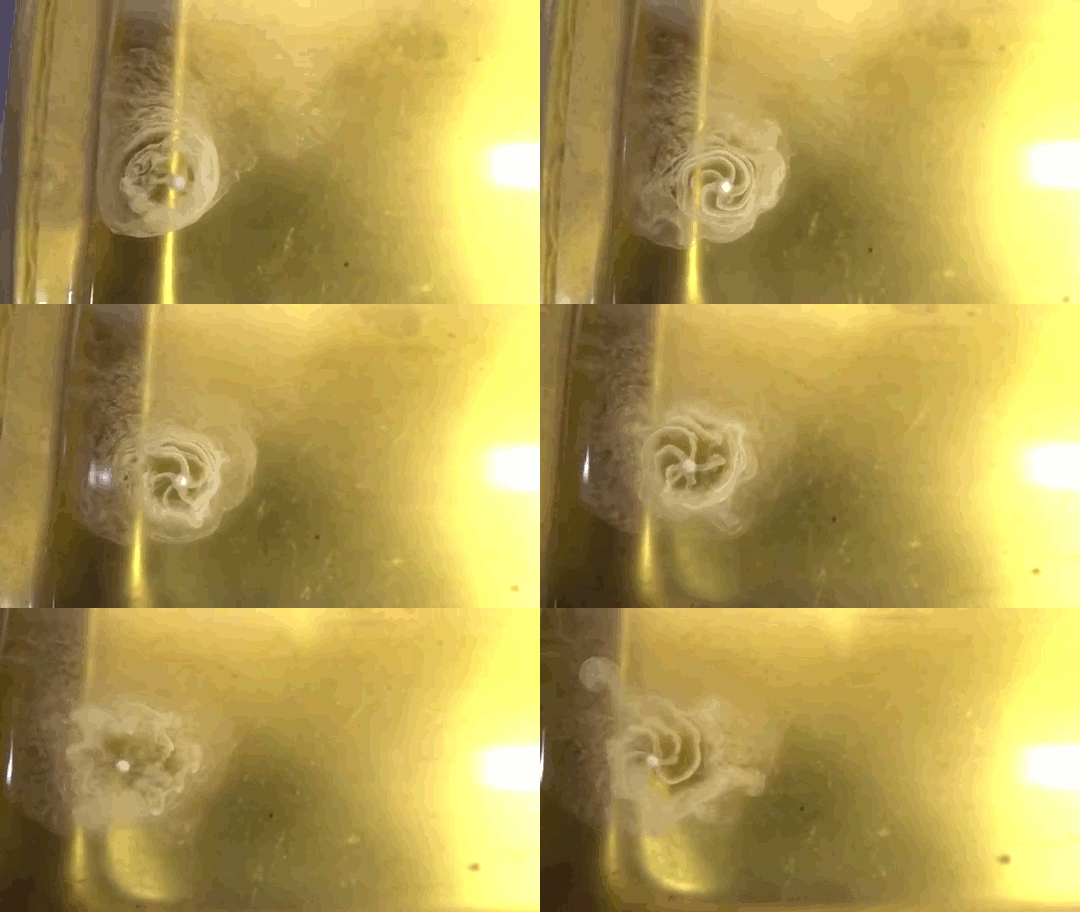
    The animations above show a little of what happens when you pour a spoonful of liquid nitrogen onto a container of gasoline. A couple of things are happening simultaneously here. First of all, the liquid nitrogen is experiencing the Leidenfrost effect. Because of the extreme difference in temperature between the gasoline (~20 degrees C) and the liquid nitrogen (-196 degrees C), part of the nitrogen is evaporating immediately, creating a vapor layer that insulates the remainder of the liquid nitrogen and allows it to float above the gasoline surface. The same thing happens to water drops on a very hot skillet.

    The extreme cold of the nitrogen also seems to have formed some ice that’s further protecting the nitrogen drop. I’m not 100% sure what that would be made of, though – a mixture of water and gasoline?

    Finally, there’s the simultaneous evaporation of the liquid nitrogen and the sublimation of the ice. This is the white vapor we see propelling and spinning the ice/drop. Note the “bounce” that happens in the top animation. The drop never actually impacts the wall. When it gets close, the escaping vapors are affected by the wall and start pushing the drop in a new direction! Check out the whole video below. (Image credit: carsandwater; via Gizmodo)

  • Featured Video Play Icon

    Making Droplets Stick

    Lots of plants have evolved leaves that are superhydrophobic – that is, water repellent. For a plant, this makes a lot of sense. A superhydrophobic leaf will make water bounce and run off, draining down to where the plants roots can drink it up. But this same feature can be a frustration to farmers who spread pesticides by spraying plants. They need the pesticide to stick to the leaves if it’s to deter insects, and the superhydrophobicity of the leaves forces them to spray more pesticides in the hopes of getting some to stick. Researchers at MIT are looking to change this status quo with a few biodegradable polymer additives that can counter the leaves’ superhydrophobic tendencies and help droplets stick to the surface. This could reduce the amount of pesticides needed to protect crops. (Video credit: MIT)

  • Gunshot Back-Splatter

    Gunshot Back-Splatter

    Today blood pattern analysis is an important forensic technique used in reconstructing the events at crime scenes. Many methods use straight-line trajectories to try to isolate the origin of blood splatters, but this discounts the effects of gravity and drag on flying droplets. A new theory models the back-splatter of a gunshot wound fluid dynamically.

    Using characteristics of the bullet and gunshot, it estimates the initial conditions of blood drops leaving a wound, then models the break-up of the fluid as a Rayleigh-Taylor instability, where a denser fluid (blood) is accelerating into a less dense fluid (air). This results in a moving cloud of droplets and air whose trajectory and impact on a surface can be calculated. The ultimate goal is to create a physical model that can be used in reverse, where analysts can observe patterns and calculate their origin with confidence. For more, see the original paper or Gizmodo’s coverage. (Image credit: T. Webster; research credit: P. Comiskey et al.)

  • Where Jupiter’s Heat Comes From

    Where Jupiter’s Heat Comes From

    Exactly what goes on in Jupiter’s atmosphere has confounded scientists for decades. Its upper atmosphere – essentially the only part we can observe – is hundreds of degrees warmer than solar heating can account for. Although it has bright auroras at its poles, that energy is trapped at high altitudes by the same rotational effects that create Jupiter’s stunning bands.

    Observations of Jupiter’s Great Red Spot, a storm that’s lasted for hundreds of years, may provide clues as to where all the extra heat is coming from. Spectral mapping shows that the area over the Spot is over 1000K warmer than the rest of the upper atmosphere. Because of its isolated location, the best explanation for the Great Red Spot’s extra heat comes from below: scientists suspect that the raging storm is generating so much turbulence and such a deafening roar that these gravity and acoustic waves propagate upward and heat the atmosphere above. If so, a similar coupling mechanism to the clouds below may account for the widespread warmth in Jupiter’s upper atmosphere. (Image credit: NASA; research credit: J. O’Donoghue et al.)

  • Featured Video Play Icon

    Quantum Droplets

    Over the past decade, fluid dynamicists have been investigating tiny droplets bouncing on a vibrating fluid. This seemingly simple experiment has remarkable depth, including the ability to recreate quantum behaviors in a classical system. In this video, some of the researchers demonstrate their experimental techniques, including how they vary the frame rate relative to the bouncing of the drops. At the right frame rate, this sampling makes the droplets appear to glide along with their ripples, giving us a look at a system that is simultaneously a particle (drop) and wave (ripple). (Video credit: D. Harris et al.)

  • How Many Licks Does It Take to Get to the Center of a Lollipop?

    How Many Licks Does It Take to Get to the Center of a Lollipop?

    Many a child has wondered how many licks it takes to get to the center of a lollipop. Physically, this is a problem of a solid body dissolving in a flow, and it’s one scientists are interested in for its geological, industrial, and pharmacological applications.

    The animation above shows flow around a dissolving (candy!) body that was originally spherical. With both spheres and cylinders, the final shape the body takes is consistent – it has a front boundary with a curvature of nearly constant radius and a back face that is approximately flat. This creates a boundary layer of uniform thickness across the front face, and that uniform flow makes the surface dissolve steadily and evenly so that it maintains the same overall shape.

    With their model and experiments, researchers have even been able to tackle the classic question of how many licks it takes:

    “For candy of size 1 cm licked at a speed of 1 cm/s, we estimate a total of 1000 licks, a prediction that is notoriously difficult to test experimentally.”

    (Image credit: J. Huang et al., source, pdf)

  • Capturing SLS

    Capturing SLS

    NASA’s recent full-scale ground test of their Space Launch System (SLS) rocket was notable for more than just the engine. It was an opportunity to use a new high dynamic range, high speed camera prototype,

    HiDyRS-X, to capture the rocket’s exhaust in detail never seen before. Usually the extreme brightness of the rocket exhaust makes it impossible to see any structure in the flow without completely obscuring the ground equipment. With this camera, however, engineers can see how the engine, exhaust, and surroundings all interact. Be sure to check out the full video. I particularly like watching how the rocket’s exhaust entrains dust and sand from the ground nearby.  (Image credit: NASA, source; submitted by Chris P. and Matt S.)

  • Soap Film Wakes

    Soap Film Wakes

    Soap films can create remarkable flow visualizations when illuminated with monochromatic (single color) light. Each of the photos above shows a flow moving from left to right with a small object near the left creating an obstruction. In the top two images, the objects are cylinders; in the lower one it’s a flat plate tilted at 45 degrees. All of the objects shed vortices as the flow moves past. These vortices alternate in direction – the first spins clockwise, the next counter-clockwise, then clockwise again and so on. This pattern is known as a von Karman vortex street and can even show up in the atmosphere! (Image credit: D. Araya et al.)

  • Rio 2016: Diving

    Rio 2016: Diving

    Diving is a popular event for spectators, but it can also be rather confusing. We know that divers are rewarded for minimizing their splash, but what exactly does that mean and how do they do it?

    The ideal water entry, called a rip entry by divers, requires a diver to hit the water in a vertical orientation with their arms braced and palms held flat over their head. Striking the water tears open a cavity for the athlete’s body to enter. To minimize splash, the diver wants to fall into this expanding cavity without striking the sides, which would throw up an additional splash. This is the reason for vertical entry. Hand position is also important. If the athlete were to point their fingers, they would create a narrower cavity and larger splash.

    After the athlete enters the water, the cavity closes off under the surface and the water rebounds in a splashy Worthington jet. For the speed and size of human divers, this later splash is essentially unavoidable. What the commentators don’t really tell you, though, is that diving judges are only supposed to judge a diver’s entry up to the point that their feet go under the surface. They’re instructed to ignore everything that happens underwater and after entry. So that big rebound splash we all see isn’t meant to count! (Image credits: A. Pretty/GettyImages; kaorigoto, source)

    Previously: Minimizing splash by being hydrophilic; the physics of skipping rocks and avoiding splashback at the urinal

    Join us throughout the Rio Olympics for more fluid dynamics in sports. If you love FYFD, please help support the site!

  • Rio 2016: The Swimming Pool Controversy

    Rio 2016: The Swimming Pool Controversy

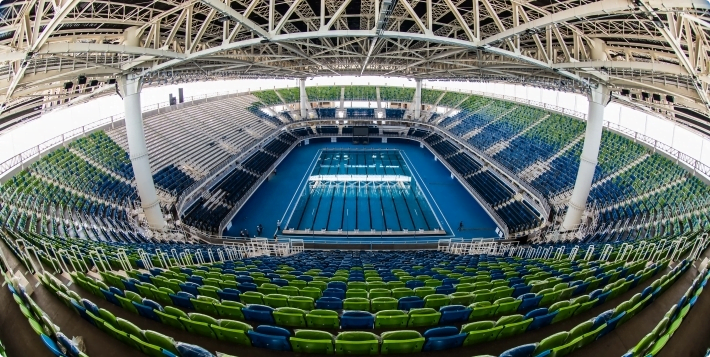
    Statistical analysis suggests possible current in the Rio Olympics swimming pool

    Several news outlets, beginning with The Wall Street Journal, are reporting that the swimming pool in Rio may have had a current that biased athletes’ performances. This is based on a statistical analysis of athlete performances across the meet, conducted by Indiana University’s Joel Stager and his coworkers. According to WSJ, Stager et al. analyzed times of athletes in the preliminary, semifinal, and final races of the 50m, 800m, and 1500m events and found consistent evidence that swimmers in the higher numbered lanes swam faster when moving toward the starting block and swimmers in the lower numbered lanes swam faster when moving toward the turn end of the pool. A separate analysis by Barry Revzin at Swim Swam came to similar conclusions about the direction and magnitude of lane effect in Rio.

    Past questions about lane bias

    This is not the first time questions have been raised about a current-induced bias in competition pools. In fact, Stager and his colleagues published an analysis in 2014 that suggested a similar bias in the pool used for the 2013 World Championships in Barcelona. That pool was a temporary pool built specifically for the competition by Myrtha Pools and was disassembled immediately after, before Stager et al.’s analysis was published.

    A more recent paper by Stager and his colleagues found that lane bias seems to be more prevalent in temporary pools than in permanent ones. The Rio Olympics pool, like the 2013 Worlds pool, is a temporary pool also built by Myrtha Pools.

    Myrtha Pools responds to the criticism 

    Myrtha responded to both WSJ and Swim Swam by sharing videos (1, 2) of their current test, which was conducted before the competition and on Day 3 of competition. The videos show a floating object in one of the outside lanes; neither video shows any noticeable movement of the object.

    Fluid dynamics and swimming pool design

    Competitive swimming pools are complicated recirculating systems that can contain special structures intended to minimize interactions between competitors. Myrtha has built many special event pools in recent years, including ones where the results did not show a bias. According to their website, Myrtha has fluid dynamicists on staff and uses computational fluid dynamics (CFD) to analyze pool performance during design, although they only show examples of freeform pools – not competition pools.

    In fact, I have found remarkably few CFD analyses of swimming pools in the literature. Most papers seem to focus on distribution of disinfectants in pools or in predicting evaporation rates – both practical problems but ones with limited relevance to this particular question.

    So, is there a current in the Rio pool?

    It’s tough to say with certainty that there is a current in Rio’s pool. The performance analyses by Stager et al. and by Revzin do show anomalies in the times of athletes in Rio based on their swim lane, and they show that those anomalies do not exist in many other recent competitions.

    I also do not think Myrtha’s current test constitutes evidence of a lack of current. Their floating object is only indicative of conditions at the air-water interface. Swimmers ride lower in the water and spend significant time completely underwater. Lane markers may also damp any flow effects near the surface.

    I think introducing dye underwater in the pool would do more to reveal any flow that may exist, and this would be a worthwhile test to conduct prior to the deconstruction of the Rio Olympic pool. Additionally, it would be wonderful to see a CFD analysis of the swimming pool, but this would require significant detail about the pool’s design (inlet and outlet locations, etc.) some of which is likely proprietary information.

    Neither dye visualization nor CFD simulation will change the results of this competition, but it may help reveal underlying issues in temporary pool designs so that any bias can be avoided in future competitions.

    (Image credit: Rio City Government)

    Special thanks to @MicahJGreen for bringing this story to my attention and to Dave B. for his assistance.