Month: July 2015

  • Cars Helping Cyclists

    Cars Helping Cyclists

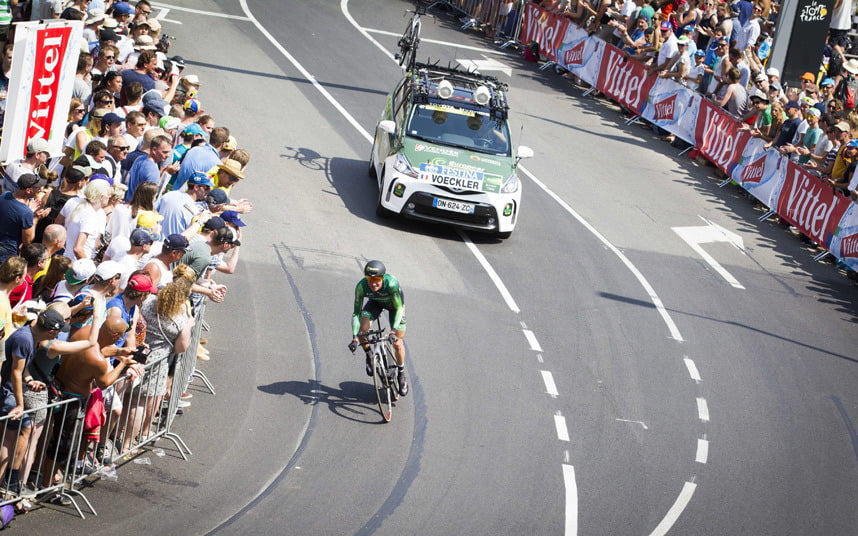
    This year’s Tour de France opened with an individual time trial stage in which riders competed solo against the clock. But, according to numerical simulations, some riders may get an unfair aerodynamic advantage in the race if they have a following car. The top image shows the pressure fields around a rider with a car following 5 meters behind versus 10 meters behind. The size of the car means that it displaces air well in advance of its arrival. By following a rider closely, that car’s high pressure region can help fill in a cyclist’s wake, thereby reducing the drag the rider experiences. For a short time trial like the 13.8 km race that kicked off this year’s tour, a rider whose car follows at 5 meter could save 6 seconds over one whose car followed at the regulation 10 meter distance. (As it happens, the stage was decided by a 5 second margin.) Since not all riders get a team follow car, it’s especially important to ensure that those who do aren’t receiving an additional advantage. For more about cycling aerodynamics, check out our previous cycling posts and Tour de France series. (Image credit: TU Eindhoven, EPA/J. Jumelet; via phys.org; submitted by @NathanMechEng)


  • Featured Video Play Icon

    How the Grand Canyon Formed

    The Grand Canyon is a monument to the power of water, air, and time. In this video from It’s Okay To Be Smart, Joe Hanson describes the formation of the Grand Canyon – from the ancient oceans that created its many layers to the tectonic upthrusts that eventually created the Colorado River that continues to cut through the Canyon’s rocks today. Fluid dynamics play a major role in the geology of the Grand Canyon, whether it’s in the mantle convection that helps drive plate tectonics or the sedimentation that builds and erodes rock layers.   (Video credit: It’s Okay To Be Smart)

  • Breaking Jets Into Drops

    Breaking Jets Into Drops

    A falling stream of water will break into droplets due to the Plateau-Rayleigh instability. Small disturbances can create a wavy perturbation in the falling jet. Under the right conditions, the pressure caused by surface tension will be larger in the narrower regions and smaller in the wider ones. This imbalance will drive flow toward the wider regions and away from the narrower ones, thereby increasing the waviness in the jet. Eventually, the wavy jet breaks into droplets, which enclose the same volume of water with less surface area than the perturbed jet did. The instability is named for Joseph Plateau and Lord Rayleigh, who studied it in the late 19th century and showed that a falling jet of a non-viscous fluid would break into droplets if the wavelength of its disturbance was larger than the jet’s circumference.  (Image credit: N. Morberg)

  • Featured Video Play Icon

    Air Pressure in Flight

    We live at the bottom of a sea of air, surrounded by a constant pressure equal to 101 kPa (14.7 psi) over our entire bodies. For the most part, we don’t notice the pressure air exerts on us. But if you’ve flown on a commercial airplane, you may have noticed some of the effects of changing that air pressure. Flexible sealed containers, like bags of chips or bottles of water, change their shape dramatically over the course of a flight because the air pressure inside them can be greater than the air cabin pressure at altitude. In the video above, Nick Moore measured his in-flight cabin pressure as 84 kPa (12psi), which is equivalent to about 1500 m (5000 ft) above sea level. Why do airlines keep the cabin pressure lower in flight? The biggest reason is because the airplane, like the in-flight snack, is a pressure vessel. At cruising altitudes the outside air pressure is about 24 kPa (3.5 psi). To keep the interior of the cabin habitable, the fuselage of the airplane has to hold a higher pressure. The larger the difference between the interior and exterior pressures, the greater the stress the airplane must withstand. Keeping the air pressure in flight a little lower makes the engineering a little easier and does the occupants no harm.  (Video credit: N. Moore)

  • Sharkskin Instability

    Sharkskin Instability

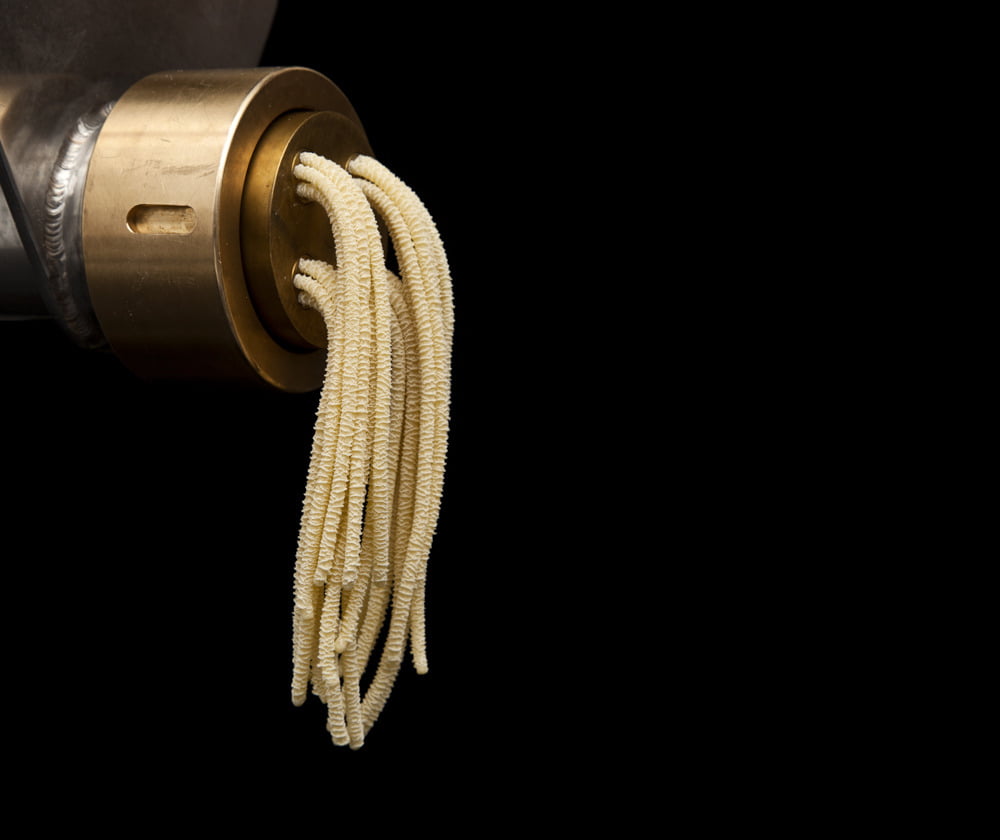
    Homemade spaghetti noodles exhibit a roughened surface that’s the result of viscoelastic behavior known as the sharkskin instability. It’s usually observed in the industrial extrusion of polymer plastics. In the case of spaghetti, the long, complex polymer molecules necessary for the instability come from the proteins in eggs. The characteristically rough surface of the extruded material is caused by the transition from flow through the die to air. Inside the die, friction from the walls exerts a strong shear force on the outer part of the fluid while the inner portion flows freely. When the material exits the die, the sudden lack of friction on the outer portion of the fluid causes it to accelerate to the same velocity as the middle of the flow. This acceleration stretches the polymers until they snap free of the die; after the strained polymers relax, the material keeps a rough, saw-tooth pattern. In industry, the sharkskin instability can be prevented by regulating temperature or flow speed. In the case of spaghetti, though, Modernist Cuisine suggests the roughness is desirable because it helps trap the pasta sauce. Bon appetit!  (Image credit: Modernist Cuisine)