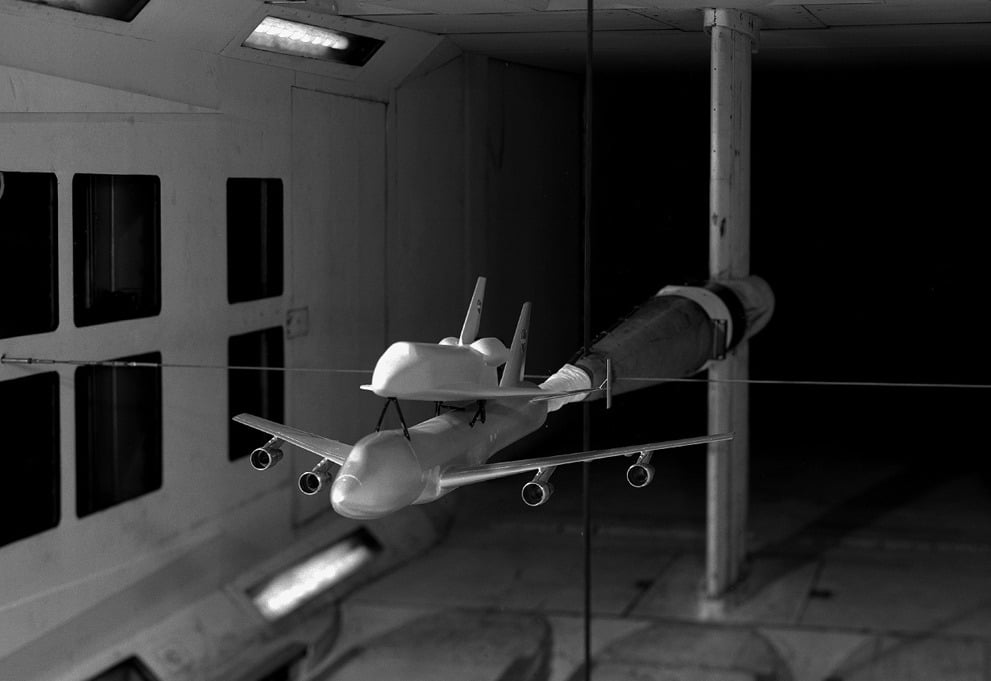
A scale model of the Space Shuttle attached to its modified 747 carrier hangs in a NASA wind tunnel. Wind tunnel tests can be used for flow visualization, lift and drag measurements, control system checks and so forth, but mounting models correctly and safely in the tunnel is crucial. Many models use sting mounts that project forward, as this one does, in order to expose the model to freestream flow unimpeded by the mounting mechanism. Any mounts and models must also be sturdy enough that all or part of them does not break off mid-test and fly into the wind tunnel’s fans. #
Month: July 2011

High-Res Rayleigh-Taylor Instability
When a heavy fluid sits atop a lighter fluid, the interface between the two breaks down through the Rayleigh-Taylor instability. This computation of a 2D interface shows the near fractal behavior of this instability as whorls and eddies of all different scales form and mix the fluids. (submitted by @markjstock)

Whipping Instability
A droplet of glycerol coalescing in silicone oil while subjected to strong electric fields exhibits a whip-like instability reminiscent of fireworks. Check out videos of the phenomenon or see the paper for more information. Happy Independence Day to our American readers!
For more fun, holiday-themed high-speed video, check out PopSci’s fireworks videos.
Triggering Avalanches
Humans often trigger avalanches purposefully before natural ones can occur. Either way, avalanches begin when external stresses on the snow pack exceed the strength within the snow pack or at the contact between the snow and the ground. Acceleration of the snow is gravity-driven. If the snow mixes with air, powder clouds can form that carry snow even further than the main slab. Although the snow itself is not a fluid, once an avalanche gets moving, its behavior can be better modeled as a fluid than as a solid.

