Tag: jellyfish

  • Jellyfish Make Their Own Walls

    Jellyfish Make Their Own Walls

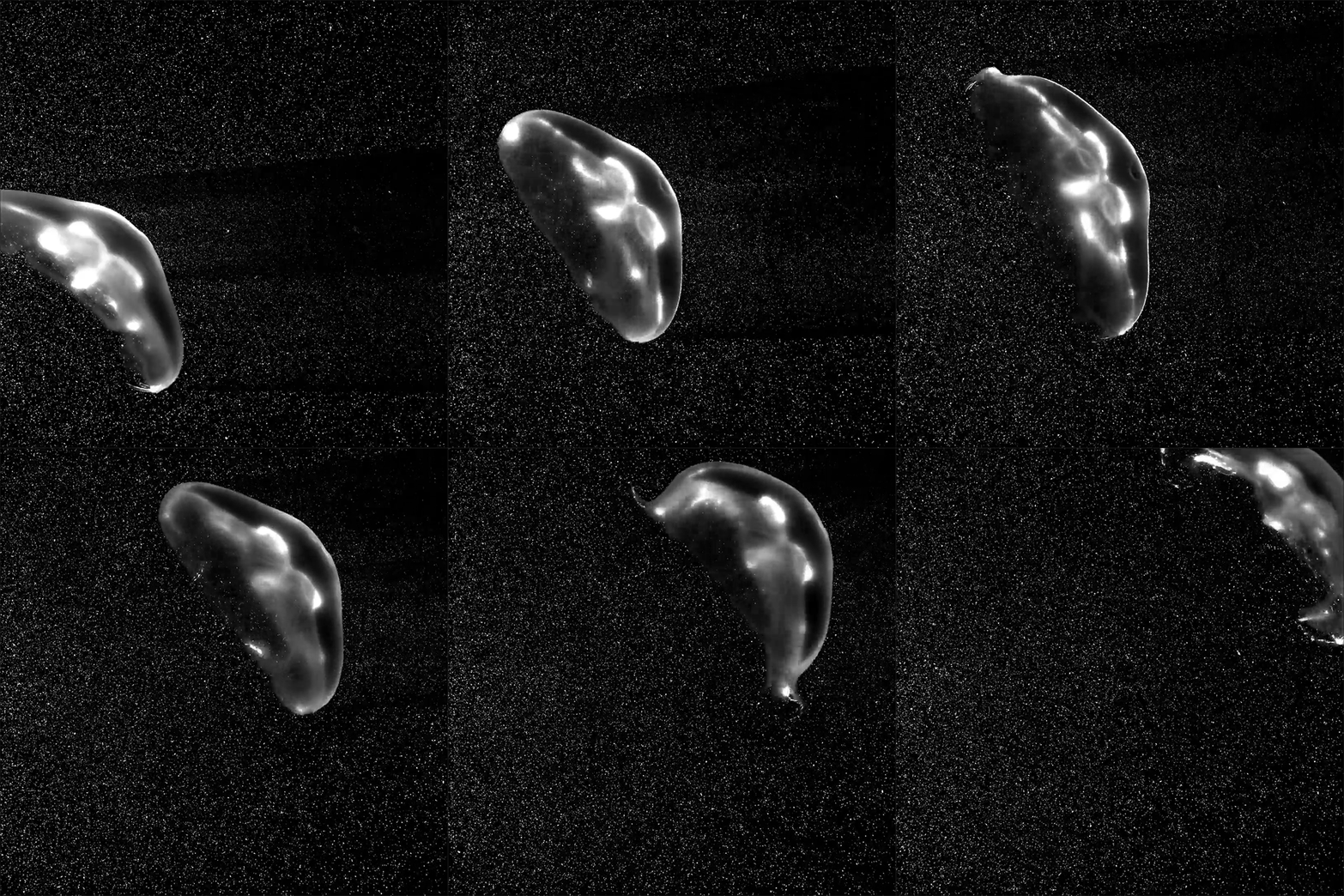
    When we walk, the ground’s resistance helps propel us. Similarly, flying or swimming near a surface is easier due to ground effect. Most of the time swimmers don’t get that extra help, but a new study shows that jellyfish create their own walls to get that boost.

    Of course, these walls aren’t literal, but fluid dynamically speaking, they are equivalent. Over the course of its stroke, the jellyfish creates two vortices, each with opposite rotation. One of these, the stopping vortex, lingers beneath the jellyfish until the next stroke’s starting vortex collides with it. When two vortices of equal strength and opposite rotation meet, the flow between them stagnates — it comes to halt — just as if a wall were there.

    In fact, mathematically, this is how scientists represent a wall: as the stagnation line between a real vortex and a virtual one of equal strength and opposite rotation. It just turns out that jellyfish use the same trick to make virtual walls they can push off! (Image and research credit: B. Gemmell et al.; via NYTimes; submitted by Kam-Yung Soh)

  • Featured Video Play Icon

    Flying Beetles, Stinging Nettles, and Jellyfish

    In the latest JFM/FYFD video, we tackle some of the less pleasant aspects of summer weather: stopping invasive insects, understanding how plants dispense poison, and looking at the physics behind jellyfish stings. And if you’ve missed any of our previous videos, we’ve got you covered. (Image and video credit: T. Crawford and N. Sharp)

  • Caught in a Whirl

    Vortex rings may look relatively calm, but they are concentrated regions of intensely spinning flow, as this poor jellyfish demonstrates. The rings form when a high-speed fluid gets pushed suddenly (and briefly) into a slower fluid. In the case of this bubble ring, a burst of air is pushed by a diver into relatively still water. The vorticity caused by the two areas of fluid trying to move past one another forms the ring. Like a spinning ice skater who pulls his arms inward, the narrow core of the vortex spins fast due to the conservation of angular momentum. Meanwhile, the bubble ring moves upward due to its buoyancy, pulling nearby water in as it goes. This catches the hapless jellyfish (who relies on vortex rings itself) and gives it quite a spin. But. don’t worry, the photographer confirmed that the jelly was okay after its ride. (Video credit: V. de Valles; via Ashlyn N.)

  • How the Jellyfish Stings

    How the Jellyfish Stings

    Many jellyfish are capable of venomously stinging both their prey and their predators. The stings originate from specialized cells in their tentacles called nematocysts (middle image) that, when activated, rapidly extend a thin tubule that acts like a hypodermic needle to deliver venom into the jellyfish’s victim (bottom image). The tubules can elongate in about 50 ms – about one-sixth of the time needed to blink your eye. This rapid extension is driven by osmotic pressure – pressure generated when water flows across a semi-permeable membrane in response to chemical changes. 

    Researchers originally thought all of the osmotic pressure resided in the nematocyst’s capsule end from which the tubule expands, but new work indicates that the tubule is instead pulled along by high osmotic pressure along its moving front. That means that disrupting osmosis at the front – by say, wearing a material with no osmotic potential – can slow down the tubule expansion and stop the jellyfish’s sting. (Image credits: jellyfish – A. Kongprepan; nematocyst – D. Brand; tubule expansion – S. Park et al.; research credit: S. Park et al.; submitted by L. Buss)

  • Fluids Round-Up

    Fluids Round-Up

    New year, new (or renewed) experiments. This is the fluids round-up, where I collect cool fluids-related links, articles, etc. that deserve a look. Without further ado:

    (Video credit and submission: Julia Set Collection/S. Bocci; image credit: IRPI LLC, source)

  • Featured Video Play Icon

    The Upside-Down Jellyfish

    The upside-down jellyfish Cassiopea lives along the sea bottom in coastal regions. As its name suggests, the jellyfish rests upside-down with its bell against the sea floor and its frilly oral arms pointed upward. This jellyfish is a filter feeder, and it draws water up and through its arms by pulsing its bell. The video above visualizes this flow using dye. Each pulse propels fluid up through the arms and draws in fresh water from the surroundings. The frilly arms break up any large vortices from the pulsed flow and diffuse the filtered water as it moves upward. (Video credit: Applied Fluid Mechanics Laboratory at Oklahoma State University)

  • Featured Video Play Icon

    The Upside-Down Jellyfish

    The upside-down jellyfish, Cassiopea, rests its bell against the ocean floor and points its frilly oral arms up toward the sun for the benefit of the symbiotic algae living on it. In return, the algae provide some of the nutrients the jellyfish needs. The rest it obtains by filter feeding for zooplankton. The video above shows how a combination of flow visualization and simplified computational modeling can reveal the jellyfish’s methods for eating. A simple pulsing bell has limited fluid flow in the region of the jellyfish’s mouths, but the addition of a permeable layer (representative of the oral arms) significantly enhances mixing. (Video credit: T. Rodriguez et al.)

  • Featured Video Play Icon

    Fluids Round-up – 13 October 2013

    There were so many good fluids links this week that I decided for an off-week fluids round-up. Here we go!

    (Video credit: #5facts/Sesame Street)

  • Featured Video Play Icon

    Jellyfish Flow

    Florescent dye reveals the flow pattern of ocean water around a swimming jellyfish. Some researchers posit that fluid drift associated with the swimming of marine animals may be as substantial a factor in ocean mixing as turbulence caused by the wind and tides. If true, modeling of climate change–past, present, and future–would need to take into account the biology of the ocean as well! #