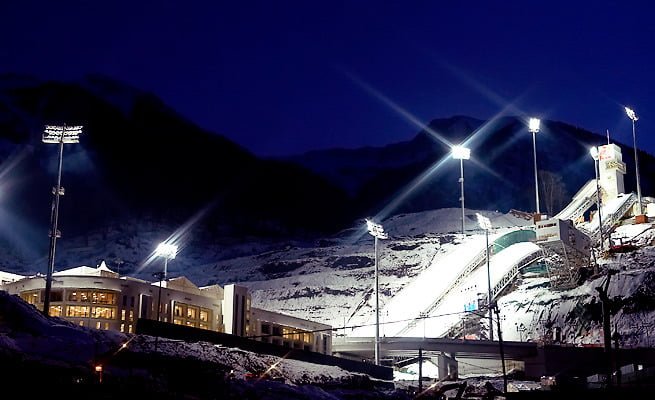
Yesterday we talked about the technique ski jumpers use to fly farther. Generating lift without too much drag is the key to a good jump. But jumpers are subject to ever-changing wind conditions, and those can help or hurt them. Unlike most sports, in ski jumping a headwind is desirable. This is because the added relative air velocity increases the jumper’s lift and helps them fly farther. A tailwind, on the other hand, saps their speed. Since 2009, ski jumping competitions have included a wind compensation factor that tries to account for these effects. Wind velocity is measured at five points along the jumper’s flight path and the tangential (i.e. head- or tailwind) components are weighted and averaged. The weighting factors seem to be individual to each hill – not all hills are built with the same profile. This average tangential wind speed is then a linear variable in an equation for wind factor. The goal of the wind factor is as much to make the competition run smoothly as it is to increase fairness. The trouble is that the wind speed effect is non-linear; in other words, a headwind does not help a jumper as much as a tailwind can hurt them. In one simulation study, researchers found a 3 m/s headwind carried jumpers 17.4 m further while a tailwind of the same magnitude shortened the jump by 29.1 m. The wind differences in competition may not be as drastic, but truly evening the playing field may require a more complicated compensation system. (Photo credit: B. Martin/Sports Illustrated)
FYFD is celebrating the Games with a look at fluid dynamics in the Winter Olympics. Check out our previous posts on the aerodynamics of speed skating, why ice is slippery and how lugers slide so fast.