Tag: space exploration

  • Martian Wind Power

    Martian Wind Power

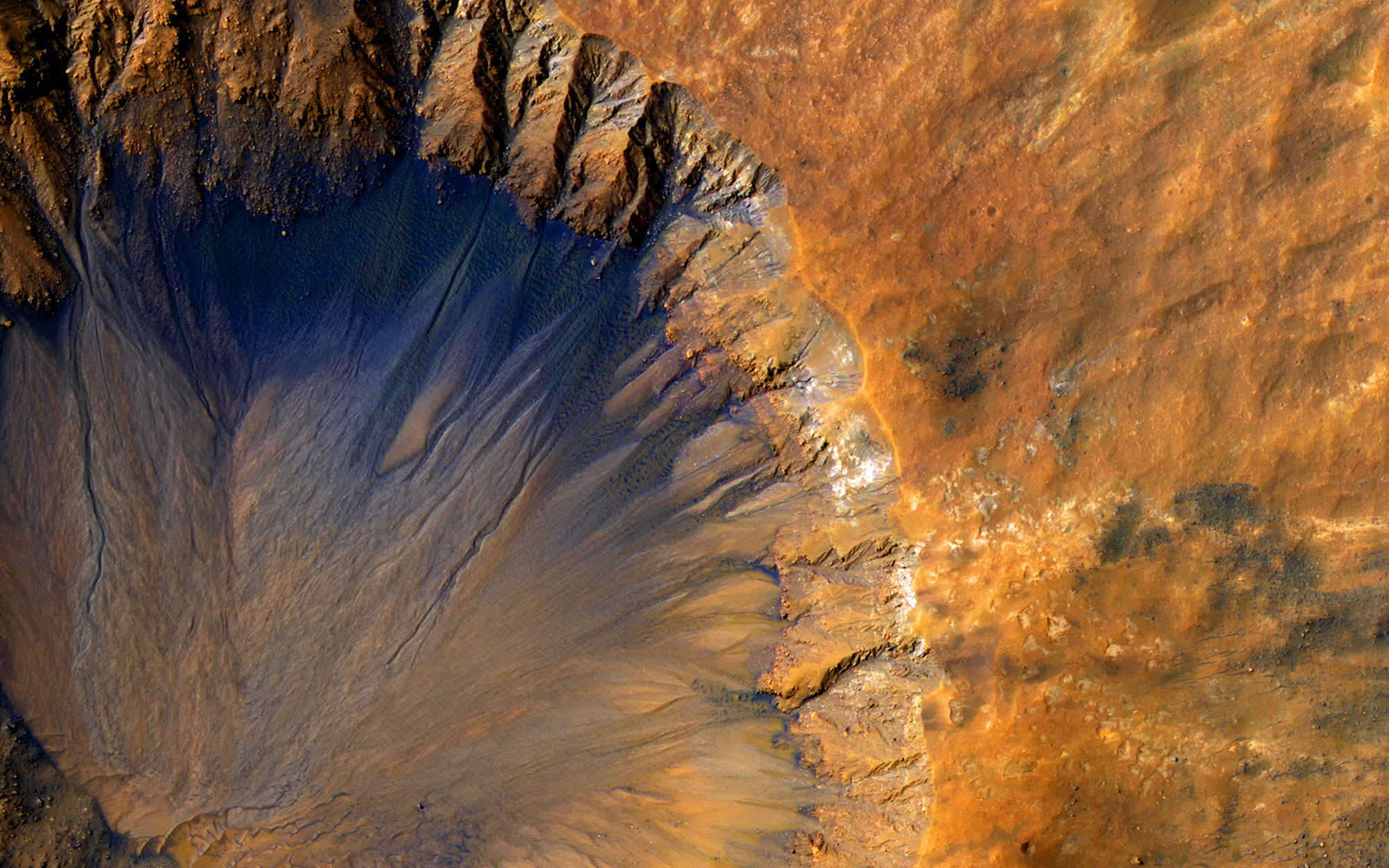
    To support a crew on Mars, a landing site must offer resources like water and allow for sufficient power generation. Thus far, most analyses of this sort have focused on the possibilities of solar power, which is limited by day-and-night cycles and seasonal variations, and nuclear power, which carries some risk to the human crew. In a new report, researchers considered the possibilities of wind power on Mars.

    Since Mars’s atmosphere is so much thinner than Earth’s, wind power has largely been overlooked as an energy source there. But researchers found that a commercially-rated wind turbine expected to produce 330 kW here on Earth could still output a respectable 10 kW on Mars. Since the target power needs for a crew are 24 kW, adding wind energy can boost a power system from providing 40% of needs from solar alone to 60-90% of the needed energy from combined solar and wind sources. A wind turbine is especially helpful in supplementing power needs at times when solar power wanes, like at night or during the Martian winter solstice. (Image credit: NASA; research credit: V. Hartwick et al.; via Physics World)

  • Galileo’s Descent

    Galileo’s Descent

    In December 1995, the Galileo probe made its dramatic descent into Jupiter’s atmosphere at a velocity of more than 47 km/s. In 30 seconds, it decelerated from Mach 50 to Mach 1, undergoing incredible heating as it did so. Anytime an object moves through a fluid faster than the local speed of sound, it creates a leading shock wave that compresses the fluid, heats it, and redirects it around the object. The faster the speed, the hotter the fluid will be after passing through the shock wave. 

    Above about five times the speed of sound, the heating effect is so strong that it’s able to rip molecules apart, creating a chemically reactive mixture that will ablate away material from the object. For this reason, Galileo and other planetary entry vehicles carry heat shields made to sacrifice themselves while protecting the cargo and (in some cases) crew onboard. Data from Galileo showed that, although the heat shield survived the brunt of its descent, it experienced worse conditions than expected. Near the heat shield’s shoulder, almost all of its material ablated away. 

    Scientists continue to study Galileo’s descent even now, using it to test and inform their models of the flow and chemistry that occurs at these hypersonic speeds. The better we can understand and predict these flows, the better our designs will become. Mass that’s currently spent on overly-conservative heat shields can instead go toward additional instruments or supplies. (Image credit: Chop Shop Studio; research credit: L. Santos Fernandes et al.; via AIP)

  • Stress Between Grains

    Stress Between Grains

    Granular materials like sand and beads can shift and flow in fluid-like ways, but they’re much harder to predict. Part of this is due to the way friction between individual grains transmits force through the network. Here, we see photoelastic beads responding to the intrusion of a narrow rod. The lightning-like flashes show how stress is traveling between neighboring grains. Notice how the lower grains are essentially frozen into a state of high stress, but the movable upper grains shift and readjust themselves to try and relieve stress.

    This experiment took place under lunar gravitational conditions. Lower gravity means that it takes a larger pile of grains on top to create a given stress. But it also means it’s easier for those movable top grains to shift or even get thrown up by a hastily applied force.  The purpose of experiments like this is to better understand how rovers and probes should dig in low-gravity environments without kicking up a cloud of regolith and dust. (Image credit: K. Daniels et al., source)